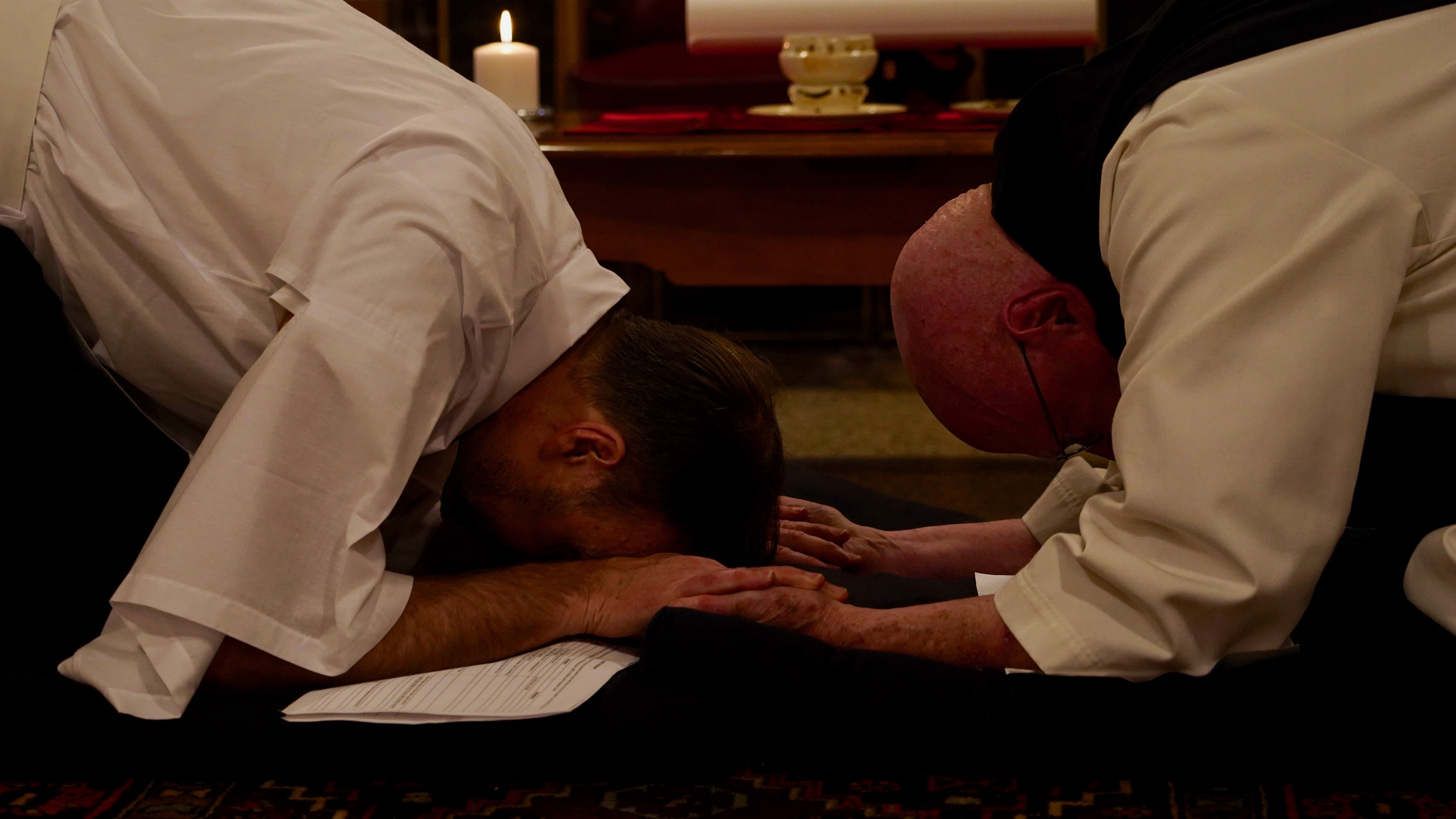
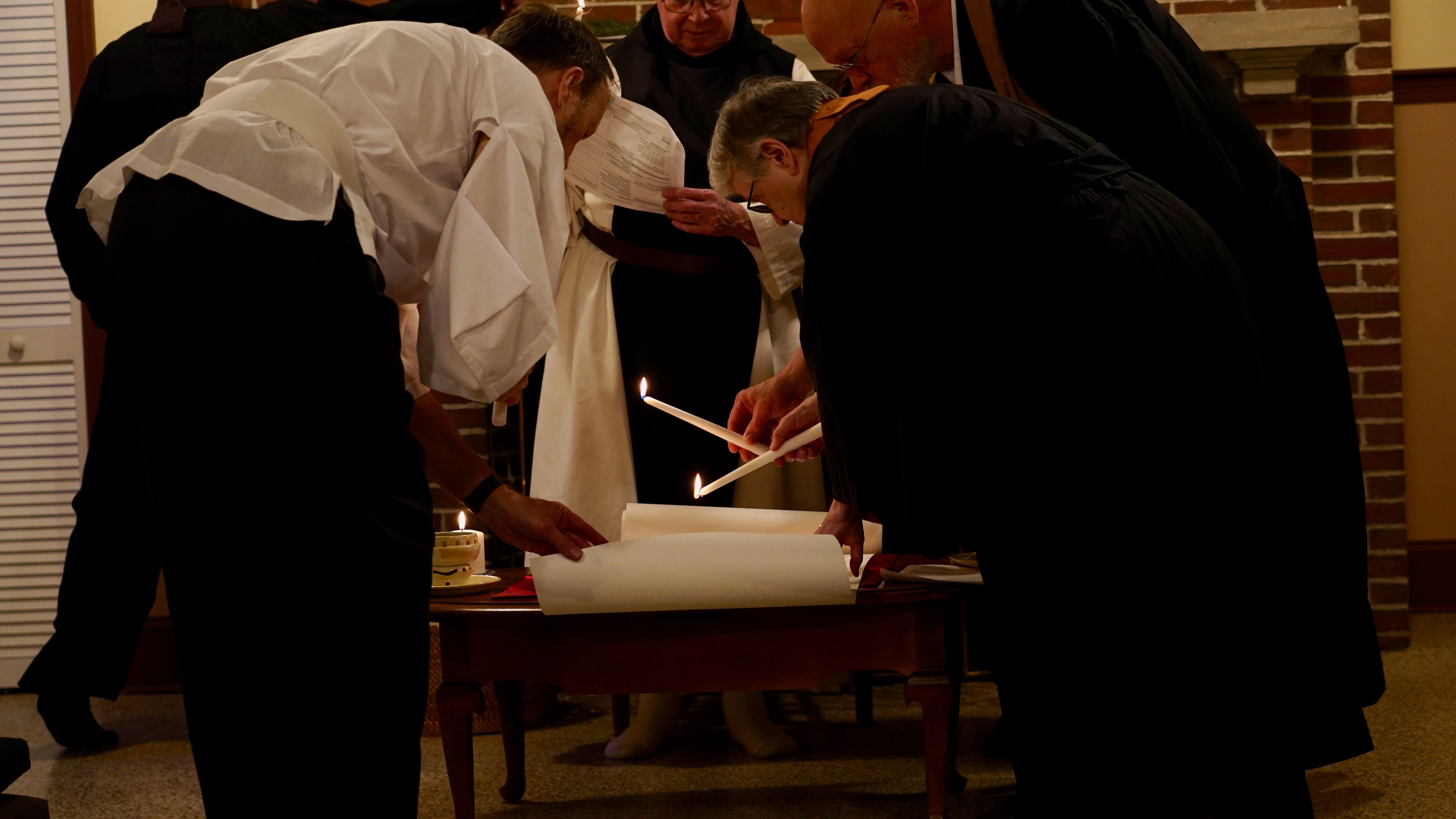
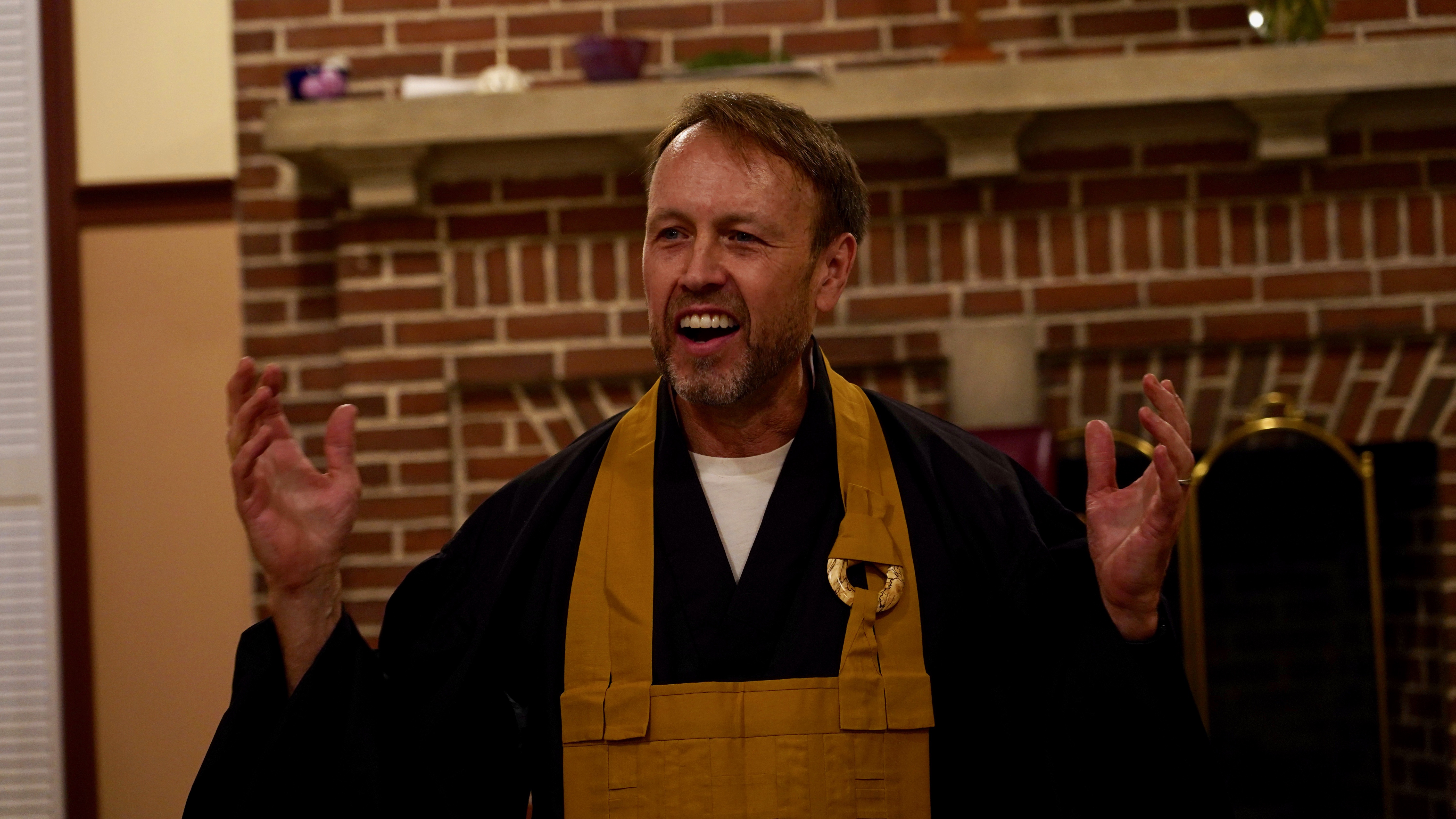
This is the talk I gave after my Denbo ceremony, in which I received Dharma transmission from my Zen teacher, Kevin Jiun Hunt, O.S.C.O., Roshi, and so became a Zen teacher myself. I’ve also posted a few pictures. The ceremony occurred on Saturday, November 10, 2018. It was very traditional, except that it occurred at 2:00 p.m. and was attended by friends and family. For reasons that are long outdated, these ceremonies have, for centuries, typically occurred privately, between teacher and student, at midnight. A number of Zen streams in the West, including ours, recently have begun to open them, and to hold them at a much more agreeable time of day. I’ve been given the Dharma name Kōgen, which means Light Source.
Gratitude is the first thing I want to express today.
Some time ago, I went looking for a new Zen teacher. I couldn’t believe it when I found a Trappist monk and Zen teacher, all rolled into one, just a couple of towns over from where we were living at the time. As you’ll hear in a moment, the Trappists were on the scene early in my travels through contemplative spiritual circles over the past 30 years. So I was really excited to discover Fr. Kevin. I wrote him a long, detailed email telling him all about my journey. And, at this point, Fr. Kevin gave me the first of the many great teachings I’ve received from him: He completely ignored my email! I re-sent it a few days later, just in case he had missed it. (Hint: He hadn’t missed it.) He ignored it again. That was my first dose of your wise, spare, direct, “no fuss” approach to spiritual guidance and friendship. You’ve known just what nudges I’ve needed. And, since our very first meeting, I’ve come to see just how genuinely you see me – and, I must say, being seen genuinely by other human beings is one of the most profound gifts any of us can receive. From the start, you’ve accepted me without pretext or pretense, and you’ve always gently insisted that I accept myself the same way. Thank you.
I eventually forwarded my email to Cindy, whose email address I’d also found on the Zendo’s website. She responded right away, and very helpfully, encouraging me to come sit with the group! And I’m glad I did! That was another tremendous gift and teaching. I so appreciate and admire your incredible openness, the sense of warm welcome you create, and your determination to make Zen accessible. You have opened the door to this Zendo to our whole family. Esther began Zen practice here, and you’ve even welcomed our kids and our dogs. Thank you.
Tim and Sr. Madeline, thank you for being here today. It means the world to me. Thank for your friendship and the many wonderful teachings you’ve offered all of us.
I also want to acknowledge five other important teachers here. First, my friend and Harvard Divinity School colleague, Charlie Hallisey. He is one of the principal scholars of Buddhism at Harvard Divinity School, where I have done some part-time teaching the past few years, and he is one of the leading scholars of Buddhism globally. Charlie has brought with him four distinguished Buddhist monastics from Asia – Bangladesh, China, Sri Lanka, and Vietnam – who are fellows at Harvard this year. So this is not just an interfaith ceremony; it is an ecumenical ceremony within the Buddhist world. It’s an honor to have all of you with us today. Thank you.
I want to thank our Charlie (Norton) for serving as attendant today, and for all you do around this place. You are a rock.
We’re going to share a bit of food after this ceremony, and the best dishes – the ones we didn’t pick up at Whole Foods – were made by our very own Kathleen Bellicchi, who quite literally is the best cook I’ve ever met. Kathleen, you so evidently pour your heart into everything you make, and your foods opens our hearts. Thank you.
I want to thank my family, of course, Esther, Ellis and Carys. For many years now, you’ve given me leave to sit for 25 minutes at a time at home, or for an evening, or sometimes two, away during the week, or for a day, or a weekend, or a week or more when I’ve been on retreat. Walking this path runs against the main currents of our culture – and yet you always have been fully supportive of my commitment to traveling it. Thank you. I love you. And, Ellis and Carys, thanks for participating in the ceremony. Good job!
I also want to acknowledge and thank my parents and my two brothers. They are not here today, much as they wanted to be. They have been interested in and supportive of my meditation practice from the very start.
Finally, I want to thank my friends, starting with the countless people I’ve had the good fortune to sit with all these years – both Zen and Christian Centering Prayer practitioners. A handful of you are here today; many more are not. I also want to acknowledge my close friends walking the contemplative path within other traditions, including Islam and Judaism. I’ve been buoyed by the friendship of all of these fellow travelers.
Last, but not least, I’m grateful to my friends from different walks of life who have come to participate in this ceremony. All the strands of my life feel woven together and of a piece at this point, and I want each of you to know you’re an important part of the whole. Thank you.
__________
It’s traditional for a new teacher to give a talk, and I’m going to open this talk in one traditional way: with a koan. For those of you who are less familiar with the Zen tradition, most koans are brief accounts of interactions between a teacher and a student, or between students, or between teachers, which have been recorded and bound together into collections that have been passed down to us through the centuries. They’re sometimes used in a very distinctive way as a teaching tool when a student meets with a teacher, and they’re also often used to open a talk, like this one.
This is Case 7 in The Gateless Gate, which is one of those koan collections:
A monk said to Chao Chou, “I have just entered this monastery. Please teach me.”
Chao Chou said, “Have you eaten your rice gruel?”
The monk said, “Yes, I have.”
Chao Chou said, “Wash your bowl.”
The monk understood.
I began meditating about 30 years ago, as I said earlier, in my mid-20s. That was a very stressful time in my life, if also a good and exciting time in many ways. I had just finished law school and begun my career in the intense legal profession at a firm in San Francisco. (Several of my lawyer friends and colleagues are here today, including my first boss and mentor at that firm, Jeff Newman, who has remained a close friend ever since. All of the lawyers here no doubt can remember the stressfulness of that transition from law student to lawyer.) I also was living far away from my family for the first time. And, most significantly, I was just beginning to touch, and open up to, and work through the pain and after-effects of witnessing a very close friend’s death in a mountain climbing accident 12 or 13 years earlier, when I was 15.
I signed up for a weekend introduction to meditation program at the Nyingma Institute, a Tibetan Buddhist monastery and study center in Berkeley. I was Catholic, and I had studied with the Jesuits, but I was totally unaware at this time of the rich tradition of contemplative prayer practice, of silent prayer, within Christianity.
I definitely signed up and showed up for that first meditation experience seeking refuge, though I doubt I would have or could have expressed it quite that way then. Life just seemed out of joint, and I was looking for a route to someplace better.
My sitting practice was irregular for the first year or two, but that weekend definitely started me on this path. A couple of years later, I took a sabbatical year, which I spent in Berlin, Germany, as the wall was being dismantled. There, I read my first Zen book, by D.T. Suzuki, the towering Japanese Zen teacher and scholar who did so much to transport Zen to the West in the first half of the 20th century. In this book, Suzuki praises several medieval Christian mystics. At the time, I found this really surprising, for two reasons. First, a Zen teacher was pointing to Christianity, my birth tradition. What’s up with that? Second, though I’d studied some theology by then, I’d never heard of these people. Who were they?
I started reading about them, and then reading what they’d written. When I returned to the States, heading home to Colorado, I connected with the Trappists – specifically, the Centering Prayer movement a number of them had launched to bring contemplative prayer out of the monasteries and into the wider Christian world. I sat in those circles for several years, while also sitting with Buddhists. I moved to Boston about 25 years ago for more graduate work, and I eventually situated myself for many years in a different local Zen community. Little did I know at any of these waypoints that I’d eventually experience the Trappist and Zen streams brought together in the likes of Fr. Kevin.
__________
In the early days of this journey, I had a burning question I would ask of any teacher or senior student who would listen: When can I stop sitting?
I had many different ways of asking this question, like:
- There will come a time when I don’t have to sit anymore, won’t there?
- So-and-so (the teacher) really doesn’t need to sit anymore, does he?
In retrospect, my question was a lot like the one with which Master Dogen, who carried Zen from China to Japan in the 13th century, was preoccupied as a young monk. His question was: Why do we practice? Or, to put it another way: What’s the point of this?
Anyway, I mostly got rather polite replies contesting the premise of my question. But, I persisted – and I’m sure I became ever more annoying to these good people from whom I was insisting upon receiving an answer they never were going to give me.
I’d been told many times that I was free to stop sitting whenever I wanted to. But what I really wanted to know, of course, was that there was a pot of gold at the end of the rainbow – that better place I was seeking – and that I was going to find it. Convinced I didn’t have them already, I wanted the Keys to the Kingdom. I wanted to know The Secret.
One day I asked one of these people my stale question yet again – Can I stop sitting someday? – and this time she just rolled her eyes and said, in a tone I can only describe as a mix of exasperation and sarcasm, “Sure, like when you die.” And then she walked away. That was a tremendous gift. I resolved then and there to shut up and just keep sitting.
__________
I’ve always loved the koan with which I opened this talk. It’s so simple, short, and truly, truly sweet. Some people who are new to Zen, or who just encounter it casually, and even some people who have been at it for some time, assume there’s something esoteric about Zen. If that’s your assumption, you might be inclined to think Chao Chou is being cagey when the teaching he offers the young monk in this koan is to ask whether he’s eaten breakfast and then to tell him to wash his bowl.
But, it’s not so.
Zen has no secrets. Or, you could say, it’s all an open secret. Zen points to the open secret that is this very life. My life. Your life. Our life together. For those of us who are seeking, the answer we seek is hidden in plain sight. And, we find what we’re seeking simply – simply! – by opening ourselves completely, giving ourselves fully, to this vital mystery that’s as plain as the nose on one’s face. That is the nose on my face; on your face.
The young monk in this koan comes looking for guidance and reassurance, just as I did years ago. There’s genuine integrity in our seeking; in our innate conviction that wholeness is the natural order of things.
And, in fact, the universe is whole, we are whole, even when things seem broken. Even when we feel lost and broken, as I was feeling years ago.
And Chao Chou’s response, his guidance, really couldn’t have been more straightforward and helpful: Just attend to the here-and-now.
The impulse that makes one curious about meditation; the person who shows up at our door seeking spiritual or physical nourishment; the dirty bowl in the sink: This is it. What we seek is manifest, right here, right now.
I love the way this koan ends. Many koans end with a student experiencing realization, but that’s almost always expressed much more dramatically, like “Suddenly, he experienced great satori [great enlightenment]!” or “Hearing this [what the teacher said, of course], he experienced great realization.”
I like this formulation much better. “The monk understood.” Whatever the monk understood, and however deeply – whether he experienced great satori, or simply knew it was time to shut up and just keep sitting – it was enough. Always enough.
__________
Like Dogen in his early days, perhaps like the young monk in this koan, I used to think there must be some end to this, some final goal or destination, and once we reach it, practice ceases.
But our practice, our life, which is the universe’s life and practice, begins long before one becomes a Zen practitioner, and it continues whether or not we meditate. It continues as our meditating or not meditating.
This path is completely open-ended, completely boundless. A path without boundaries.
And, so, we are always, already home.
The fact that many of us don’t yet reliably believe this – or, rather, don’t yet reliably experience this – is the main reason a tradition like Zen and its practices exist in the first place. “Belief” in the way we typically use that word, in a cognitive sense, isn’t really what it’s about. Belief in that sense eventually begins to feel arid and hollow; it just won’t do. What we really seek is knowing in our bones, beyond belief.
It’s all just like the young monk’s bowl. So concrete, so tangible, so present – and, yet, it cannot, it will not, be reduced to, or contained by, our ideas about it. Turn that bowl round and round in your hands as you wash it. Just like this life we live, this path we walk: What is it exactly? Where does it begin? Where does it end?
__________
I’m excited to continue this journey in this new role, helping support others in their journeys as best I can, as others have supported me so generously for so long. I’ll continue to need your support, of course, and I’ll welcome it. I’m also excited about some of the things we see emerging as Zen becomes more firmly planted in the West, including its turn toward social and environmental justice concerns and its deep encounters with other traditions, both religious and secular. I also look forward to doing my part to contribute to these developments.
Thank you. Thank you.






 Turning Words