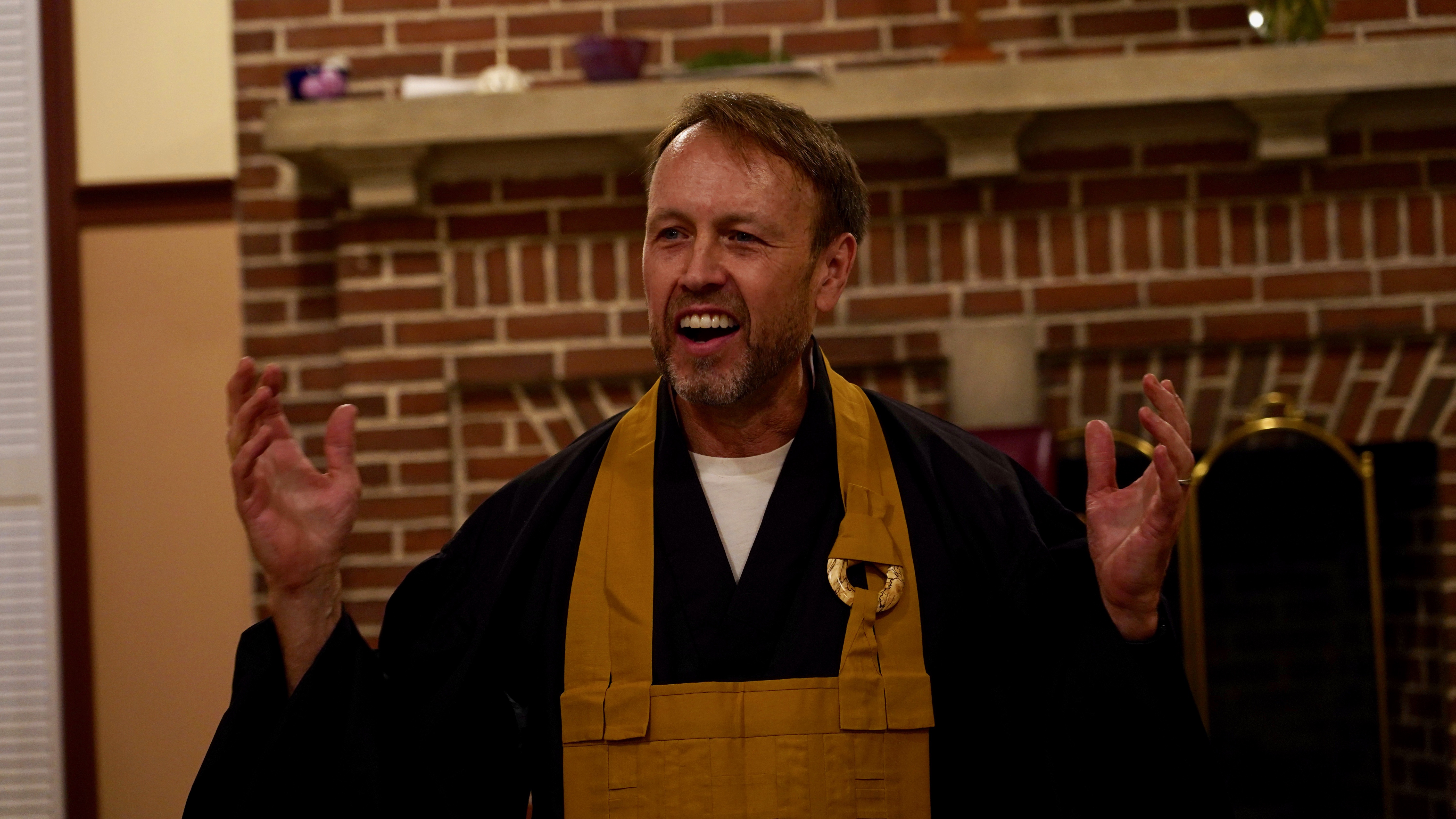
Meditation Myths

I gave this teisho Thursday night.

I’ll start and end this talk with verses from Transmission of Light, one of Zen’s koan collections. This opening verse is from Case 7:

Though there be the purity of the Autumn waters
Extending to the horizons,
How does that compare with the haziness
Of a spring night’s moon?
Most people want clear purity,
But though we sweep and sweep,
The mind is not yet emptied.

I hear many people say they’ve tried to meditate, but have given up because they can’t stop their thoughts.

This is a misconception of what’s supposed to be happening in meditation, and I’m sure it’s one of the biggest reasons people don’t start or give up.

There’s nothing wrong with thoughts or thinking. Thoughts are just the mental activity that arises all the time. Thinking is giving our full attention to thoughts; conjuring thoughts, engaging with them, directing them. Our capacity for thinking is marvelous and immensely useful.

And, many of us, much of the time, are trapped in an echo chamber, a hall of mirrors, in which our endless internal dialogue is all we perceive, and our main way of knowing ourselves.

In meditation, we take the lid off of this echo chamber, this hall of mirrors. In meditation, we see and hear this dialogue, and we discover it is not all there is. In fact, it’s just one feature of what is.

And, in truth, it isn’t a particularly good portrait of who and what we are. It’s an isolating perspective. For all the good our thinking sometimes can achieve, it also can contribute greatly to our own and others’ suffering, when we only inhabit the myopic world of thought.

So, what are we doing in meditation as we take up the practice?  Well, in a nutshell, we don’t try to stop or resist thought or other mental activity — but we do gently relax its grip on us when we find ourselves lost in thought. We don’t engage with our thoughts or other mental activity the way many of us tend to do reflexively at other times.

So, for example, if I notice the thought “this seems to be going well” or “that was a car passing,” I don’t respond to that thought with another one.  When I think “this seems to be going well,” I don’t then actively think, “but I’m going to bail early if my foot won’t wake up, because I’ll fall over when it’s time for walking meditation.”  When I think, “that was a car passing,” I don’t then choose to think, “I wonder if that was Ginny coming home from the grocery store.”  I just gently return my attention to my breath.  If the response comes anyway, I just gently return to my breath after that.

If my lower back hurts, I don’t think about whether it’s okay to reposition a bit, I just do the least needed to reposition.

Sometimes you’ll hear it said that very experienced meditators reliably go through every meditation period with a completely quiet mind; without mental activity.  This is simply not true.  I know this from my own experience.

(Brain scientists are learning that meditation alters patterns of brain activity over time, rather than quieting mental activity altogether—whatever that might mean.)

Sure, there will be times and states that seem more clear and spacious, in which thoughts arise less frequently and assertively, and in which our attention is more relaxed, still, undisturbed, and focused, but focused on nothing in particular. These times may become more frequent and last longer over years of regular practice.  Our tendency to get trapped in loops of discursive thinking will diminish, and when that sort of mental activity occurs, one likely will be quicker to notice, and to disengage.  But a completely quiet mind?  Without thoughts, ever?  No.

What we eventually experience, as a sort of base stage to which one returns, is a relaxed, receptive (but non-striving) alertness.  It will feel open, spacious, grounded, calm.

It’s not a blankness, or fog, or half-sleep sort of nothingness.

If you just find yourself being less anxious about periods when the thoughts keep coming, or of active thinking, that’s progress. When you eventually find yourself unconcerned about whether you’re making progress, even better.

What’s happening in meditation isn’t mainly happening on the plane of thought anyway. The goal isn’t perfect mind control, whatever that might mean.

Our problem in meditation, even at the beginning, isn’t thoughts. Our problem is thinking the problem is thoughts. Being sure that, in meditation, as in the rest of our lives, I’m doing it wrong; that there’s something wrong with life, and with me.

The very part of oneself that brings some of us to Zen practice is also the very part that tries to sabotage Zen practice once we start it. It’s the part that compels us to search for something other than this, because this just couldn’t be right or enough, could it?

We judge Zen and our practice just like we judge everything else.  And it creates distance.  Separation. It separates me from my own life.

On the other hand, Zen and other contemplative practices are sometimes criticized for being anti-intellectual and quietistic, in part because of this suggestion that thinking—and, particularly, rational thought, which has been so fetishized since The Enlightenment, which is such an ironic term for Zen types like us—defines what it is to be human, or at least what is best about being human.

But Zen has no issue with thoughts and thinking. Its leading lights have produced endless volumes of conceptual, discursive literature, and they show no sign of stopping. Some of our practices other than meditation invite reflection, like certain verses, such as the Meal Gatha (in which we’re asked to reflect upon how our food comes to us) and our dedications (in which we’re asked to remember specific other people and commit our practice to their memory or well-being).

Zen is not anti-intellectual, but its core practices—meditation and koan introspection—aim to help us grasp what thinking cannot.

We tend to see our intellects as the whole of who and what we are and intellectualism as our only, or as our best and highest, capacity. Because of this tendency, we may believe we can think our way out of or through everything. Many of us come to a practice like Zen in search of something we think thinking will help us find, and so we tend to approach practice that way.

In reality, our thinking mind tends to spin up predicaments and dilemmas that aren’t there, and then tries to think our way out of them, which thinking can’t do. Our thinking creates the hall of mirrors then tries to plot our escape from it.

But we can’t think our way out of the existential trap our—amazing and otherwise useful!—capacity for thought thinks we are in.

The Zen path invites us to step off that hamster wheel.

Zen exposes our questions and dilemmas as baseless, as hollow—as empty!  It acquaints, or re-acquaints, us with the possibility of a different, and ultimately more satisfying, experience.  One that’s always right here, right now.

The Zen path doesn’t really lead to answers to our questions.  Rather, our intellectual questions tend to lose their force, sometimes swiftly, sometime slowly.  They begin to lose their death grip on us as we begin to touch our own experience differently.  As a different way of relating to life, of being in the world begins to take hold of us; as we begin to develop a different sense of who and what we are.

Buddha. Or, as Meister Eckhart said, “Though we don’t realize it yet, we are all sons and daughters of God.”

This new sense isn’t any less intellectual than our sense of sight. We can get very brainy about seeing, and analyzing and describing sight, but that is thinking about our sense of sight, not sight itself.

This new state of being, or orientation to life, isn’t any less intellectual than our sleep state. We can get very brainy about sleep, and analyzing and describing sleep, but that is thinking about our sleep state, not sleep itself.

We have no quarrel with sight and sleep, but most of us struggle to stick with meditation and Zen practice. Most of us struggle with our experience of life. We need to give up the fight, and our practice—with which many tend to struggle, to fight, at first—helps us do that.

Don’t let your practice become part of the struggle. Go easy on yourself. Lower your expectations at first. Sit for five minutes a day at first, if that’s all you feel you can manage initially, but stick with it. Every day, or most days, at least. When you feel you’re ready for five minutes more, start sitting for 10 minutes a day. Lower the bar enough to sustain your practice. Don’t judge it; just do it.

My 11-year old daughter sometimes fights sleep, even as she seeks it. I tell her that thinking about not falling asleep—the loop she gets stuck in, telling herself she can’t do it—is what’s keeping her awake. A few times I’ve laid next to her, holding her and encouraging her to follow her breath into sleep. At other times, she lies alone struggling. Either way, she eventually falls asleep! And then she has sleep, she is sleep, instead of being captive to thoughts about sleep and no sleep. Her fear of letting go into sleep has lost its grip.

Meditation practice is the same way. There have been countless times over my years of meditation practice—in the early days, or in the seventh hour of the first day of sesshin, or on the seventh day of sesshin—when I was struggling so; when the thought “I can’t make it” would arise. Then, “Ding! Ding!” The session was over. A session of mostly struggling and discomfort as meditation. And, then, getting up and carrying on with the rest of the day, the rest of the retreat . . . as meditation.

Zen, and what it reacquaints us with, is nothing other than this vital life we are living, right here, right now. Through our practice, we come to know and live life so intimately, and not as an “it,” as an object to our subject. Subject-object is not the mode in and through which we experience or comprehend life most deeply. Rather, we come to experience life neither in subject-object mode or not in subject-object mode—trusting life “in our bones,” in and as every fiber of our being, in and as every breath we take and release, without thinking about it. Matter. Of Fact. The Great Matter.

Best as we can tell, the historical Buddha merely called this state and sense “awake.” When people asked him what he was, and what made him different than other sages, he didn’t allow them to project anything too exalted on him. He simply said he was awake—and he no doubt knew what it meant to be truly awake.

Zen practice, including meditation, helps us let go of our fear of being alive, of being truly awake to life itself, as opposed to our ideas about life and how it should be. Fear of life loses its grip on us, just as my daughter loses her fear of sleep as she melts into it, whether she goes struggling or not.

Now, about everything I’ve just said:

Please don’t receive it in the mode of “too much thinking,” as my old Kyudo (Zen archery) teacher used to say. That’s what he would say when I released a shot that didn’t come from a heart centered in the place I’ve been talking about, even if the arrow happened to hit the target. I hope what I’ve just said speaks to your heart, more than your head. A heart centered in that place is the target. The target is life itself. Your life.

As promised, I’ll close with another verse, this one from Case 9 in the Transmission of Light:

Even Manjusri and Vimalakirti could not talk about it,
Even Maudgalyayana and Shariputra could not see it.
If people want to understand the meaning themselves,
When has the flavor of salt ever been inappropriate?
Death and Life

This is a teisho I gave last night, on sesshin in Connecticut, with 60 White Plums, including 17 teachers in our lineage.

We will hear our Evening Gatha* chanted a short while from now, and, in it, these lines:

Time swiftly passes by and opportunity is lost.

Do not squander your life.

Last Tuesday night, exactly a week ago, I had a very restless night’s sleep.  I suppose it would be more accurate to say I got very little sleep.  In the early hours of Wednesday morning, perhaps 1:00 or 2:00 a.m., I woke up with a strong, clear, compelling sense that death was nearby.

It wasn’t a thought.  It wasn’t a feeling.  It was just a very clear sense of death’s nearness.

It wasn’t frightening.  It didn’t make me anxious.  It didn’t send thoughts spinning in my head.

But it demanded, and so commanded, my attention. I laid awake much of the night with, and in, this sense of death’s nearness.

I was at my office later that morning – I’m a partner in a big law firm – when, around 10:00 a.m., everyone in our Boston office received an email from our office manager, informing us that the sister-in-law of one of our colleagues, with whom I’m quite friendly, had passed away that morning. This woman had been ill with cancer for some time, and she had spent the last few months living with our colleague and her family as she approached her death.

Twenty-four hours later, around the same time Thursday morning, I was again at my desk when I received an email from one of our partners in our Boston office.  He was writing to a small group of us who are friendly with a partner in our New York office. His email informed us that an adult son of this friend in New York had been discovered dead at his home.

As if all this weren’t enough, as I was driving from Boston to Connecticut Friday afternoon to attend this sesshin, I spoke to one of my brothers, who informed me that our uncle Paul, a man in his early 80s, who had lived with diabetes much of his adult life, and had been in decline for some time, was in the hospital.  His heart had failed, he was brain-dead, and his family would soon instruct the doctors to remove life support.

As we were gathering here Friday night, perhaps half an hour before Roshi Kennedy welcomed us and we began our first sit, I received a text from my brother letting me know that Paul had passed.

It seems this sense of death’s nearness that kept me awake last Tuesday night was on-the-mark.  It was communicating something quite real.  Death is always nearby, of course.  I suppose it has just been more apparent in my little corner of Indra’s Net over the past week.

We never quite know what awaits us when we arrive for sesshin.  During these first couple of days, I’ve been very aware of death’s aliveness.

__________

I didn’t know my colleagues’ relatives who passed away last week, but I did know Paul very well, of course.  He was married to my mom’s sister, Regina, and he also was my dad’s first cousin, and, really, his best friend.  All four of them grew up in the same area north of Chicago, and the two men were acquainted with the two women by the time they all were in their late-teens or early 20s.  They got married around the same time, had kids around the same time, and packed up their families and moved to Colorado around the same time, in the late `60s, when I was eight.

The two families ultimately settled in small, rural, mountain towns a few hours apart.  We saw each other regularly, on holidays and some weekends, when I was between the ages of eight and my late-teens – the age range my own kids are in now.  We have a daughter who is about to turn 11 and a son who is 14.  Paul and Regina returned to Chicago around 30 years ago, and I saw them much less frequently after that.

I have many lovely, vivid memories of Paul during those years:  Perilous toboggan rides.  Fly fishing, just with Paul, in a beaver pond near their home (where, sadly, there is now a shopping mall).  My first record album, which Paul and Regina gave me one Christmas or birthday.

I turned 57 last month.  For the first time, retirement age seems right around the corner, as if I could almost reach out and touch it.  How did that happen?  Where did the time go?  And, yet, I definitely can touch those times with Paul, now nearly 50 years ago.  They’re right here, still.

Time truly passes by swiftly.  And its pace seems to accelerate as I get older.  Perhaps you’ve noticed this, too.

__________

About 20 years ago, at a much earlier point in my career, I was offered a full-time teaching job, at a good university in the Midwest, in a field I care about greatly:  international conflict resolution and peacebuilding.  I had done graduate work in this field, both as part of my legal studies and apart from them, and I’d done a bit of publishing and applied work in the field by then.  I very much wanted to devote all my time and energy to the field, and this job seemed like my ticket.

It also was a much earlier time in my relationship with my wife, who already had her dream job, teaching full-time at a good university here on the East Coast, in a field she cares about greatly.  She did not want to change jobs.  It became clear to me that, had I pushed for a move, it would have put a terrible strain on our young relationship.  So, I let that job go.

But I was angry and resentful for several years.

Little by little, I would find ways to deepen and expand the scope of my commitment to the conflict resolution field: I arranged some part-time teaching near home.  I continued to publish.  I took on new practice-oriented activities.  Fast forward to today, and I’m quite content with the package of things I have in my life, including activities and experiences I value, and that I presumably would not have, if I had taken the full-time teaching job.

But it would be some time – longer than I care to admit – before I would realize, before I could realize, that the opportunity I lost 20 years ago was not that job.  It was the opportunity to appreciate my life, and to be a good friend and companion, during those years when I was angry and resentful.

__________

How do we squander a life?  How do we squander life?

By not sitting, and by not living, with confidence, as we were told Friday that Roshi encouraged everyone to do on the first sesshin he led after becoming a teacher.  By not living with confidence that the life we’re actually living, right here and now, is the life we’re meant to be living, right here and now.

Sure, sometimes change is in order.  When the call to change is strong, clear, and compelling, we should summon the courage to change.

Perhaps more often, however, we are called to change in place, and that call can be harder to hear.  Sometimes we don’t want to hear it, and, hearing it, we turn from it.

How do we squander a life?  How do we squander life?

By not sitting, and by not living, with joy, as Roshi also encouraged everyone to do during his first sesshin as a teacher.  By not welcoming the joy and potential for joy that presents itself right now, whatever our circumstances.

How do we squander a life?  How do we squander life?

By not being a good friend and companion, as Charles [Birx, Roshi] summed up the call and fruits of Zen practice during his teisho yesterday.

__________

My wish for each of you – each of us –  as we end another day of sesshin and go off to sleep, is that you fall asleep knowing you have lived today.  That you fall asleep alive.

And my wish for each of us, as our lives come to an end, as did the lives of the Dear Ones who departed last week, is that you die knowing you lived.  That you die alive.

This life, this alive, like Zhaozhou’s Mu – his no which is the yes that has no opposite – is, of course, that life which is not death’s opposite.

I’ll end with a brief koan:

Two monks who had been away from the monastery for the day passed a funeral as they returned.

One monk slapped the lid of the coffin twice, glared at the other, and asked ferociously, “Dead or alive?  Dead or alive?”

The other fired back, just as ferociously, “I won’t say!  I won’t say!”

Like the second monk, may we always refuse to take the bait when the Great Matter of life and death is framed like that.

May we continue to seek and find and live and give and share that life which is not the opposite of death.

__________

* Evening Gatha:

Let me respectfully remind you,

Life and death are of supreme importance.

Time swiftly passes by and opportunity is lost.

Each of us should strive to awaken.

Awaken!  Take heed.

This night your days are diminished by one.

Do not squander your life.

Wash Your Bowl — Denbo Ceremony Teisho

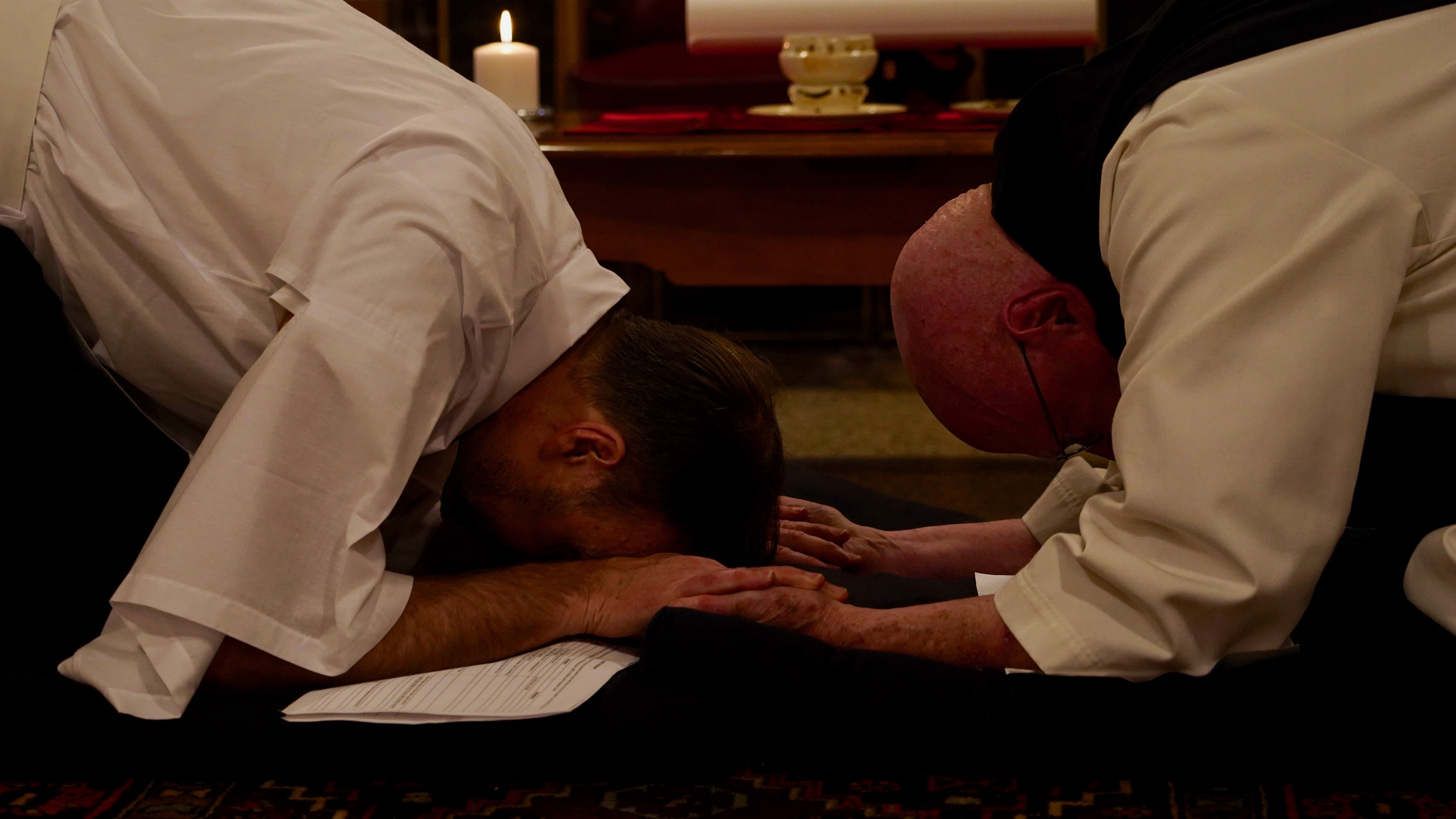
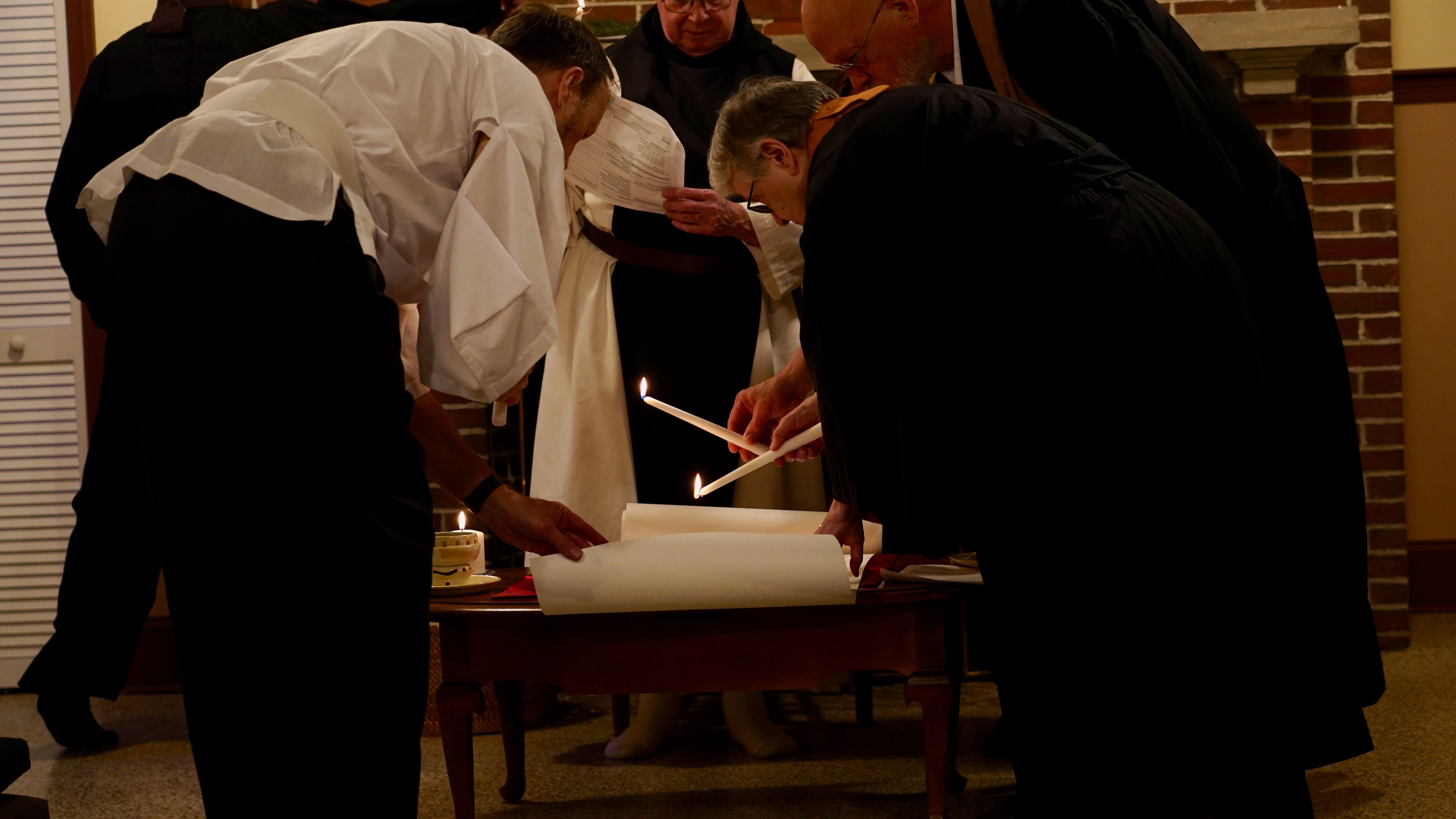
This is the talk I gave after my Denbo ceremony, in which I received Dharma transmission from my Zen teacher, Kevin Jiun Hunt, O.S.C.O., Roshi, and so became a Zen teacher myself.  I’ve also posted a few pictures.  The ceremony occurred on Saturday, November 10, 2018.  It was very traditional, except that it occurred at 2:00 p.m. and was attended by friends and family.  For reasons that are long outdated, these ceremonies have, for centuries, typically occurred privately, between teacher and student, at midnight.  A number of Zen streams in the West, including ours, recently have begun to open them, and to hold them at a much more agreeable time of day.  I’ve been given the Dharma name Kōgen, which means Light Source.

Gratitude is the first thing I want to express today.

Some time ago, I went looking for a new Zen teacher.  I couldn’t believe it when I found a Trappist monk and Zen teacher, all rolled into one, just a couple of towns over from where we were living at the time.  As you’ll hear in a moment, the Trappists were on the scene early in my travels through contemplative spiritual circles over the past 30 years.  So I was really excited to discover Fr. Kevin.  I wrote him a long, detailed email telling him all about my journey.  And, at this point, Fr. Kevin gave me the first of the many great teachings I’ve received from him:  He completely ignored my email!  I re-sent it a few days later, just in case he had missed it.  (Hint: He hadn’t missed it.)  He ignored it again.  That was my first dose of your wise, spare, direct, “no fuss” approach to spiritual guidance and friendship.  You’ve known just what nudges I’ve needed.  And, since our very first meeting, I’ve come to see just how genuinely you see me – and, I must say, being seen genuinely by other human beings is one of the most profound gifts any of us can receive.  From the start, you’ve accepted me without pretext or pretense, and you’ve always gently insisted that I accept myself the same way.  Thank you.

I eventually forwarded my email to Cindy, whose email address I’d also found on the Zendo’s website.  She responded right away, and very helpfully, encouraging me to come sit with the group!  And I’m glad I did!  That was another tremendous gift and teaching.  I so appreciate and admire your incredible openness, the sense of warm welcome you create, and your determination to make Zen accessible.  You have opened the door to this Zendo to our whole family.  Esther began Zen practice here, and you’ve even welcomed our kids and our dogs.  Thank you.

Tim and Sr. Madeline, thank you for being here today.  It means the world to me.  Thank for your friendship and the many wonderful teachings you’ve offered all of us.

I also want to acknowledge five other important teachers here.  First, my friend and Harvard Divinity School colleague, Charlie Hallisey.  He is one of the principal scholars of Buddhism at Harvard Divinity School, where I have done some part-time teaching the past few years, and he is one of the leading scholars of Buddhism globally.  Charlie has brought with him four distinguished Buddhist monastics from Asia – Bangladesh, China, Sri Lanka, and Vietnam – who are fellows at Harvard this year.  So this is not just an interfaith ceremony; it is an ecumenical ceremony within the Buddhist world.  It’s an honor to have all of you with us today.  Thank you.

I want to thank our Charlie (Norton) for serving as attendant today, and for all you do around this place. You are a rock.

We’re going to share a bit of food after this ceremony, and the best dishes – the ones we didn’t pick up at Whole Foods – were made by our very own Kathleen Bellicchi, who quite literally is the best cook I’ve ever met.  Kathleen, you so evidently pour your heart into everything you make, and your foods opens our hearts.  Thank you.

I want to thank my family, of course, Esther, Ellis and Carys.  For many years now, you’ve given me leave to sit for 25 minutes at a time at home, or for an evening, or sometimes two, away during the week, or for a day, or a weekend, or a week or more when I’ve been on retreat.  Walking this path runs against the main currents of our culture – and yet you always have been fully supportive of my commitment to traveling it.  Thank you.  I love you.  And, Ellis and Carys, thanks for participating in the ceremony.  Good job!

I also want to acknowledge and thank my parents and my two brothers.  They are not here today, much as they wanted to be.  They have been interested in and supportive of my meditation practice from the very start.

Finally, I want to thank my friends, starting with the countless people I’ve had the good fortune to sit with all these years – both Zen and Christian Centering Prayer practitioners.  A handful of you are here today; many more are not.  I also want to acknowledge my close friends walking the contemplative path within other traditions, including Islam and Judaism.  I’ve been buoyed by the friendship of all of these fellow travelers.

Last, but not least, I’m grateful to my friends from different walks of life who have come to participate in this ceremony.  All the strands of my life feel woven together and of a piece at this point, and I want each of you to know you’re an important part of the whole.  Thank you.

__________

It’s traditional for a new teacher to give a talk, and I’m going to open this talk in one traditional way: with a koan.  For those of you who are less familiar with the Zen tradition, most koans are brief accounts of interactions between a teacher and a student, or between students, or between teachers, which have been recorded and bound together into collections that have been passed down to us through the centuries.  They’re sometimes used in a very distinctive way as a teaching tool when a student meets with a teacher, and they’re also often used to open a talk, like this one.

This is Case 7 in The Gateless Gate, which is one of those koan collections:


A monk said to Chao Chou, “I have just entered this monastery.  Please teach me.”

Chao Chou said, “Have you eaten your rice gruel?”

The monk said, “Yes, I have.”

Chao Chou said, “Wash your bowl.”

The monk understood.


I began meditating about 30 years ago, as I said earlier, in my mid-20s.  That was a very stressful time in my life, if also a good and exciting time in many ways.  I had just finished law school and begun my career in the intense legal profession at a firm in San Francisco.  (Several of my lawyer friends and colleagues are here today, including my first boss and mentor at that firm, Jeff Newman, who has remained a close friend ever since.  All of the lawyers here no doubt can remember the stressfulness of that transition from law student to lawyer.)  I also was living far away from my family for the first time.  And, most significantly, I was just beginning to touch, and open up to, and work through the pain and after-effects of witnessing a very close friend’s death in a mountain climbing accident 12 or 13 years earlier, when I was 15.

I signed up for a weekend introduction to meditation program at the Nyingma Institute, a Tibetan Buddhist monastery and study center in Berkeley.  I was Catholic, and I had studied with the Jesuits, but I was totally unaware at this time of the rich tradition of contemplative prayer practice, of silent prayer, within Christianity.

I definitely signed up and showed up for that first meditation experience seeking refuge, though I doubt I would have or could have expressed it quite that way then.  Life just seemed out of joint, and I was looking for a route to someplace better.

My sitting practice was irregular for the first year or two, but that weekend definitely started me on this path.  A couple of years later, I took a sabbatical year, which I spent in Berlin, Germany, as the wall was being dismantled.  There, I read my first Zen book, by D.T. Suzuki, the towering Japanese Zen teacher and scholar who did so much to transport Zen to the West in the first half of the 20th century.  In this book, Suzuki praises several medieval Christian mystics.  At the time, I found this really surprising, for two reasons.  First, a Zen teacher was pointing to Christianity, my birth tradition.  What’s up with that?  Second, though I’d studied some theology by then, I’d never heard of these people.  Who were they?

I started reading about them, and then reading what they’d written.  When I returned to the States, heading home to Colorado, I connected with the Trappists – specifically, the Centering Prayer movement a number of them had launched to bring contemplative prayer out of the monasteries and into the wider Christian world.  I sat in those circles for several years, while also sitting with Buddhists.  I moved to Boston about 25 years ago for more graduate work, and I eventually situated myself for many years in a different local Zen community.  Little did I know at any of these waypoints that I’d eventually experience the Trappist and Zen streams brought together in the likes of Fr. Kevin.

__________

In the early days of this journey, I had a burning question I would ask of any teacher or senior student who would listen:  When can I stop sitting?

I had many different ways of asking this question, like:

  • There will come a time when I don’t have to sit anymore, won’t there?
  • So-and-so (the teacher) really doesn’t need to sit anymore, does he?

In retrospect, my question was a lot like the one with which Master Dogen, who carried Zen from China to Japan in the 13th century, was preoccupied as a young monk.  His question was:  Why do we practice?  Or, to put it another way:  What’s the point of this?

Anyway, I mostly got rather polite replies contesting the premise of my question.  But, I persisted – and I’m sure I became ever more annoying to these good people from whom I was insisting upon receiving an answer they never were going to give me.

I’d been told many times that I was free to stop sitting whenever I wanted to.  But what I really wanted to know, of course, was that there was a pot of gold at the end of the rainbow – that better place I was seeking – and that I was going to find it.  Convinced I didn’t have them already, I wanted the Keys to the Kingdom.  I wanted to know The Secret.

One day I asked one of these people my stale question yet again – Can I stop sitting someday? – and this time she just rolled her eyes and said, in a tone I can only describe as a mix of exasperation and sarcasm, “Sure, like when you die.”  And then she walked away.  That was a tremendous gift.  I resolved then and there to shut up and just keep sitting.

__________

I’ve always loved the koan with which I opened this talk.  It’s so simple, short, and truly, truly sweet.  Some people who are new to Zen, or who just encounter it casually, and even some people who have been at it for some time, assume there’s something esoteric about Zen.  If that’s your assumption, you might be inclined to think Chao Chou is being cagey when the teaching he offers the young monk in this koan is to ask whether he’s eaten breakfast and then to tell him to wash his bowl.

But, it’s not so.

Zen has no secrets.  Or, you could say, it’s all an open secret.  Zen points to the open secret that is this very life.  My life.  Your life. Our life together.  For those of us who are seeking, the answer we seek is hidden in plain sight.  And, we find what we’re seeking simply – simply! – by opening ourselves completely, giving ourselves fully, to this vital mystery that’s as plain as the nose on one’s face.  That is the nose on my face; on your face.

The young monk in this koan comes looking for guidance and reassurance, just as I did years ago. There’s genuine integrity in our seeking; in our innate conviction that wholeness is the natural order of things.

And, in fact, the universe is whole, we are whole, even when things seem broken.  Even when we feel lost and broken, as I was feeling years ago.

And Chao Chou’s response, his guidance, really couldn’t have been more straightforward and helpful: Just attend to the here-and-now.

The impulse that makes one curious about meditation; the person who shows up at our door seeking spiritual or physical nourishment; the dirty bowl in the sink:  This is it.  What we seek is manifest, right here, right now.

I love the way this koan ends.  Many koans end with a student experiencing realization, but that’s almost always expressed much more dramatically, like “Suddenly, he experienced great satori [great enlightenment]!” or “Hearing this [what the teacher said, of course], he experienced great realization.”

I like this formulation much better.  “The monk understood.”  Whatever the monk understood, and however deeply – whether he experienced great satori, or simply knew it was time to shut up and just keep sitting – it was enough.  Always enough.

__________

Like Dogen in his early days, perhaps like the young monk in this koan, I used to think there must be some end to this, some final goal or destination, and once we reach it, practice ceases.

But our practice, our life, which is the universe’s life and practice, begins long before one becomes a Zen practitioner, and it continues whether or not we meditate.  It continues as our meditating or not meditating.

This path is completely open-ended, completely boundless.  A path without boundaries.

And, so, we are always, already home.

The fact that many of us don’t yet reliably believe this – or, rather, don’t yet reliably experience this – is the main reason a tradition like Zen and its practices exist in the first place. “Belief” in the way we typically use that word, in a cognitive sense, isn’t really what it’s about.  Belief in that sense eventually begins to feel arid and hollow; it just won’t do.  What we really seek is knowing in our bones, beyond belief.

It’s all just like the young monk’s bowl.  So concrete, so tangible, so present – and, yet, it cannot, it will not, be reduced to, or contained by, our ideas about it.  Turn that bowl round and round in your hands as you wash it.  Just like this life we live, this path we walk:  What is it exactly?  Where does it begin?  Where does it end?

__________

I’m excited to continue this journey in this new role, helping support others in their journeys as best I can, as others have supported me so generously for so long.  I’ll continue to need your support, of course, and I’ll welcome it.  I’m also excited about some of the things we see emerging as Zen becomes more firmly planted in the West, including its turn toward social and environmental justice concerns and its deep encounters with other traditions, both religious and secular.  I also look forward to doing my part to contribute to these developments.

Thank you. Thank you.

This is a recording of my talk, kindly provided by my Dharma brother Charlie Norton,

Ceaseless practice


This an an approximation of a talk I gave on May 31, 2017 at Bright Sea Zen, the sangha led by my dear friend, Kate Hartland.

“The meaning of zazen, the enlightenment and liberation of all living beings, is not brought forth by the power of personal effort and is not brought forth by the power of some other.  Zazen doesn’t start when we start making effort, doesn’t stop when we stop.

We can’t do it by ourselves, and nobody else can do it for us.”

From “Guidance in Shikintaza,” by Reb Anderson

I want to use this passage from one of our chants tonight to talk about the notion of ceaseless practice.

The universe practices ceaselessly.  Everything that’s happening right here, now – everything that’s happening everywhere – is the universe’s practice.  The universe is universing.  This is Buddha’s practice. It is Buddha nature expressing itself.

Buddha nature expresses itself ceaselessly.  The universe practices ceaselessly. E ndlessly flows forth; erupts; gives its all; gives it all up for the sake of . . . giving it all up.

Kate and I just had a nice visit at her house before our sit.  She definitely delivered on her promise to make a wicked grilled cheese sandwich.  The sandwich and time with her were a real treat, yet the main event was a tour of Kate’s beautiful garden.  Kate is an avid gardener, as I suspect you know.  I’ve always appreciated and admired the way so much of her teaching is inspired by what nature teaches her.

Kate’s garden is radiant now.  Many of the flowers are erupting.  The universe erupting as Kate’s flowers.

And, later in the year, when the flowers die, their death is the universe erupting, too.

It’s the same with us.  Each of us is the universe universing.  We are flowers blooming. Our lives – our thoughts, speech and action – are the universe erupting.  And our deaths are the universe erupting, too.

And, yet, many of us, much of the time, don’t seem to regard our lives this way.  We have this gnawing sense of separateness, of isolation, of not-okayness.  And we often, in more or less unconscious ways, respond anxiously to this sense, and often in ways that tend to compound it.  We take refuge in thought, speech or conduct, in situations we create or gravitate toward, that are about escaping from the here-and-now.  That aren’t about nearness to it and intimacy with it.

Why is this?  I don’t know. In some religious worldviews, it’s a mark of our fallen nature.  In some, it’s a pathology; a kind of sickness.

I’m more inclined to see it in the spirit of what Zen types call the “samadhi of play.”  Why shouldn’t the one wish to flow forth and know itself in the many; in and as myriad dharmas, “the 10,000 things”; as you and me?  And why shouldn’t the many, why shouldn’t you and I, truly feel distinct and separate, with the twinge of discomfort that entails (even as it also creates opportunities for joy).  And why shouldn’t all delight in discovering, and constantly rediscovering, oneness-in-manyness and the boundless love manifested in and generated through all this?

But these are just ideas, and, so far as I can tell, the universe universing doesn’t seem to be dependent upon my own or anyone else’s ideas about it.

This is the “we can’t do it for ourselves” part.  We can’t do it for ourselves, because it’s already done.  From this perspective, there’s nothing at all to do. Polishing ourselves – trying to be wiser, more virtuous, more spiritual; shinier, newer or whatever – it’s all futile from this perspective.  This is a come-as-you-are universe.  The universe goes on erupting, despite and as our efforts, whatever our efforts may or may not be.

So why practice?  We practice because of the opportunity it provides to become more and more aware of the universe universing, and to discover ourselves as participants in the universe universing.  It helps us not to resist our participation, just as we are here and now.  To attune.  Zazen tends to help us attune.

This is the “nobody else can do it for us” part.  Nobody else can live our lives, and nobody else can sit for us. Nobody else can practice for us.

Sitting is optional . . . we’re part of it all, no matter what, and the universe goes on practicing as me, whether or not I sit.  Yet this attunement, this particular quality of willing participation, can matter so much personally and collectively.  So much individual and collective suffering is attributable to our resistance; to our attempts to take refuge in someplace other than this.  Someplace we think promises something more.

The quality of our lives – our thought, speech and actions – may begin to change as we attune.  The universe goes on erupting despite our efforts and as our efforts, no matter what, but we do have agency.  We participate.  We have the ability to influence the universe erupting as our efforts.

So what we realize from our practice is simply that we are part of the universe’s ceaseless practice.  We realize that we are already home.  That we are practicing ceaselessly, too.

This isn’t exactly a destination, at least not in the way we’re accustomed to thinking about destinations.  The universe’s practice is completely open-ended.  And our practice must take on this open-ended quality, too.

Time and again in our practice, we must confront the idea that there is a goal, a destination, an ultimate point.  This idea can arise in many different ways, sometimes with a positive, sometimes with a negative tinge: a belief that there’s something wrong with my sitting practice, or that my practice is going really well; a belief that I’m virtuous or not virtuous; a belief that I’m not enlightened and never will be or that I’m finally realized.

However this idea arises time and time again, time and time again we must let it go.

So it’s all sort of like the line in that old folk spiritual:  “My life goes on in endless song. How can I stop from singing?”  The universe goes on universing as me no matter what.  Goes on in endless song.  So why not sing in tune?

As we let go of our gaining ideas over and over and over again (including our gaining ideas about supposedly losing), we tend to begin to manifest a positive quality of poverty of spirit.  By this I mean simply that we become more at ease with our practice and with ourselves and our lives.  We tend to increasingly practice without striving.

Another word for this quality of practice with poverty of spirit is reverence.  Simple reverence.  Reverence with a light touch.  Reverence with a sense of humor.  Reverence that is loving, but not too precious.

Reverence for the 10,000 things.  Reverence for your own life and experience.  Reverence for others’ lives and experiences.

Experiencing things this way is a cue that our personal practice is aligning with the ceaseless practice of the whole universe.

The universe, you and me practicing together.  Each breath.  Each step.  Each supernova bursting.  Each grilled cheese sandwich.  Each flower blooming.  Ceaselessly.


Zen as Religion


I gave this Dharma talk at the Greater Boston Zen Center on Tuesday, October 13, 2015.


Blue Cliff Record Case 77: Yunmen’s Sesame Rice Cake

 A monk asked Yunmen, What is the conversation that saves the buddhas and goes beyond the ancestors?”

Yunmen said, “Sesame rice cake.”


Tonight I want to take up a rather slippery topic:  Zen as religion.

We don’t spend much time in Zen circles engaging in theological reflection – at least not the sort of analytical reflection and discourse that’s common in other traditions.  We don’t concern ourselves too much with definitions and boundaries. It’s not a tradition that demands adherence to any particular beliefs.

There are ideas and principles practitioners through the ages have found useful, based upon their own practical experience with them, but there are no litmus test beliefs that define what it means to be a Zen practitioner.

(To be fair, we concern ourselves with definitions and boundaries some; for instance, in relation to authority within the community, as is true of any other organization, religious or secular.)

There are some western Zen practitioners who don’t think of themselves as practicing a religion.  I suppose it’s possible to view Zen as a sort of psychological system, as some western practitioners seem to do, though I think that’s a limited and limiting frame.

Scholars debate the defining characteristics of religion.  We won’t resolve that debate tonight.  But let me offer one element of one scholar’s working definition of religion as a launching pad for some things I want to say about Zen. Émile Durkheim, the great 19th century French sociologist, famously defined religion this way:

Since the idea of the sacred is always and everywhere separated from the idea of the profane in the thought of men, the mind irresistibly refuses to allow the two corresponding things to be confounded, or even put in contact with one another.

We see this sort of binary between profane and sacred, between the mundane and the other-worldly, defining religion in the work of other scholars, like Rudolf Otto, for instance.

It’s a fair point.  This is a key insight into much of what’s going on within many strains of most religions – including some strains of Buddhism, I believe – so it’s not surprising that this binary is considered by many to be a defining characteristic of religion.

I’m hedging, of course, when I say that this binary describes “much of what’s going on within many strains of most religions.”  There certainly are strains of most religions that resist the idea that there’s an impenetrable barrier between sacred and profane, as Durkheim imagined.

For example, one might say that Christianity was founded on a degree of resistance to this binary.  Dominant strains within the Greek philosophical tradition that held sway within the ancient world into which Jesus was born maintained that what is ultimately real is removed from this world.  Think: Plato and his forms.  Christianity upended that notion.  Here was God among us.

Of course, the Christian community found itself in schism at times over questions about the extent of this divine-mundane intermingling.  Some Christians really pushed the edge of that envelope along the way, like Meister Eckhart, the great 14th century mystic.  It was orthodox to regard Jesus as the Son of God, of course, but Eckhart also said, “We are God’s sons and daughters, but we don’t realize it yet.”

That has a real resonance with how we sometimes talk about Buddha nature and enlightenment in Zen, as D.T. Suzuki and other Zen scholars have noted.  Of course, Eckhart was tried as a heretic by the Inquisition.  Fortunately for him, he managed to die before his verdict was pronounced.

Does this sacred and profane binary describe Zen?

Yes and no, I suppose.  But, more than most strains of most religions, I think not.

We have our notions of the absolute and the relative, of emptiness and form, yet we’re reminded again and again and again that they’re one and the same.

And, as we think and speak about the relative and the absolute – think and speak about them – they’re notions, of course.  Ideas.  Whatever God or the absolute or emptiness or the ultimately real is to you – well, I sincerely hope you experience it, or come to experience it, as something other than an idea.

The koan with which I opened this talk is typical of so many.  A student comes to a teacher and asks earnestly, “What’s it all about?”

A rice cake, Yunmen says.

In other cases, we hear it’s about . . .

. . . three pounds of flax

. . . a pail of water

. . . the oak tree in the courtyard

. . . even a dried piece of dung

Dung.  Excrement.

Our tradition seems to be making a point of imploding distinctions between sacred and profane; of playfully poking fun at our tendency to make such distinctions; of using that tendency as a nudge toward realization – dangling the distinctions as cat nip.  Lovely story after lovely story like that.

From a theistic perspective, one might say Zen brings heaven and earth together, without obliterating either.  It’s relentless in this way.  It’s the religious equivalent of a supercollider.  A theological Large Hadron Collider.

From an atheistic scientific materialist perspective, one might say Zen brings the dead (the inert) to life.  In this day and age, it’s something of an antidote to the turn in philosophy that attempted to jettison metaphysics – yet still a place, in this day and age, many skeptics feel they can call home.

Tapping on a coffin (in a koan set at a funeral), one monk asked another, “Dead or alive?”  “I won’t say!  I won’t say!” replied the other.

Can this be contained in sacred or profane, heaven or earth, absolute or relative, dead or alive?

This/that mind is concerned with pulling Humpty Dumpty apart and putting him back together again.  That capacity is immensely, immensely useful.  And, even as we exercise that capacity in those situations where it’s useful, we can know in our bones that Humpty Dumpty is, fundamentally, everywhere and always, together in its distinctions.

That potential is one of Zen’s great invitations and gifts to us.

Is Zen religion?

Let me close with another story (also from a koan):

The Emperor Wu of Liang asked Bodhidarma – the 28th Buddhist patriarch, who brought Buddhism to China, where it mingled with Taoism and became Chan, eventually migrating to Japan, where it’s called Zen – “What is the highest meaning of the Holy Truth of Buddhism?”

“Empty – there’s no holy,” Bodhidharma replied.

No separation.

Stunned by this answer, the emperor asked, “Who are you facing me?”

“Don’t know,” was Bodhidharma’s response.

Is Zen religion?

Who are you facing me?

Who are we facing one another?


Passing through Hell

I gave this Dharma talk at the Greater Boston Zen Center on Tuesday, October 13, 2015.

“If you are despised by others and are about to drop into hell because of evil karma from your previous life, then because you are despised by others, the evil karma of your previous life will be extinguished.”

Blue Cliff Record Case 97: The Diamond Sutra and Evil Karma

I just passed through a week from hell.

Two weeks ago this past Monday my 79-year old mother was hospitalized with a serious intestinal condition requiring emergency surgery.  Her system had gone septic, and she was teetering on the edge of death.

I booked the next flight to Colorado, which had me departing the next day at the crack of dawn.

My mom was still in surgery as I landed in Denver, which is a two-and-a-half drive from my parents’ home.  One of my brothers was waiting at the hospital for news from the surgeons.  He called about an hour into my drive to say that our mother had come through the surgery, barely, but was by no means out of the woods.

He and I had both been calling my parents’ house that morning to check on my father.  My mother had been caring for him at home, though she was barely able to do so.  My dad wasn’t answering the phone.

My brother went from the hospital to my parents’ house after the surgery and found my dad lying face down on the floor, conscious, but unable to get up, and with a big bump on his head from the wood step he hit when he fell some hours ago.  He couldn’t say when.  He’s on a blood thinner, so falls are risky; they can lead to fatal internal bleeding.

I arrived at my parents’ place shortly after my brother did.  We called 911 and followed the ambulance to the hospital where my mother was still in the recovery room.

As if all this weren’t enough, my wife texted me around this time to say that two falls her mother had recently were caused by strokes, that she was undergoing an urgent series of tests to determine whether she was in immediate risk of another, and that she and my wife’s father would not be able to travel to Boston from the UK (where they live) to visit us later that week.

Stress.  Fear.  Sadness.  Exhaustion.  Hell.

Over the next 48 hours, my mom began to stabilize, the doctors determined my father hadn’t been seriously injured in his fall, and my mother-in-law was cleared to visit us (but still requires more testing and, possibly, treatment).  The aging parent thing has become ten times more intense for us overnight, but the immediate danger for each of them seemed to pass almost as quickly as it emerged.

The koan with which I opened this talk describes another sort of hellish experience: being despised by others.  Perhaps one is despised because of something one did, like taking another life; perhaps it’s because one is a member of a minority racial group or religion; perhaps it’s because of a combination of these or other factors.

It is tempting to read this koan as if it’s about some cosmic algebraic equation; an equality in which we gain future karmic happiness in proportion to our present karmic misery caused by past karmic transgressions.

But this is 21st Zen Buddhism we’re practicing.  That can’t possibly be what we mean.  Indeed, that can’t even be what the ancient masters meant. Can it?

I suspect this sort of good/bad, past/present/future karmic accounting has helped countless people cope with the difficulties of life throughout the ages, including this one – and not only in the Buddhist world, but through similar notions in other religious traditions.

Yet I think this koan extends another sort of invitation.  It’s the same invitation extended by the Five Remembrances that we recite each week.  That verse reminds us that we’re of the nature to grow old, become ill, and die, and that there’s no escaping this.

Life really was hell a couple of weeks ago; it truly felt like hell.  We really are watching our parents grow old, and become ill.  We will say goodbye to them in time . . . if we ourselves outlive them, and we must remember that’s not guaranteed.

The Five Remembrances can be a real shocker for those new to Zen: they certainly have a bubble bursting quality that one doesn’t find much in religion.  But bursting the bubble in which we’re bound to keep searching for that mythical way out, that door from hell to heaven, is only half of the real Zen equation.

Whether we feel we’re in heaven or hell or someplace in-between, the door, the Dharma gate, actually is always right here, and always has been.  It’s a gateless gate.  A boundless gate.  And it leads to this.

Sitting alone at my mom’s bedside in the ICU as she laid there on life support, unaware of my presence, holding her cold, swollen, unmoving hand, hell seemed so . . . solid.  That moment, tortuous as it was in one sense, seemed so solid.

So trustable.

And so bearable.

I couldn’t help but feel grateful for it all somehow.  Grateful for her.  Grateful for the presence of mind and spirit to be present to that moment.

All is blessed. Every day is a good day, as old Master Yun-men said when asked about his own illness and impending death.

Even the hell states.  Even the hell states in which we can’t manage to see that all is blessed.

I credit Zen practice for helping me experience that moment this way.  But I think you know this isn’t the product of some great yogic feat of mental discipline in which we banish all our fears and anxieties or cultivate a stoic detachment from this world of pain and suffering.  Quite the opposite.

It’s by actually allowing ourselves to be in hell when we’re in hell.  And by discovering there and elsewhere, including on these cushions, that we contain hell, rather than the other way around.

Knowing in our bones that we’re part of it all; submitting to that reality.  Finally letting it have us, as, in fact, it has all along.

Knowing that we’re both dew drop and this very dew containing universe. Or, in this case, tear drops.

We find our liberation and our peace in that.  We ultimately find the exemption we’ve been seeking by realizing – by which I simply mean being – the raw reality, the brute fact that we’re not exempt.

Great Thought

This is an approximation of a Dharma talk I gave at the Greater Boston Zen Center on April 29, 2015.

 Dongshan asked Yunju, “I heard that a monk named `Great Thought’ was reborn in the Kingdom of Wei and became the king. Is this true or not?”

 “If his name was `Great Thought,’ then even the Buddha couldn’t do it.”

 Dongshan agreed.

I came across this koan last week while paging through Zen’s Chinese Heritage, Andy Ferguson’s wonderful compilation and translation of some of the most important teachings of some of the most important Chinese Chan masters who laid the foundation for Zen as we have received it via Japan and Korea.

Yunju was a great teacher who died at the turn of the tenth century. Dongshan was his main teacher.

Koans are stories of these teachers and their students – and they’re our stories, too, of course.

I thought I’d use this koan as a launching pad for talking a bit about thought in zazen, and in Zen more generally.

The sentiment that may seem to be expressed in this koan and so many other Zen teachings is that the main problem we confront in and through Zen is thought. Mental activity and constructions.

If we just cease to get lost in thought, to cling to thought even when we’re certain our thoughts are right and trustworthy, we’ll be free in the way we imagine Zen can make us free. This is why we came to Zen, right?

And it’s true that our early instruction in zazen is, in part, about developing the ability to disengage from thought gently when we become aware we’re lost in it.

There is a certain kind of freedom – a greater sense of personal agency – that one may gain by gaining a perspective on one’s thought, one’s cognitions.

Much of the time many of us are completely lost in thought, and we just accept whatever is coursing through our minds as our perspective. As the perspective. And so it is, if we let it be so.

We all know the philosophical proposition “I think, therefore, I am.” Much of the time, for many of us, however, it’s really more like, “I am what I think,” but without being fully aware that’s how we’re operating.

Yes, of course, meditation can and does help us develop the capacity to “go meta” on the endless stream of mental matter that’s always bubbling to the surface of our awareness, and this can be a really transformative thing for oneself – indeed, for our relationships, and for the world.

But you’ve probably noticed that it’s hard to stay in that place always. We inevitably become lost in thought again.

It’s not just you. It’s all practitioners, even those who’ve been meditating for decades.

In Zen, this meta observation deck is not someplace we expect and strive always to remain (though there are some schools of meditation that do seem to hold this out as the goal).

Imagine you could remain there. Perhaps you’ve even had what seemed like particularly “good” or “deep” periods of meditation that had this quality and now seem like the standard by which all other meditation periods – even time off the cushion – should be judged.

But what lies beyond or sits above that perspective?  Has one really found IT – the Great Thought, the Great Place, the Great Perspective one has been seeking?

What is this perspective? Is it the One True You? Is it ever-enduring – in the background, even when it’s not my conscious foreground – or is it contingent, like other things we observe? How can you know?

Perhaps it really is just turtles all the way down.

Thinking we’ve arrived somewhere, even that we’ve glimpsed someplace, is just confirmation that we still imagine there’s someplace else to go.

In reality, our thoughts and our being lost in thoughts – monkey mind, as we call it – is it, too.

Thinking there is someplace to go, and searching for that someplace, and the very impulse to search: All part of it. Part of who we are. Part of this.

Yes, we can reduce much optional suffering – our own and others – by gaining a perspective on our tendency to become lost in thought. Becoming better at noticing that; less prone to running completely on autopilot, to being captive to and defined and pushed around by our unreflective throught-stream. We can become more reflective and less reflexive. There’s big upside here.

But we ultimately must gain a perspective on our perspective seeking and perspective gaining, too.

(And, even this perspective is something we can’t let become too precious, precious as it is.)

Zen practice is not primarily about just becoming more cognitively reflective or somehow detached. About somehow occupying some superior mental space.

Zazen presents a chance to sit with all that arises and all that is, including our discomfort and distraction, and the impulse to search for escape from discomfort and distraction.

The impulse to search for the ultimate escape from existential discomfort. To glimpse behind the veil we imagine is there.

In time, we may come to see – even to know, to feel in our bones – that this impulse is like “trying to bite your teeth,” as Josh recently told me some Zen sage once said.

“If his name was Great Thought, then even the Buddha couldn’t do it.”

Zen is not ultimately just about contending with our thoughts. The goal isn’t to replace small thoughts with a Great Thought; our small, local, enmeshed perspective with some imagined uber perspective in which we hope and expect always to abide.

Our small perspective is the big perspective. Like box and lid, or two arrows meeting tip-to-tip in mid-air, as the sayings go.

This is it.

And this is not a thought.

And it’s not not our thoughts.

Our possible impossible vows

This is an approximation of a Dharma talk I gave at the Greater Boston Zen Center one Tuesday night during the summer of 2012. I’m posting it now to complete my series of talks about the major elements of our liturgy.

I’d like to talk a bit about the Four Vows — how I have come to understand and experience them.

Beings are numberless, I vow to save them.

Delusions are inexhaustible, I vow to end them.

Dharma gates are boundless, I vow to enter them.

The Buddha way is unsurpassable, I vow to embody it.

We’ll often hear it said in Zen circles that these vows are impossible to fulfill, and indeed they are.

There are beings suffering everywhere that you and I will never meet; there is suffering in our midst we’ll never perceive.  There is the starving, AIDS-afflicted child in Africa, and also the colleague I see in the hall every day who doesn’t share her sorrows with me.

There are forms and causes of suffering that no person can end alone:  war, poverty, global warming.

The Four Vows are aspirational and inspirational.  They prod us to help as we can, to strive to help more than we think we can – but, of course, we cannot literally save all beings from all forms of pain, sorrow, and hardship, at least not in the relative sense of saving beings.

This is a difficult reality — downright depressing, from one perspective, if we allow this truth to sink in.  And this discomfort, if we permit ourselves to experience it, hopefully does move us to do something.

Impossible as it is to save all beings from all suffering always in this sense, however, the Four Vows also have a paradoxical, even teasing, quality.

Infinite beings.  I nonetheless vow earnestly to save each one.

Really?  You must be kidding.

Actually, our translation of the first vow doesn’t say “infinite” beings, it says “numberless” beings.

What does that mean, “numberless beings”?  Zero beings?  Zero and not zero beings?

Just as this line — each of our vows — truly and profoundly recognizes the distinctness of each and every thing, and the reality of personal suffering, it also, and equally, truly and profoundly speaks from the perspective of that being in which all beings participate.

The perspective from which there is no subject, verb and object.

The perspective from which there is no possible and impossible.

No savior, saving, or saved.

This is the perspective of the absolute to which one’s attention frequently is called by Zen teachers and texts.

Someone very dear to me is an alcoholic.  I have been pained by and struggled with this fact for years, as have others I know who care deeply about this person, who I’ll call Sam.

I have tried — many have tried — to help Sam acknowledge and address this condition.  Over the years there have been individual and collective efforts to appeal to and influence Sam through reasoned discussion, a jointly authored letter of concern, interventions of various kinds, accompanying Sam to AA meetings — you name it.

Sam has seemed to recognize his drinking as a problem and make a real effort to stop at times, but most of these periods have passed, with Sam cycling back into a phase of denial (often belligerent denial), alienation, and darkness.

Alcoholism, as I’m sure many of you know, is a complex condition, with a variety of possible contributing causes that differ from person to person.  Some are genetic; some environmental. It’s no easy thing to address. The data on long-term recovery from alcoholism are not very confidence inspiring.

The periods of struggle and darkness have been so hard for me and for others close to Sam.  There’s the sadness for Sam; the desperate desire to see him happy and well.

And there’s my own fear and anger and frustration and sense of loss of Sam as I knew him, and knew us, in the years when he seemed more in control of his drinking, rather than the other way around.

While sitting with many of you one Tuesday night about a year ago, I had this sense that Sam was sitting with us; that I was sitting here with Sam as I sit here with all of you week after week; as I sit here tonight with the heat and the whir of the fans and everything else.  I had this sense of Sam sitting here in this way, too.

This was a turning point in my relationship with Sam.

I had so wanted to save Sam, but my efforts weren’t paying off in the way I had hoped, and they likely were just contributing to our growing alienation.

Sitting in that emptiness, with the numberless beings, Sam and I somehow both seemed less in need of saving.

And our fears, anxieties and judgments, and my own and others’ efforts to make Sam a “project,” didn’t seem to have the same ability to hold us captive at that moment.  Our delusions — mine and his — indeed were inexhaustible.  Opinions, fears, judgments, emotions — all bound to keep arising endlessly.

And they could be ended — ended by knowing there’s no need to end them.  Ended by dropping the delusion label, accepting them as features of the moment, and knowing they needn’t color my outlook completely, and always, nor dictate my every action.

A Dharma gate opened during that sit, a gate that always was open, and which remains open now.  Each moment, each encounter, a gate.

The gate is open, even when I see no hope and am sure it’s closed.   The way is boundless, even when I think it’s impossibly narrow.  Sam and I are walking the path, even when I feel lost, when he seems lost.

The Buddha’s way is our way.  There’s no Buddha but us Buddhas.  We can’t help but embody Buddha.

The Buddha way is unsurpassable because it is none other than this.

Right here.  Right now.

This very moment that has arrived.

And this can’t be surpassed, much as we might try in our own ways to transcend it.

Sitting here with Sam, I knew Sam was Buddha, that I was Buddha, that our struggles are the Buddha’s struggles.

Realizing this, encountering Sam in daily life has been different.  Less tension-filled.  For me for sure, but also for him in relation to me, it often seems.

For my part, I’ve found it easier just to be with Sam.  And, when it has seemed appropriate, to encourage in a gentle, un-pushy, less needy way that Sam seems actually to experience as encouragement.  I do think I’m increasingly meeting Sam as Sam, and not as someone who is constantly falling short of my own selfish, idiosyncratic image of what a “perfect” Sam would be.

Sam has been in a considerably better space at the moment, and he has been for some time, but I’ve also found it easier — though not entirely easy — not to freak out completely when there are signs that maybe things won’t be better indefinitely.

[Sam’s condition very much has been up and down during the nearly three years since I gave this talk.]

I’d like to think this capacity to relate to Sam and his condition a bit differently has been one small factor among many others that are helping him deal with his condition differently.  I honestly don’t know.  When we have visibly cheered up someone who was crying, or found a cure for some disease or whatever, it’s more clear that we’ve made a difference, that we’re saving beings.

I do know there’s been a small, but important, shift in our relationship. This shift certainly has helped me, and I do think it likely has helped Sam just a bit.

I can trace that shift back to the realization, sparked by sitting with you, that Sam and I and our struggles are part of this greater stream of life, and that things are always okay from that perspective — or, rather, things just are.  Suchness.

So perhaps holding these twin perspectives together — the relative and the absolute; the reality that there is terrible suffering we should work to end, even though we can’t possibly end it all, and the reality that all is ultimately as it should be at this very moment, which is simply to say it’s the only way it can be, actually as it is — and letting these perspectives be “not one, not two,” can help motivate us to act skillfully to do some good in the world; to avoid a detached complacency, on the one hand, or despair and/or less skillful action, on the other.

Perhaps our impossible vows are possible after all.

Dedicating our practice

This is an approximation of a Dharma talk I gave at the Boundless Way Temple on February 19, 2015, during our annual Coming and Going Retreat. It is the next in a series of talks I have been giving about the major elements of our liturgy.  A recording of the talk, along with many other lovely talks from the retreat, can be found here.

I went skiing with two Swedes a few weeks ago. At the end of the day, I asked them – rather innocently, I thought – “Did you have a nice time?”

One of the two, who has become a close friend over the past five years, and who now lives in the U.S., said, “It was a great day.”

Our other companion, who I’d just met, said nothing. I looked at my friend, wondering whether he’d had a bad day, despite outward appearances.

My friend explained that this is an awkward question for Swedes. Theirs is a fairly collectivist culture, and yet also a fairly competitive culture. This question puts Swedes in a bind.

On the one hand, everyone is supposed to have an equivalent experience.   That’s the ideal. On the other hand, people really don’t have precisely equivalent experiences, and people do desire to have a comparatively good experience.

My friend has known me long enough, and been immersed in U.S. culture long enough, to have felt compelled to respond to my question. Not so for the other Swede.

From this cultural frame of reference, revealing how he felt about the day – good, bad, or in-between – would have been to engage in a comparison of experiences, which is verboten.

Because we do have different experiences, and experience things differently, my skiing companions explained that this taboo often leaves Swedes feeling jealous, but not having any way to contend with that feeling. As a result, they said, it can be hard for Swedes to take joy in others’ joy.

My friend tried to explain how these cultural patterns are born of the cold and darkness that makes life up north so hard. They’re a recipe for group survival in harsh conditions.

I told them that the ideal I’m more acclimated to, at least in my little corner of the U.S., is taking joy in other’s joy, even though most of us probably practice it quite unevenly. It’s a nice idea, they agreed.

I was also thinking, of course, of one of the closing dedications for our sutra services:

Buddha nature pervades the whole universe, existing right here, now. The wind blows, waves fall on the shore, and Guanyin finds us in the dark and broken roads. We give thanks to all the ancestors of meditation in the still halls, the unknown women and men, centuries of enlightened women and men, ants and sticks and grizzly bears. Let wisdom go to every corner of the house. Let people have joy in each other’s joy.

I really appreciate our dedications. For me, they answer the “So what?” question about our practice. What is our practice about?

And I’ve always loved this particular verse.

Buddha nature pervades the whole universe, existing right here, now.

Other dedication verses also open with this reminder. I find it so interesting that this verse, which is about dedicating our practice, opens with something akin to a statement of fact; some might also say an article of faith:

We’re alive. All is alive. And all is blessed.

Notice this! Wake up!

After this or another opening reminder, other verses tend to transition into what we might think of as more clear cut dedications: to all being; to those who suffer from calamity, cruelty and war; to specific people who we know are suffering.

With this verse, we chant:

The wind blows, waves fall on the shore . . .

The alarm clock rings.

The dog scratches its neck.

An email arrives.

Buddha nature pervades the whole day.

. . . and Guanyin finds us in the dark and broken roads.

Compassion does have a way of finding us in our “dark and broken roads.” We may be particularly open to others’ helping hands and the compassion that fills the universe, including our own broken hearts, in moments when we feel lost or down. And, of course, that’s precisely the same love available, and that we may feel, in the wind blowing on our face; the surf pounding against our chest on a warm summer day; that email arriving. Whatever our current life circumstance and disposition.

We give thanks to all the ancestors of meditation in the still halls, the unknown women and men, centuries of enlightened women and men . . .

We dedicate ourselves to this practice, for all it gives us, and enables us to offer to others, with gratitude to those who have sustained it and transmitted it to us. It’s truly something to be cherished, preserved, and developed.

And we dedicate ourselves to . . .

. . . ants and sticks and grizzly bears.

Chanting and hearing this for this first time was one of the moments when I knew Zen was for me. I remember laughing out loud. I was hooked.

This is both playful and serious, of course. Matter of fact. Buddha nature pervades the whole universe, ants, sticks and bears included. The 10,000 things.

And it is our animal nature; the baser parts of our human nature. We, too, are crawling on the ground, like ants. We are dirt and sticks. We can be grumpy and brutish, like bears. We dedicate ourselves to these parts of ourselves, too. We’d might as well face them. We’re enmeshed in it all. We’re in the stew.

Let wisdom go to every corner of the house.

I hear this less as an expansionist, missionary aspiration, than as yet another reminder of what’s here already. This practice is so much about just noticing, I find; about letting be; about getting out of the way – or, rather, coming to know in our bones that we are part of this, and this is the way.

Let people have joy in each other’s joy.

Can there be any doubt that we’d all be happier if we could learn to practice this collectively and consistently? This is the pithiest little ethical mandate I know.

And, like the phrase before it, I think it’s as much descriptive as it is prescriptive. People taking joy in others’ joy. This is the way. The motion and frequency of the universe, to which we can tune in and with which we’re invited to cooperate.

Such a simple principle.

Yet, it’s the work of a lifetime, it seems.

And of generations, across cultures.

The Five Remembrances

This is an approximation of a Dharma talk I gave on April 30, 2014, at the Greater Boston Zen Center in Cambridge, Massachusetts.


I am of the nature to grow old;

There is no way to escape growing old.

I am of the nature to have ill health;

There is no way to escape having ill health.

I am of the nature to die;

There is no way to escape death.

All that is dear to me and everyone I love are of the nature of change;

There is no way to escape being separated from them.

My deeds are my closest companions;

I am the beneficiary of my deeds;

My deeds are the ground on which I stand.


— The Five Remembrances


Tonight I’ll continue exploring features of our liturgy by talking about The Five Remembrances.


This short verse from the Pali Canon is as spare, and non-metaphysical, and direct – even “in your face” — as anything one encounters in religion. It tells it like it is, and does so succinctly.


It doesn’t make any speculative truth claims.


It doesn’t draw lines between chosen and un-chosen, saved and un-saved.


It doesn’t make any promises.


It doesn’t idealize.


At first blush, this verse may not seem to offer any comfort in light of the stark realities of this life that it describes – and, let’s be clear: comfort is what we seek.


This verse spoke to me deeply the first time I heard it, and it continues to speak to me deeply today. For me, personally, it is our most important text; at the core of what we do, and of what Buddhism is as a religion.


If we want to live fully and skillfully, we must eventually see and accept things as they are. Buddhism offers so much to help us live fully and skillfully, but accepting the inescapable facts of this-worldly life is an essential part of the equation. It is the essential part, really. Unskippable.


We won’t live as fully and skillfully as we can unless and until these seeming barriers become gates for us.


And this acceptance must occur moment after moment after moment. Much of our default programming points us in another direction.


The Five Remembrances are aptly named. Many of us need to be reminded constantly of these facts of life, either because we try to avoid them, or because we anxiously obsess about them and need to meet them in a new way.


Life manifests as change everywhere and always. It can’t help but do otherwise. This is obvious enough.


It’s the balanced accepting part that’s hard for us; so often, some form of avoiding becomes our refuge. Repeating The Five Remembrances each time we gather makes it harder and harder to hide. More and more evident that our efforts to escape are futile, and counter-productive.


The first four of The Five Rembrances remind us that we are “of the nature of change,” offering us no escape from that fact:


  • We grow old, if we’re lucky.


  • We become ill along the way. Some of us are born with serious ailments, and spend our whole lives coping with them.


  • Ultimately, we die.


  • Those we love are “of this nature,” as well. No one, nothing, is immune. Partings are unavoidable.


Do any of us really doubt this?


But do we really accept it – and not just casually and conceptually?


So much psychic and physical energy is exerted, so much social, political and economic activity is generated, to try to evade these inescapable realities.


That’s not all bad, of course. Quietism and defeatism aren’t noble responses to the facts of existence. By all means, let’s cure diseases. Extend life, if we can make the time worth living. Our urge to avoid old age, sickness and death propels much valuable social, political and technological effort and innovation.


And it also breeds much avoidable anxiety, conflict, misuse of resources, and misdirected energy and missed opportunity. So many forms of escapism – substance abuse, consumerism, and the like all can be that.


As we truly accept the basic facts of our existence, we tend to cherish life more. Live and love more fully and intimately.


The final remembrance is equal parts prescription and description. In this realm of constant change, the only solid ground – indeed, our very being, is what we do (and say) right here, right now.


Our actions and speech are rubber and road, and here-now is where they meet.


This is it, so far as we know and seemingly can know. This is conditioned by our own and others’ deeds in past moments. This is conditioning future moments, just as past moments have conditioned the present.


Each of us is the beneficiary of our deeds in this moment. We lie in the beds we make, so we should make our beds with care.


The present is our opportunity to shape the future. What preceded this moment conditions the present, but now is our opportunity to address what we’ve left undone in the past, or know we’ve done poorly.


Meditation and our other practices may tend to increase our capacity to conduct ourselves skillfully, to show up as the precepts encourage us to show up. If and as we do, that can have ripple effects, seen and unseen.


This past weekend I was home alone organizing things in our basement – creating a craft table area for the kids, an exercise space for my wife and me, a storage area. My family came home, and our eight-year old son made a big fuss about how I was encroaching on his indoor soccer space.


I had little patience for this at the moment. I told him to calm down. He didn’t, so I told him to go upstairs and leave me alone. I had a project to finish, and I couldn’t deal with the whining. He went upstairs in a huff.


Not skillful.


I got my bearings, went upstairs, and asked him if he’d come back down to help me make decisions about the layout of the space, including an area for him to play with his soccer ball.


We talked it through, and came up with a sensible plan that satisfied everyone. He was great. So cooperative when I was truly listening to him and demonstrating concern for his concerns.


Such a small moment, but such a chance to strengthen a bond and to model behavior that I hope will help my son resolve conflict constructively with others.


I don’t want to idealize about this mundane encounter, make predictions from it or make other big claims based upon it. I can’t.


But I will say that the tension, and my initial response to it, were a gate, not a barrier. Past conduct conditions the present, but the main thing that imposes constraints in the present is our narratives about the past, and what’s possible now.


We don’t get a chance to rewrite past moments. They stand.


We do have the opportunity to meet this moment in an intentional way.


The Five Remembrances may strike us as bad news initially, but they’re really the good news. Embracing these facts of our existence, not raging against them, is liberation.


The good news is that everything is of the nature of change.


As a witty theist once said, God created time so everything wouldn’t happen all at once.


And, as the Germans say, machs gute. Let’s make it good.