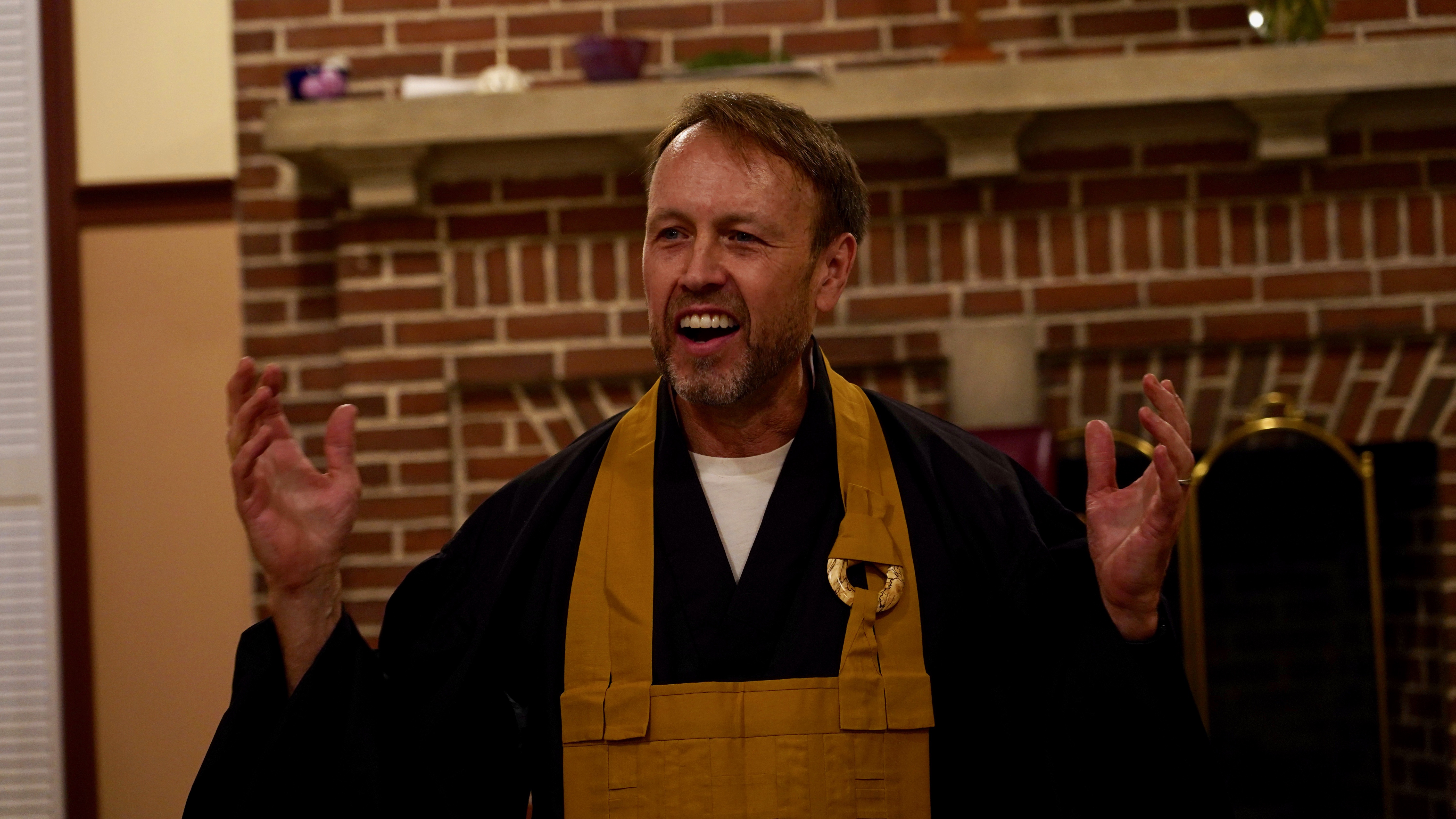
Not Entering Nirvana

I gave this teisho Thursday night during our Full Moon Zen regular weekly practice session.  You’ll find a recording of this talk after the text.

In the Mahāprajñā Sutra Preached by Mañjuśrī, it says, “Virtuous practitioners do not enter nirvana; precept-breaking monks do not fall into hell.”

Case 24, Shūmon Kattōshū (Entangling Vines)

Last week we chanted a variation of the Sixteen Boddhisattva Precepts:

  • The Three Treasures:  Buddha, Dharma, and Sangha;
  • The three Pure Precepts:  ceasing from (or not creating) evil, doing good, and saving all beings (or working for the wellbeing of the whole); and
  • The Ten Grave Precepts:  not killing, not stealing, not misusing sex, not speaking falsely, etc.

These precepts—and particularly the Ten Grave Precepts—are Zen’s much abbreviated set of the traditional vows Theravada Buddhist monks throughout South East Asia have made for thousands of years.  They were formulated by Eihei Dōgen, the 13th century master who brought what became the Sōtō Zen stream from China to Japan.

Theravada Buddhism, also called the Way of the Elders, represents the first wave of Buddhism.  These are the crimson and saffron robed monks we see in places like Myanmar, Sri Lanka, and Thailand.  As you know, the Zen tradition is part of a later turn called Mahayana Buddhism.  Fully-ordained Theravada monks make scores, if not hundreds, of vows.  Like Zen’s Ten Grave Precepts, most are expressed as prohibitions.  Don’t do this; don’t do that.  Most monks in a country like Myanmar relate to their vows this way.  

When I was in Myanmar in 2013, there were monks everywhere, begging for their daily meals, just like Gotama Buddha and his followers did.  I seldom had food with me, so I would offer a few dollars.  Young boys accompanying older monks would take the money.  These young boys were “monks,” too, but likely only living at the monastery for a year or so, as a right of passage.  Unlike the older monks, they had not yet taken the vow that prohibits touching money, which the older monks take quite literally.

In our cultural context, most of us can’t relate easily to this aspect of the life of a Theravada monk.  If you know an Orthodox Jew, you probably have a sense of what this way of life is like.  There are many norms one must observe throughout the day, week, and year.  

To be sure, most Theravada monks and Jews who observe the Halakha do not experience these norms primarily as burdens or constraints.  Quite to the contrary, they find their joy and freedom in them.  Yet, if you are a conventional Theravada monk, the injunction against killing means you almost certainly are vegetarian.  Individual monks have some freedom to vary from that group norm, but the norm is quite strong.  

For most of us in the West today, this way of life would indeed feel quite constraining—at first, anyway.  Many of us bristle at lists of traditional moral injunctions.  They run counter to the “live and let live” and “no judgment” zeitgeist in the cultural context many of us inhabit.

What about the Zen Precepts?  Zen practitioners have the opportunity to make these vows formally, in a process and ceremony called Jukai.  For the most part, these are the same vows Zen priests make.  What does the Zen tradition have to say about them?  

Well, the koan with which I began should give you a hint that Zen’s orientation is a bit different:  ““Virtuous practitioners do not enter nirvana; precept-breaking monks do not fall into hell.”

In Zen, we actually approach the precepts from three different perspectives.  One is the perspective we just noted with reference to Theravada Buddhism and Orthodox Judaism.  It’s sometimes called the literal, or fundamental, perspective.  From this perspective, don’t kill means don’t kill.

The fundamental perspective is important for progressive people living in a contemporary (non-traditional) cultural milieu, like ours, to take seriously.  In these circles, hard norms are often regarded as naïve or backwards.  But we should wrestle seriously with the precepts from this perspective—to consider the merits of honoring a literal prohibition against particular conduct.  If I eat meat, and if I really reflect on the consequences of that—not just for my own health, but for other beings and the planet—I may see the logic and appeal of a plant-based diet in a new way.

And, yet, we are almost guaranteed to violate the precepts in their literal sense.  This sometimes happens because of human foibles and fallibility.  “To err is to be human,” as they say.  We can commit to honoring the precepts literally, and wholeheartedly try, but chances are we occasionally will act selfishly or speak unkindly of another person, despite that expressed commitment.  When we cause injury, we can acknowledge it, try to repair, and seek forgiveness—ideally, immediately and sincerely, without excuse, equivocation, or defensiveness.

But sometimes we break a precept in its literal sense because a situation puts two worthy ideals in tension, and we cannot literally conform to one without violating another, or without violating the same precept in a different way.  I was vegan during two long periods of my life.  Most of my friends knew this, so would prepare a meal without animal products when I came to visit.  From time to time, however, I was a guest of someone who did not know how I ate.  When I was offered a meal with animal products—even meat—I chose to eat it, without saying a word about how I normally ate.  The animal had already perished.  Refusing a meal offered so generously would kill something else, I felt:  joy.

This is the second perspective:  the relational perspective.  This is “situational ethics,” not as a way to avoid a prohibition, but because we must always be mindful of context, or what Zen-types call the Four Considerations:  time, place, people, and amount (or degree).  The animal has died, and there is no rewind button that will change that (time); I am in the home (place) of a new acquaintance (people) who eats meat; and refusing even a small portion (amount) of what I am being served is likely to create more suffering than sharing in the meal.  Perhaps I’ll even have a chance to discuss my eating practices with this person at a later time, and perhaps she will be more open to my perspective, because she can see I’m not an idealogue.  Reasonable minds can differ here; there’s no clear “right” or “wrong” from this perspective.  The goal is to be compassionate and reverent, and to achieve those two objectives in some skillful way in the moment.

The koan with which I opened captures the third perspective from which we approach the Zen precepts.  These first two perspectives, the fundamental and the relational, are staple items in Western moral philosophy.  The third perspective—known as the intrinsic or unified perspective—is not a common feature of Western thought.  From the intrinsic perspective, there can be no killing, because there is no birth and death; there can be no stealing, because there is nothing to be stolen and no one to steal it; and so on.

This is Oneness; nonduality.  Even words like “One” and “nondual” fail to express it—as concepts, anyway—because all concepts divide.  This is Buddha nature.  The ground that is no ground.  From the intrinsic perspective, it’s impossible to violate the precepts.  There is no good and bad.  No judgment, really: not as a left-leaning meme.  Ultimately, as the Absolute.  

But here’s the thing:  the relative and the Absolute are one.  The fundamental and relational perspectives are themselves expressions of the ultimate, and they matter very much.  In Zen, we embrace and practice the precepts from all three of these perspectives.  We know that we can’t fall out of nirvana, because we are it, and yet this insight doesn’t grant us a free pass.  We express and honor our own and others’ Buddha nature by doing our best to do the right thing from a fundamental and/or relational perspective.

Just as we can’t fall out of nirvana, we can’t enter it, either:  We do our best to do the right thing, but we can’t gloat, or congratulate ourselves too much, or be too sure.  We don’t accumulate merit—or brownie points, or rewards in heaven—as we do our best to do our best.

Bernie Glassman—who was the teacher of my teacher’s teacher—gave a wonderful talk about the precepts over 40 years ago, which I recently read.  He said, “in studying the Sixteen Precepts, essentially we’re studying sixteen different ways of appreciating Buddha, appreciating the fact that we are buddha.  It always boils down to just seeing [this] one fact itself.”

We practice Zen to realize that we are Buddha; to realize oneself and all else as Buddha.  As this realization dawns and deepens, our actions tend to accord more and more with the spirit of the precepts; with Buddha nature as it manifests ceaselessly throughout the universe.  

With that thought in mind, let me end by reading the single footnote appended to this koan in Entangled Vines, the collection in which it appears:

The Japanese Zen master Hakuin once commented on this koan with the following verse:

Silent ants pull at a dragonfly’s wing; 

Young swallows rest side by side on a willow branch.

Silk-growers’ wives, pale in face, carry their baskets;

Village children with pilfered bamboo shoots crawl through a fence.

After hearing this verse, two monks who had completed their training under the great Zen master Kogetsu Zenzai decided to train again under Hakuin.
Not Entering Nirvana

The Ox Doesn’t Know

I gave this teisho Thursday night during our Full Moon Zen regular weekly practice session.  You’ll find a recording of this talk after the text.

One day, when the Layman and Sung-shan were out for a walk, they saw an ox plowing the fields.  The Layman pointed to the ox and said, “He’s having the time of his life, but he doesn’t know anything about it.”

 Sung-shan said, “That is, unless Mr. P’ang wants to bring the issue to his attention.”

 The Layman said, “My master always said he never knew what he was doing.”

 Sung-shan said, “Since I never saw Shih-t’ou, it would be better if I didn’t say anything about it.”

 The Layman said, “What would you have to say after you’d seen him?”

 Sung-shan clapped his hands three times.

(Case 29, The Sayings of Layman P’ang)


Layman P’ang is an especially wonderful, enigmatic character in the history of Zen, which is a tradition that has more than its fair share of wonderful, enigmatic characters.

He was born around 740 CE and died in 808, so he lived during the Tang Dynasty.  Many consider this the high point of ancient Chinese civilization.

P’ang lived in Hengyang, in Hunan Province of Southern China.  It was a big city then, as it is now.  It would be about a five hour drive due north from Hong Kong today.  P’ang’s father was a government official, and perhaps even the governor of the area, so P’ang was well-to-do.  We know he owned a house with enough land to have a gatehouse where he and others in the area met to meditate.

All Zen teachers today are successors of one of two masters from that time and place, Shih-t’ou and Ma-tsu.  Each had monasteries on mountains outside Hengyang.  The two great streams of Zen that still flow today originate with these teachers: the Soto School from Shih-t’ou, and the Rinzai School from Ma-tsu.  This period was not just a high point in Chinese culture; it was a watershed moment in the development of the Zen tradition.

P’ang engaged deeply with both of these masters, which must have been truly extraordinary for anyone at the time.  P’ang first met Shih-t’ou, and then lived at Ma-tsu’s monastery for a while, working closely with him.  Ma-tsu ultimately made P’ang a teacher, but P’ang never became a monk, like at least one of his childhood friends we meet in these stories.

Throughout most of the history of the Zen tradition—throughout most of the history of all Buddhist traditions—the terms “monk” and “priest” were basically synonyms.  There weren’t monks in monasteries and priests in the world, as there are today in many religious traditions.  Being on the Zen path at that time, and even today in much of Asia, meant becoming a monk—an ordained person living in a monastery.

But here we have P’ang, student of two great teachers, Dharma heir of one of them, living in the world.  P’ang and his wife, son and daughter, are said to have sunk all their personal possessions in a boat in the middle of a lake, donated their house to be made into a temple, and lived as wanderers from then on, supporting themselves by making and selling baskets.

The short stories in this book are mostly about P’ang’s encounters with the ordained (monastic) teachers of his era.  In most of these stories, P’ang engages in playful games of spiritual one-upmanship with these teachers—predictably, coming out on top.  Taking the piss out of them, as the Brits say, while seeing more deeply into the Great Matter than they do.

This little book is a classic—widely read in and beyond China for centuries.  What a fascinating figure  P’ang was; a truly extraordinary, ordinary person.  He certainly foreshadowed what’s happening today in the West, where there are few monasteries, and lay teachers are on a trajectory to outnumber teachers who are ordained, if we don’t already.

What are we to make of this curious Zen adept—the only lay teacher in recorded Zen history for nearly 12 centuries—and this story about the ox who doesn’t know?

Sung-shan, P’ang’s companion in this story, was a disciple of Ma-tsu.  Out on a walk, P’ang decides to have a little wise fun, in the playful jousting mode that’s so typical of anecdotes about encounters with Zen teachers.

P’ang points to the ox and says, “He’s having the time of his life, but he doesn’t know anything about it.”  It might seem at first blush like P’ang is being sarcastic.  “Look at that dumb ox.  He can’t reflect on his experience, like we can.”  But P’ang is paying the ox a high compliment, comparing it favorably to most humans, not looking down on it.

The ox is just doing its thing—oxing—living its life, undisturbed by the fact that he doesn’t know anything about it.  He undoubtedly knows that his life is, but he presumably doesn’t know what or why his life is.  And this doesn’t detract from his plowing.

One of the many Zen tidbits that has entered pop culture, the phrase “chop wood, carry water,” comes from Layman P’ang.   “Chopping wood, chop wood,” he’s saying.  “Carrying water, carry water.”

My carrying water is the universe carrying water.  My mental chatter—complaining about my sore arms, wondering why this is my lot in life, or contemplating how the Big Bang led to H2O—doesn’t add anything to, or subtract anything from, carrying water.  It’s just the universe chattering as the universe carries a bucket full of itself.

To be clear, if there’s a conversation that needs to be had about the equitable division of labor in your household or community, by all means, have it.  When you do, that’s the universe having a conversation the universe needs to have.  If your ambition or calling is something other than carrying water, pursue it.  And study physics, by all means; it’s a wonderful and wonderous lens on all this, and immensely useful.  But let’s not kid ourselves: Even if scientists find their Holy Grail—a grand unified theory of physics; a theory of everything—it will still be a theory, a description, and not the thing itself.

The price of our marvelous, human capacity for self-reflection seems to be a sort of cosmic forgetfulness.  It’s as if we’ve wandered so far toward the edge of the universe that we’ve forgotten the universe has no edges.  Wherever we wander, we can’t help but remain one of its infinite centers.   There’s no getting lost in this universe, even when we feel lost.

We practice Zen to find ourselves at the center of the universe again—and everyone and everything else there with us, as center, too.

Paradoxical as it sounds, and as much as I hate to use the word “goal” when talking about Zen practice, the ox’s not knowing is the goal of our practice.  The goal is no goal.  We normally think of goals as something we achieve and possess for ourselves.  Something we once lacked and have now obtained.

In Zen, our goal is the opposite of that.  We already have what we’re looking for.  We are it.  Unlike the ox, however, we think there must be more to it.  Something I must know about my life.  Not so, yet there is something I must realize and experience as my life.

Sung-shan jovially invites P’ang to inform the ox that he’s having the time of his life.

P’ang declines.  “My master always said he never knew what he was doing,” P’ang replies.  My master also doesn’t know anything about all this, just like the ox.

“I haven’t met him,” Sung-Shan says, “so I wouldn’t know.”

“Even if you had,” P’ang replies, “what more would there be to say?”

In texts like this one, and a talk like mine now, guides on the Zen path are trying to express the inexpressible.  Or, to say the same thing a bit differently, we’re heaping extra words on what the universe is saying right here, now.

It’s impossible to talk about it . . . and this talk is it, too.  It’s all right here, right in front of our noses. Your nose is it.

Even as we are it, however, most of us are searching for it.  We want an “it” we can sum up, and so contain, as an object of thought.  Having developed this wonderfully useful capacity for discursive cognition, we’ve become transfixed by it.  We search for answers to the heart’s deepest questions in the hall of mirrors it creates.

But those answers lie outside that box.  Outside the realm of this-that thinking.  In fact, the box we’re trapped in is itself contained in the realm “outside.”  We just think we’re trapped!

I, Jeff (this), sees the moon (that).  Zen practice—especially meditation and working with koans—relaxes the grip of this-that thinking, so the moon can reveal itself to you as you.  We can’t will this realization—this revelation—but we can open ourselves to it.  The moon tends to reveal itself fully in hearts that are wide open, and Zen practice is about opening hearts.

The ox and P’ang’s master both are the full moon.  One is not “more” moon than the other.  I do know, however, that we humans can know ourselves as manifestations of, and participants, in this awesome, incomprehensible, inescapable, luminous mystery that is . . . what?   Mystery.  Mystery manifest.  This.

These little stories about this lay sage are thought to presage the koan tradition that eventually developed in Zen.  I wonder whether this particular story about P’ang might also presage another wonderful part of the Zen tradition, The Ten Oxherding Pictures, which is one account of the spiritual journey.  As portrayed in the Oxherding Pictures, the apex of Zen practice isn’t the moment of sudden illumination, when we see our true nature.

The apex is returning to the marketplace with open hands—to daily life in the world—with that awareness; animated by that awareness, but not thinking it makes us special, because now we see the full moon everywhere, and in everyone we meet.  The tenth picture is Putai, the Laughing Buddha, entering the open market—an open heart, extending open hands.

We tend to think of the renunciates in monasteries or on mountaintops as the spiritual paragons.  Layman P’ang, and the old fool in the marketplace, point to a different ideal—of awakening in the world, in the midst of the everyday sorts of lives lived by people like us.  This is a fitting image and ideal for our time, I believe.

The sort of knowing we seek and cultivate through Zen practice is an awakened, vital, experiential, in-your-bones not knowing.  “Not knowing is the most intimate,” Master Dizang famously said.

May you not know.

And may we, like the ox, have the time of our lives.


On Chanting: Old and new, familiar and strange, known and unknown

I gave this teisho tonight at our Full Moon Zen regular weekly practice session.  You’ll find a recording of this talk after the text.


Vast is the robe of liberation,

A formless field of benefaction!

I wear the Tathāgatha’s teaching

Saving all sentient beings.

This chant is called the Verse of the Kesa. Kesa is the Japanese version of the Sanskrit word kāshāya, which means robe. Zen adepts through the centuries have chanted this verse each morning, whether individually or collectively, as they put on their robes before meditation. They balance them on their heads and let them drop into their hands near the end, just as I did now.

I do this every day before I sit. This rakusu I wear, which is ochre to signify that I’m a teacher, is a simplified version of the longer and more formal patched robe worn over the shoulder by a Buddhist monk or nun. I didn’t sew this one, but years ago I sewed the traditional black rakusu worn by a student after their Jukai ceremony, in which one formally receives and takes on the Buddhist precepts as a way of life.

Eihei Dōgen, who carried the Zen tradition from China to Japan early in the 13th century, was moved to tears the first time he heard this chant and observed this practice while on retreat at a monastery in China.  He made a vow to himself at that moment:

However unsuited I may be, I will become an authentic holder of the buddha dharma . . . and with compassion show the buddha ancestors’ authentically transmitted dharma robes to those in my land.

Dōgen ultimately returned to Japan and fulfilled that vow.  Not only did he carry traditional Zen forms and practices from China to Japan—many of which you and I still uphold today—he also became a great religious innovator.  Whenever Zen migrates from one land to another, form one cultural context to another, new life is breathed into the tradition, just as the tradition breathes new life into that land and context.  This is happening now in the United States, and throughout the Western world, in these still relatively early days of Zen’s migration here.

Like Dōgen, I love this chant and practice. Well, most of it, anyway.

Vast is the robe of liberation,

A formless field of benefaction!

When I chant these words each morning, I remind myself that this is the garment I wear; the robe that envelops me, everywhere and always. This robe is a borderless, seamless field of benefaction—of goodness. At once, vast and mysterious and as concrete and visible as my tee shirt.

You and I also are that vastness and mystery, made concrete and visible. Each morning when I chant these words, I remind myself of this. Each day, if I consent and commit the way Dōgen did, I live more deeply and concretely into the mystery, and the mystery lives more deeply and concretely into me.

My life becomes more and more like that old Zen story about the monk walking through the mist.  When he leaves the meditation hall, his robe is dry.  At some point, it’s soaked through and through.  When is that point exactly?  Who really knows.  Just walk the path, and it’s happening.

I wear the Tathāgatha’s teaching

Tathātaga is a Sanskrit word the Indian sage Siddhartha Gotama, aka The Buddha, used to refer to himself.  It means “one who is thus gone” or “one who has thus come,” suggesting that he had seen into his true nature, beyond all dualities of coming and going, living and dying.  When I chant these words, I remind myself of my own buddha nature.  I also situate myself in the ancient, evolving Zen tradition.

To be honest, I don’t much like the last line in this particular translation of the chant:

Saving all sentient beings.

To my ears, this smacks of a sort of dualistic exclusivism or fundamentalism and of missionary zeal. On one reading of this line, and others like it in other Zen chants and verses, one is either saved or not, and it’s our job to save others once we’ve saved ourselves. Sure, there are more nuanced and contemporary ways this line can be spun; even so, it still grates on me a bit.

Salvation here means awakening; seeing our true nature.  This commitment to save other beings actually is viewed within the Mahayana strain of Buddhism, from which Zen sprouted, as an advance over the goal in the prior, and oldest strain of Buddhism, called Hinayana, where the focus was on personal salvation.  The Boddhisattva ideal arises with this new commitment.  A Boddhisattva vows not to transcend this realm of suffering until all sentient beings do so.

But what is a sentient being exactly?  Only humans, or also animal life?  What about plant life, and even seemingly inanimate things?  What about the biosphere and the universe as a whole?

What would it mean for a plant, or our whole biosphere, to wake up; to be saved?  Perhaps, especially now, waking up, salvation, must be as much a collective endeavor and experience as a personal one.  Perhaps it’s less about striving to escape one’s personal suffering and more about compassionately embracing our own and others’ creatureliness, and making this one life—yours and mine and the goldfish’s—as good and right as it can be.

There’s another traditional translation of the last line of the Verse of the Kesa that I like a bit better.  Rather than “saving all sentient beings,” it’s simply “to awaken countless beings.”

But maybe we need a new last line for this era, in this land and context.  As I was reading the David Loy book, A New Buddhist Path, that I quoted from in my last talk, a phrase that seems like a good candidate last line leapt off a page:

Working for the wellbeing of the whole.

I rather like it:

Vast is the robe of liberation,

A formless field of benefaction!

I wear the Tathāgatha’s teaching

Working for the wellbeing of the whole.

Zen master Keizan urges us not to “just long for the past,” but to “avail oneself of the present day to practice Zen.”  These words are so contemporary, yet Keizan lived over 700 years ago.  He studied and became a teacher at the great monastery Dōgen founded when he returned to Japan from China.  Keizan ultimately left it to make Zen more accessible and relevant to ordinary people like you and me, including women—which, sadly, was a rather radical proposition at that time.

I assembled a very bare bones chant book as we launched this small, informal group a short while ago.  Some people today find the traditional Zen chants and verses, many of which are still recited in the West in Pali, Sanskrit or Japanese, odd and off-putting.  Others, love and are very moved by chanting.  Our chants and verses are a rich part of the tradition.  I’ll progressively be adding more of them to our chant book and liturgy. 

As I do, I plan to revisit the traditional formulations of some them, perhaps taking liberties here and there; updating some of those formulations, mindful of Keizan’s encouragement.  I want to be careful and respectful as I do, however.  We are recipients and stewards of an ancient tradition that has served countless beings very well.  These beings developed these chants for us.  These chants are recognizable to people all over the world, much like a Catholic can attend mass anywhere and feel it’s familiar, even if she doesn’t speak the local language.  There’s something really beautiful and awe inspiring about this.

Our chants take many different forms and seem to have many different functions.  Invocations.  Thanksgiving.  Atonement.  Remembrance.  Dedication.  Honoring our ancestors in The Way.  Marking the opening or the close of a meal or a teacher’s talk.  Expressing our aspirations.  Though Zen is nontheistic, some chants bear a resemblance to petitionary prayer in theistic traditions, as in the version of the dedication chant we used tonight:

Whenever these devoted invocations are sent forth they are perceived and subtly answered.

Some chants, called dharanis, are incantations that are thought to bring good fortune, to help avert calamity, or whatever.  Most have their roots in the Vedic scriptures of Hinduism.  We can think of them as mantras.  Most have not been translated into English, in part because that would be difficult or impossible to do.  The literal meaning of the words is obscure, and their literal meaning is not really the point.  Our intention, in our hearts, and the experience of chanting them is the point.

Here’s one common dharani:

No mo san man da moto nan

oha ra chi koto sha sono nan

to ji to en gya gya gya ki gya ki un nun

shifu ra shifu ra hara shifu ra hara shifu ra

chishu sa chishu sa chishu ri chishu ri

soha ja soha ja sen chi gya

shiri ei somo ko

Whatever your present orientation to our chants, I encourage you to let them chant you. I’ll be chanting them in the traditional way, so just follow along. You’ll get the hang of it. Don’t let fear of making mistakes hinder you. In Zen, there is no such thing as a mistake, and everything is a mistake.

Why do we chant?  Why do we play bells and drums and wooden blocks?  Why do we balance our robes on our heads and let them fall to our hands?

In a famous koan, the great teacher Yunmen said, “The world is vast and wide.  For what reason do you put on your seven-piece robe at the sound of the bell?”

Today Yunmen might ask instead, “For what reason do you pull your jeans on in the morning?”

The answer for each of us is lurking in the question.

Perhaps you will also chant the Verse of the Kesa as you put on your robe—even if that means your sweatpants and hoodie—in the morning. If that seems like too much, perhaps you might at least call to mind and heart the spirit of this verse as you dress for the day. Maybe some of you will decide to sew your own rakusu and take up the Boddhisattva precepts one day. I’d be more than happy to support anyone who wishes to do that; to help you make it happen.

Great Faith, Great Doubt, Great Determination: On Mu

This is a teisho I gave on June 7, 2020.

A monk asked Chao-chou, “Has the dog Buddha nature or not?”

Chao-chou said, “Mu.”

Mumonkan, Case 1

Chao-chou’s Dog, or Mu, is Zen’s most famous koan.  It’s the first koan a student normally receives; the first koan in The Gateless Gate, which is the first collection of koans one normally encounters.  In fact, Mu is said to be the first koan given to Wumen himself, the 13th century Rinzai Zen master who compiled the whole collection.

Even if the monk in this koan was a relatively new student of The Way at the time he asked Chao-chou his question about the Temple dog, he already would have known the doctrinal answer to his question; the correct conceptual response.  Yes, of course, the dog has Buddha nature.

Wumen is said to have sat with this koan—sat with Mu—for six years before penetrating it.  Even today, older teachers I know tell me about students who have sat with this koan even longer.

The monk in this story isn’t really asking about the dog, of course.  He’s asking about himself.  He’s asking, “Do I have Buddha nature?”

Why?  Why did this monk ask a question to which he already had an answer?  Why did Chao-chou answer “Mu,” which means “no”?  Why did Wumen himself, and countless students after him, labor over this koan for years before passing through it?

It’s simple.  The monk in the koan, and Wumen, and these many students of The Way realized at this point in their journeys that, although they “got it” conceptually, they still didn’t really get it.  They could recite the canonical answer, but it didn’t satisfy.  They knew, or at least could sense, that cognitive knowing—belief in a proposition—wasn’t really knowing.

They doubted what they supposedly knew.

This admission may seem like a sort of undoing; like the opposite of progress.  In truth, it’s a huge step in right direction.  This doubt is an opening.

Another 13th century Rinzai master (Gaofeng Yuanmiao) famously said that the “three essentials” of Zen practice are great faith, great doubt, and great fury.  Great fury often gets translated in a watered down way, as “great determination,” but I like great fury much better.

Depending upon who and where one is at this particular moment, maybe an existential question like “Do I have Buhha nature?” doesn’t have much urgency.  In this part of the world, many of us live quite comfortable lives—a fact that is all the more apparent during this triple public health, economic, and racial justice crisis.  Maybe you’re not very concerned about whether you have Buddha nature or not, let alone with whether you’ll ever realize it.  But, you’re here, and I assume you’re not here for the coffee social following the service.  Zen isn’t particularly known for that.  Maybe you’re just becoming a bit more curious about why other people seem concerned with these questions, and why you don’t.  What am I missing as I think nothing is missing?

Most of us are lost in our narratives much of the time; lost in inner chatter that we mistake as reality, but which is really just a thin veneer that separates us from the deeper reality of our lives, of who we are. Zen bids us to penetrate this veneer.

If we begin to notice our everyday condition, even just a bit: that’s a speck of doubt; a nascent question.  Even if our questions begin tepidly, skeptically, perhaps even arrogantly— more as an expression of self-satisfied, or blasé knowing, rather than genuine, humble curiosity and not knowing—great doubt is bound to blossom eventually, if we sit with that speck of doubt long enough.  Early in Zen practice—and “early” may mean years and years—our job is just to sit with our doubt.  To welcome it.

Great faith simply means developing unwavering trust in our own experience.  Not to separate from our experience.  Particularly our questions.  Our doubt.  Our not knowing.

We need to abide with the doubt.  Let it grow.

Our impulse is just the opposite.  We usually rush to fill in the blanks.  To fill in our not knowing with pseudo-knowing.  We must resist that impulse with great determination.  Great fury!

Your determination may start as an act of will, but great determination ultimately is not an act of will.  It’s a force of nature that overtakes you.

Many people these days come to Zen practice seeking stress or anxiety reduction, or mindfulness-as-self-improvement, or self-mastery.  Our practice may deliver these things, but it offers so much more.  The mind and heart that seeks these things is not the mind and heart of a genuine—or at least not a mature—student of The Way.

In his commentary on Mu, Robert Aitken, the contemporary teacher who produced the translation of The Gateless Gate I prefer, quotes his own teacher, Yamada Kōun Roshi, who said:

“Make your whole body a mass of doubt, and with your three hundred and sixty bones and joints and your eighty-four thousand hair follicles concentrate on this one word `Mu.’”

What is Mu?  Yamada Roshi and Aitken continue:

“Don’t consider it to be nothingness.  Don’t think in terms of `has’ or `has not.’”  Mu is not nothingness or somethingness.  Fixed notions of “nothing” bar you from true intimacy. . . . “Has” and “has not,” like self and other, arise with the concept of human skin as some kind of armor.  Actually, your skin is as porous as the universe.

What is it to sit with Mu, to become intimate with Mu?  Yamada Roshi and Aitkin answer:

“It is like swallowing a red-hot iron ball.  You try to vomit it out, but can’t.”  Sitting there, big with Mu, letting Mu breath Mu, you are completely caught up in your zazen.  This is the red-hot iron ball you can neither swallow nor spit out.

That is Great Doubt!  Great faith in one’s experience!  That is practicing with Great Fury!

The mind and heart of a genuine student of The Way will not settle for less than the whole shebang.  Zen practice is not about seeking bigger and better ideas about myself, my life, or the universe.  It’s not about becoming a shinier, or more perfect, or more masterful self.  A calmer or less anxious self.  These are just ways to continue seeking safety in stories about ourselves and the universe.  To thicken our armor.  To separate from our experience, to avoid life, rather than stepping into the vastness.  Into the void.  Without a rope.

The word religion is thought to come from the Latin, religare, “to bind,” as with a rope.  To secure ourselves.

This is Zen’s great jest.  It playfully declares that the truth is just the opposite; that true security comes from discovering we’re cosmically untethered.  Zen coaxes us toward the realization that there is no rope, and no post to which we could bind ourselves.

Not even a ripcord to pull.

Withholding.  Protecting.  Grasping.  These are the behaviors that get us into trouble, time and again. That prevent all possibility of genuine intimacy with the world, with others, and with oneself.

Seeking bigger and better versions of myself, my life, or the universe; striving to become a shinier, more perfect, more masterful, calmer, less anxious or more secure self.  These are just ways the ego—that blank-filling part of oneself—tries to find a way to be present at its own funeral, as the Tibetan crazy wisdom teacher, Chogyam Trungpa, was fond of saying.

Trungpa Rinpoche also said something very quotable about stepping into the void:  Giving yourself completely to your practice is like jumping out of an airplane without a parachute.  It’s terrifying, of course.  But we already know the bad news:  We have no parachute.  When we truly give in to our practice, when we truly let go of our impulse to know, and all the subtle ways it continues to try to contain us, we discover the good news:  Although we have no parachute, there is no ground.

To practice with Great Faith, Great Doubt and Great Determination, to really sit with Mu, is to let whatever doubt you now experience about who and what you are and how you’re approaching life—whether that doubt is a mountain or a micron—snowball.  That doubt might start as a single snowflake.  Maybe there’s not yet much energy behind you’re not knowing.  Fine, sit with that.  Whatever hint of curiosity and doubt brought you to Zen practice, whatever keeps you on the cushion:  Stay with that.

Sitting with that genuinely, resisting the impulse to pivot away from doubt, to fill in blanks:  Well, that snowflake of doubt tends to build into a snowball of Great Doubt.  Stay with your experience and see where it leads you.

The not knowing with which we begin is not ultimately replaced by the sort of knowing we expect to find.  Great determination won’t lead you to more satisfying cognitive answers to whatever questions you once had.  Doubt won’t be replaced with tidy answers; it will be transformed and transfigured.  You will discover what Master Dizang meant when he said “not knowing is most intimate.”

In Zen’s Ten Oxherding Pictures, the Ox is a metaphor for Buddha nature; the true source.  A Buddha is simply one who is awakened to this source, and who knows oneself as a manifestation of this source.

The eighth Oxherding picture, which is the crescendo moment in (though not exactly the apex of) spiritual practice, is titled “Forget Both Self and Ox.”  This is the verse that accompanies it:

Whip and line and you and the ox, all gone to emptiness,

Into a blue sky for words too vast.

Can a snowflake survive the fire of a flamepit?

Attain this, truly be one with the masters of the past.

Wise old Chao-chou forces the monk in this koan to sit with his question.  “Does the dog have Buddha nature?” the monk asks.  “Who, or what, is asking?” Chao-chou responds.

Can a snowflake survive the fire of a flamepit?

Can you become a red-hot snowball of doubt?

Muuuuuuuuuuuuuuuuuu!

Wash Your Bowl — Denbo Ceremony Teisho

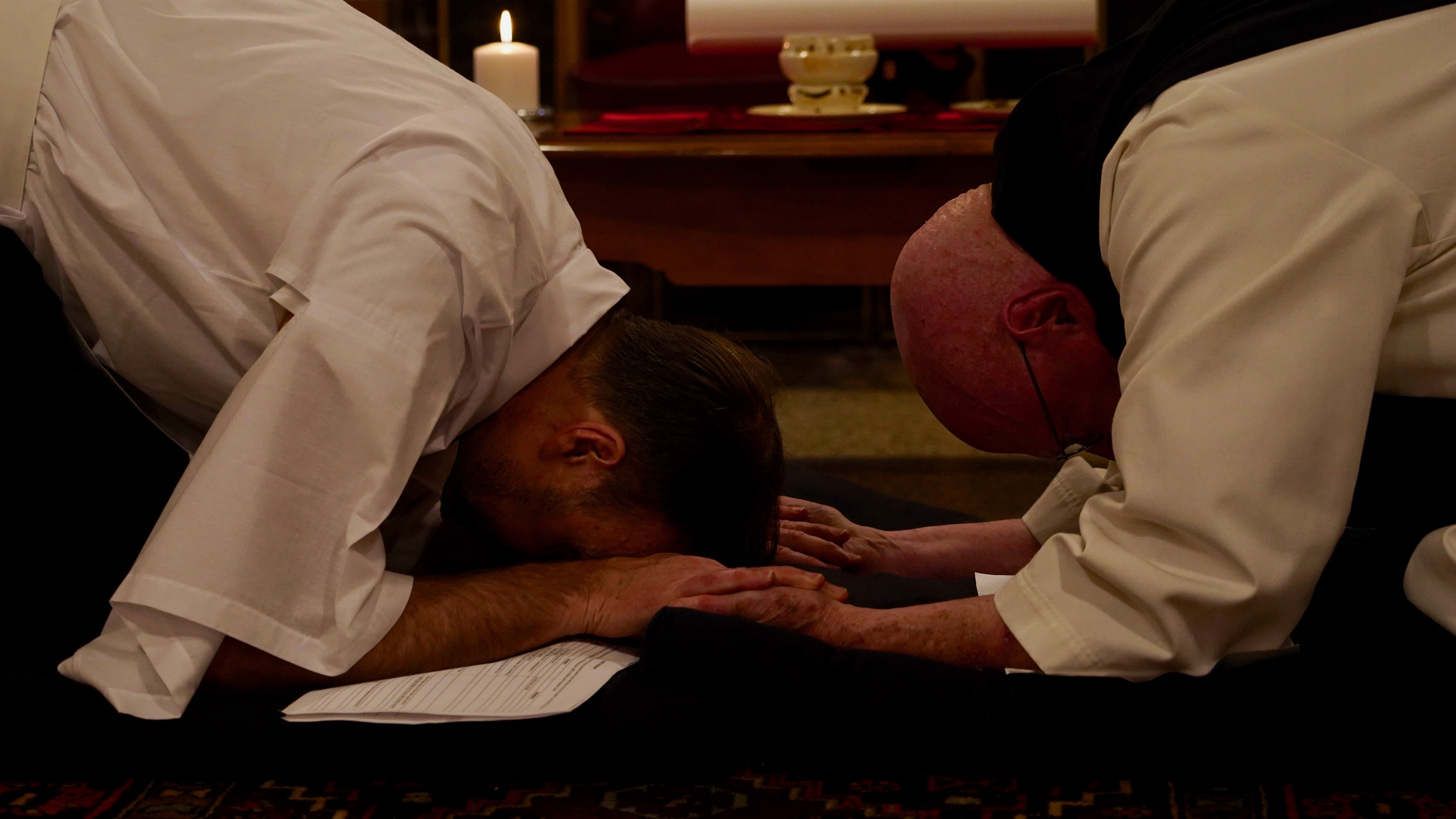
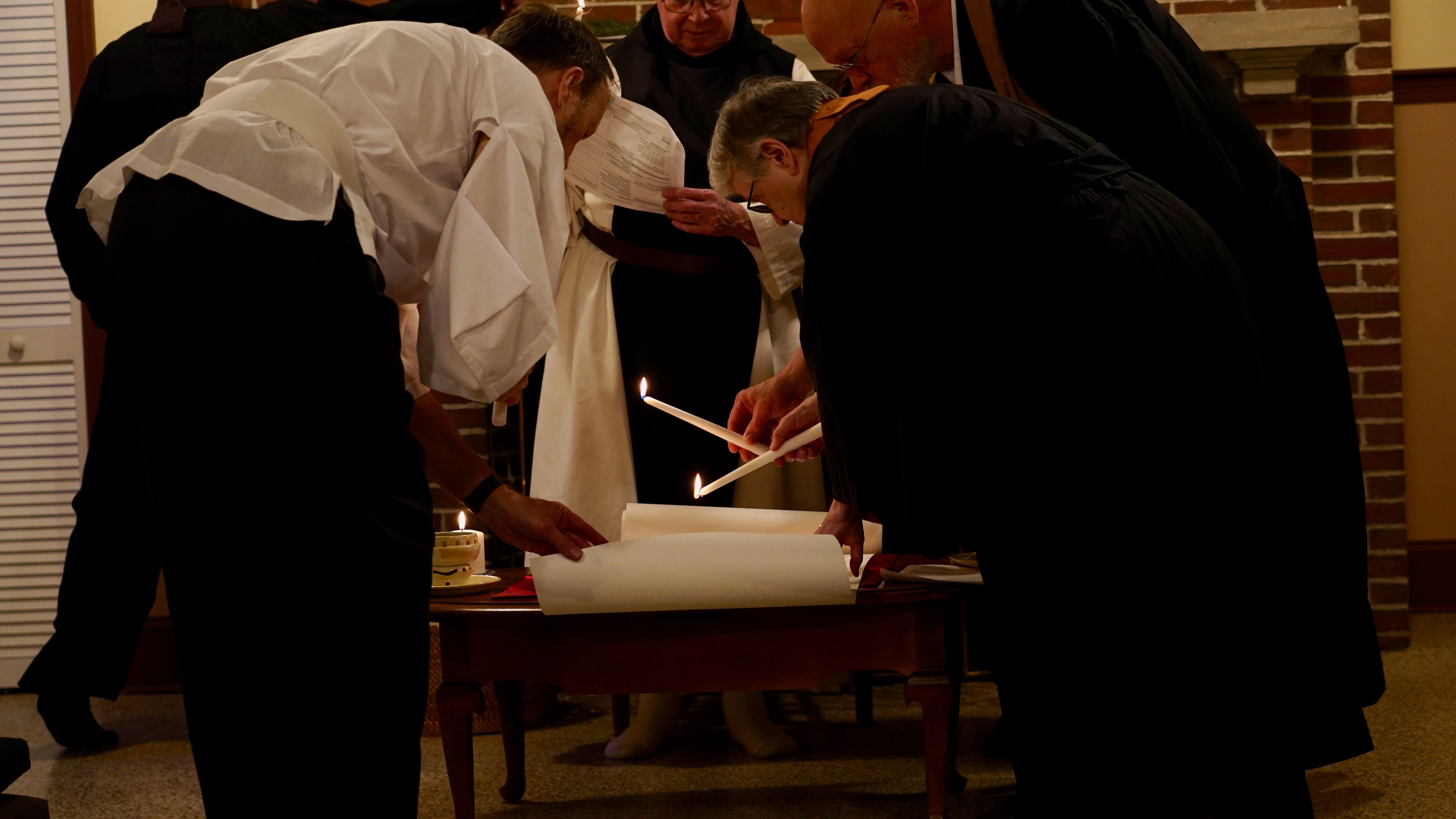
This is the talk I gave after my Denbo ceremony, in which I received Dharma transmission from my Zen teacher, Kevin Jiun Hunt, O.S.C.O., Roshi, and so became a Zen teacher myself.  I’ve also posted a few pictures.  The ceremony occurred on Saturday, November 10, 2018.  It was very traditional, except that it occurred at 2:00 p.m. and was attended by friends and family.  For reasons that are long outdated, these ceremonies have, for centuries, typically occurred privately, between teacher and student, at midnight.  A number of Zen streams in the West, including ours, recently have begun to open them, and to hold them at a much more agreeable time of day.  I’ve been given the Dharma name Kōgen, which means Light Source.

Gratitude is the first thing I want to express today.

Some time ago, I went looking for a new Zen teacher.  I couldn’t believe it when I found a Trappist monk and Zen teacher, all rolled into one, just a couple of towns over from where we were living at the time.  As you’ll hear in a moment, the Trappists were on the scene early in my travels through contemplative spiritual circles over the past 30 years.  So I was really excited to discover Fr. Kevin.  I wrote him a long, detailed email telling him all about my journey.  And, at this point, Fr. Kevin gave me the first of the many great teachings I’ve received from him:  He completely ignored my email!  I re-sent it a few days later, just in case he had missed it.  (Hint: He hadn’t missed it.)  He ignored it again.  That was my first dose of your wise, spare, direct, “no fuss” approach to spiritual guidance and friendship.  You’ve known just what nudges I’ve needed.  And, since our very first meeting, I’ve come to see just how genuinely you see me – and, I must say, being seen genuinely by other human beings is one of the most profound gifts any of us can receive.  From the start, you’ve accepted me without pretext or pretense, and you’ve always gently insisted that I accept myself the same way.  Thank you.

I eventually forwarded my email to Cindy, whose email address I’d also found on the Zendo’s website.  She responded right away, and very helpfully, encouraging me to come sit with the group!  And I’m glad I did!  That was another tremendous gift and teaching.  I so appreciate and admire your incredible openness, the sense of warm welcome you create, and your determination to make Zen accessible.  You have opened the door to this Zendo to our whole family.  Esther began Zen practice here, and you’ve even welcomed our kids and our dogs.  Thank you.

Tim and Sr. Madeline, thank you for being here today.  It means the world to me.  Thank for your friendship and the many wonderful teachings you’ve offered all of us.

I also want to acknowledge five other important teachers here.  First, my friend and Harvard Divinity School colleague, Charlie Hallisey.  He is one of the principal scholars of Buddhism at Harvard Divinity School, where I have done some part-time teaching the past few years, and he is one of the leading scholars of Buddhism globally.  Charlie has brought with him four distinguished Buddhist monastics from Asia – Bangladesh, China, Sri Lanka, and Vietnam – who are fellows at Harvard this year.  So this is not just an interfaith ceremony; it is an ecumenical ceremony within the Buddhist world.  It’s an honor to have all of you with us today.  Thank you.

I want to thank our Charlie (Norton) for serving as attendant today, and for all you do around this place. You are a rock.

We’re going to share a bit of food after this ceremony, and the best dishes – the ones we didn’t pick up at Whole Foods – were made by our very own Kathleen Bellicchi, who quite literally is the best cook I’ve ever met.  Kathleen, you so evidently pour your heart into everything you make, and your foods opens our hearts.  Thank you.

I want to thank my family, of course, Esther, Ellis and Carys.  For many years now, you’ve given me leave to sit for 25 minutes at a time at home, or for an evening, or sometimes two, away during the week, or for a day, or a weekend, or a week or more when I’ve been on retreat.  Walking this path runs against the main currents of our culture – and yet you always have been fully supportive of my commitment to traveling it.  Thank you.  I love you.  And, Ellis and Carys, thanks for participating in the ceremony.  Good job!

I also want to acknowledge and thank my parents and my two brothers.  They are not here today, much as they wanted to be.  They have been interested in and supportive of my meditation practice from the very start.

Finally, I want to thank my friends, starting with the countless people I’ve had the good fortune to sit with all these years – both Zen and Christian Centering Prayer practitioners.  A handful of you are here today; many more are not.  I also want to acknowledge my close friends walking the contemplative path within other traditions, including Islam and Judaism.  I’ve been buoyed by the friendship of all of these fellow travelers.

Last, but not least, I’m grateful to my friends from different walks of life who have come to participate in this ceremony.  All the strands of my life feel woven together and of a piece at this point, and I want each of you to know you’re an important part of the whole.  Thank you.

__________

It’s traditional for a new teacher to give a talk, and I’m going to open this talk in one traditional way: with a koan.  For those of you who are less familiar with the Zen tradition, most koans are brief accounts of interactions between a teacher and a student, or between students, or between teachers, which have been recorded and bound together into collections that have been passed down to us through the centuries.  They’re sometimes used in a very distinctive way as a teaching tool when a student meets with a teacher, and they’re also often used to open a talk, like this one.

This is Case 7 in The Gateless Gate, which is one of those koan collections:


A monk said to Chao Chou, “I have just entered this monastery.  Please teach me.”

Chao Chou said, “Have you eaten your rice gruel?”

The monk said, “Yes, I have.”

Chao Chou said, “Wash your bowl.”

The monk understood.


I began meditating about 30 years ago, as I said earlier, in my mid-20s.  That was a very stressful time in my life, if also a good and exciting time in many ways.  I had just finished law school and begun my career in the intense legal profession at a firm in San Francisco.  (Several of my lawyer friends and colleagues are here today, including my first boss and mentor at that firm, Jeff Newman, who has remained a close friend ever since.  All of the lawyers here no doubt can remember the stressfulness of that transition from law student to lawyer.)  I also was living far away from my family for the first time.  And, most significantly, I was just beginning to touch, and open up to, and work through the pain and after-effects of witnessing a very close friend’s death in a mountain climbing accident 12 or 13 years earlier, when I was 15.

I signed up for a weekend introduction to meditation program at the Nyingma Institute, a Tibetan Buddhist monastery and study center in Berkeley.  I was Catholic, and I had studied with the Jesuits, but I was totally unaware at this time of the rich tradition of contemplative prayer practice, of silent prayer, within Christianity.

I definitely signed up and showed up for that first meditation experience seeking refuge, though I doubt I would have or could have expressed it quite that way then.  Life just seemed out of joint, and I was looking for a route to someplace better.

My sitting practice was irregular for the first year or two, but that weekend definitely started me on this path.  A couple of years later, I took a sabbatical year, which I spent in Berlin, Germany, as the wall was being dismantled.  There, I read my first Zen book, by D.T. Suzuki, the towering Japanese Zen teacher and scholar who did so much to transport Zen to the West in the first half of the 20th century.  In this book, Suzuki praises several medieval Christian mystics.  At the time, I found this really surprising, for two reasons.  First, a Zen teacher was pointing to Christianity, my birth tradition.  What’s up with that?  Second, though I’d studied some theology by then, I’d never heard of these people.  Who were they?

I started reading about them, and then reading what they’d written.  When I returned to the States, heading home to Colorado, I connected with the Trappists – specifically, the Centering Prayer movement a number of them had launched to bring contemplative prayer out of the monasteries and into the wider Christian world.  I sat in those circles for several years, while also sitting with Buddhists.  I moved to Boston about 25 years ago for more graduate work, and I eventually situated myself for many years in a different local Zen community.  Little did I know at any of these waypoints that I’d eventually experience the Trappist and Zen streams brought together in the likes of Fr. Kevin.

__________

In the early days of this journey, I had a burning question I would ask of any teacher or senior student who would listen:  When can I stop sitting?

I had many different ways of asking this question, like:

  • There will come a time when I don’t have to sit anymore, won’t there?
  • So-and-so (the teacher) really doesn’t need to sit anymore, does he?

In retrospect, my question was a lot like the one with which Master Dogen, who carried Zen from China to Japan in the 13th century, was preoccupied as a young monk.  His question was:  Why do we practice?  Or, to put it another way:  What’s the point of this?

Anyway, I mostly got rather polite replies contesting the premise of my question.  But, I persisted – and I’m sure I became ever more annoying to these good people from whom I was insisting upon receiving an answer they never were going to give me.

I’d been told many times that I was free to stop sitting whenever I wanted to.  But what I really wanted to know, of course, was that there was a pot of gold at the end of the rainbow – that better place I was seeking – and that I was going to find it.  Convinced I didn’t have them already, I wanted the Keys to the Kingdom.  I wanted to know The Secret.

One day I asked one of these people my stale question yet again – Can I stop sitting someday? – and this time she just rolled her eyes and said, in a tone I can only describe as a mix of exasperation and sarcasm, “Sure, like when you die.”  And then she walked away.  That was a tremendous gift.  I resolved then and there to shut up and just keep sitting.

__________

I’ve always loved the koan with which I opened this talk.  It’s so simple, short, and truly, truly sweet.  Some people who are new to Zen, or who just encounter it casually, and even some people who have been at it for some time, assume there’s something esoteric about Zen.  If that’s your assumption, you might be inclined to think Chao Chou is being cagey when the teaching he offers the young monk in this koan is to ask whether he’s eaten breakfast and then to tell him to wash his bowl.

But, it’s not so.

Zen has no secrets.  Or, you could say, it’s all an open secret.  Zen points to the open secret that is this very life.  My life.  Your life. Our life together.  For those of us who are seeking, the answer we seek is hidden in plain sight.  And, we find what we’re seeking simply – simply! – by opening ourselves completely, giving ourselves fully, to this vital mystery that’s as plain as the nose on one’s face.  That is the nose on my face; on your face.

The young monk in this koan comes looking for guidance and reassurance, just as I did years ago. There’s genuine integrity in our seeking; in our innate conviction that wholeness is the natural order of things.

And, in fact, the universe is whole, we are whole, even when things seem broken.  Even when we feel lost and broken, as I was feeling years ago.

And Chao Chou’s response, his guidance, really couldn’t have been more straightforward and helpful: Just attend to the here-and-now.

The impulse that makes one curious about meditation; the person who shows up at our door seeking spiritual or physical nourishment; the dirty bowl in the sink:  This is it.  What we seek is manifest, right here, right now.

I love the way this koan ends.  Many koans end with a student experiencing realization, but that’s almost always expressed much more dramatically, like “Suddenly, he experienced great satori [great enlightenment]!” or “Hearing this [what the teacher said, of course], he experienced great realization.”

I like this formulation much better.  “The monk understood.”  Whatever the monk understood, and however deeply – whether he experienced great satori, or simply knew it was time to shut up and just keep sitting – it was enough.  Always enough.

__________

Like Dogen in his early days, perhaps like the young monk in this koan, I used to think there must be some end to this, some final goal or destination, and once we reach it, practice ceases.

But our practice, our life, which is the universe’s life and practice, begins long before one becomes a Zen practitioner, and it continues whether or not we meditate.  It continues as our meditating or not meditating.

This path is completely open-ended, completely boundless.  A path without boundaries.

And, so, we are always, already home.

The fact that many of us don’t yet reliably believe this – or, rather, don’t yet reliably experience this – is the main reason a tradition like Zen and its practices exist in the first place. “Belief” in the way we typically use that word, in a cognitive sense, isn’t really what it’s about.  Belief in that sense eventually begins to feel arid and hollow; it just won’t do.  What we really seek is knowing in our bones, beyond belief.

It’s all just like the young monk’s bowl.  So concrete, so tangible, so present – and, yet, it cannot, it will not, be reduced to, or contained by, our ideas about it.  Turn that bowl round and round in your hands as you wash it.  Just like this life we live, this path we walk:  What is it exactly?  Where does it begin?  Where does it end?

__________

I’m excited to continue this journey in this new role, helping support others in their journeys as best I can, as others have supported me so generously for so long.  I’ll continue to need your support, of course, and I’ll welcome it.  I’m also excited about some of the things we see emerging as Zen becomes more firmly planted in the West, including its turn toward social and environmental justice concerns and its deep encounters with other traditions, both religious and secular.  I also look forward to doing my part to contribute to these developments.

Thank you. Thank you.

This is a recording of my talk, kindly provided by my Dharma brother Charlie Norton,

The accomplishing work of great peace


This lovely verse accompanies Case No. 5 in The Book of Serenity.  It was written by Taintong, the Chan master who provided the lovely reflections-in-verse to each of the cases in this particular koan collection.

The accomplishing work of great peace has no sign;

The family way of peasants is most pristine —

Only concerned with village songs and festival drinking,

How would they know of the virtues of Shun or the benevolence of Yao?


And this is the koan to which the verse is a companion:

A monk asked Qingyuan, “What is the greatest meaning of Buddhism?”

Qingyuan said, “What is the price of rice in Luling?”

Zen as Religion


I gave this Dharma talk at the Greater Boston Zen Center on Tuesday, October 13, 2015.


Blue Cliff Record Case 77: Yunmen’s Sesame Rice Cake

 A monk asked Yunmen, What is the conversation that saves the buddhas and goes beyond the ancestors?”

Yunmen said, “Sesame rice cake.”


Tonight I want to take up a rather slippery topic:  Zen as religion.

We don’t spend much time in Zen circles engaging in theological reflection – at least not the sort of analytical reflection and discourse that’s common in other traditions.  We don’t concern ourselves too much with definitions and boundaries. It’s not a tradition that demands adherence to any particular beliefs.

There are ideas and principles practitioners through the ages have found useful, based upon their own practical experience with them, but there are no litmus test beliefs that define what it means to be a Zen practitioner.

(To be fair, we concern ourselves with definitions and boundaries some; for instance, in relation to authority within the community, as is true of any other organization, religious or secular.)

There are some western Zen practitioners who don’t think of themselves as practicing a religion.  I suppose it’s possible to view Zen as a sort of psychological system, as some western practitioners seem to do, though I think that’s a limited and limiting frame.

Scholars debate the defining characteristics of religion.  We won’t resolve that debate tonight.  But let me offer one element of one scholar’s working definition of religion as a launching pad for some things I want to say about Zen. Émile Durkheim, the great 19th century French sociologist, famously defined religion this way:

Since the idea of the sacred is always and everywhere separated from the idea of the profane in the thought of men, the mind irresistibly refuses to allow the two corresponding things to be confounded, or even put in contact with one another.

We see this sort of binary between profane and sacred, between the mundane and the other-worldly, defining religion in the work of other scholars, like Rudolf Otto, for instance.

It’s a fair point.  This is a key insight into much of what’s going on within many strains of most religions – including some strains of Buddhism, I believe – so it’s not surprising that this binary is considered by many to be a defining characteristic of religion.

I’m hedging, of course, when I say that this binary describes “much of what’s going on within many strains of most religions.”  There certainly are strains of most religions that resist the idea that there’s an impenetrable barrier between sacred and profane, as Durkheim imagined.

For example, one might say that Christianity was founded on a degree of resistance to this binary.  Dominant strains within the Greek philosophical tradition that held sway within the ancient world into which Jesus was born maintained that what is ultimately real is removed from this world.  Think: Plato and his forms.  Christianity upended that notion.  Here was God among us.

Of course, the Christian community found itself in schism at times over questions about the extent of this divine-mundane intermingling.  Some Christians really pushed the edge of that envelope along the way, like Meister Eckhart, the great 14th century mystic.  It was orthodox to regard Jesus as the Son of God, of course, but Eckhart also said, “We are God’s sons and daughters, but we don’t realize it yet.”

That has a real resonance with how we sometimes talk about Buddha nature and enlightenment in Zen, as D.T. Suzuki and other Zen scholars have noted.  Of course, Eckhart was tried as a heretic by the Inquisition.  Fortunately for him, he managed to die before his verdict was pronounced.

Does this sacred and profane binary describe Zen?

Yes and no, I suppose.  But, more than most strains of most religions, I think not.

We have our notions of the absolute and the relative, of emptiness and form, yet we’re reminded again and again and again that they’re one and the same.

And, as we think and speak about the relative and the absolute – think and speak about them – they’re notions, of course.  Ideas.  Whatever God or the absolute or emptiness or the ultimately real is to you – well, I sincerely hope you experience it, or come to experience it, as something other than an idea.

The koan with which I opened this talk is typical of so many.  A student comes to a teacher and asks earnestly, “What’s it all about?”

A rice cake, Yunmen says.

In other cases, we hear it’s about . . .

. . . three pounds of flax

. . . a pail of water

. . . the oak tree in the courtyard

. . . even a dried piece of dung

Dung.  Excrement.

Our tradition seems to be making a point of imploding distinctions between sacred and profane; of playfully poking fun at our tendency to make such distinctions; of using that tendency as a nudge toward realization – dangling the distinctions as cat nip.  Lovely story after lovely story like that.

From a theistic perspective, one might say Zen brings heaven and earth together, without obliterating either.  It’s relentless in this way.  It’s the religious equivalent of a supercollider.  A theological Large Hadron Collider.

From an atheistic scientific materialist perspective, one might say Zen brings the dead (the inert) to life.  In this day and age, it’s something of an antidote to the turn in philosophy that attempted to jettison metaphysics – yet still a place, in this day and age, many skeptics feel they can call home.

Tapping on a coffin (in a koan set at a funeral), one monk asked another, “Dead or alive?”  “I won’t say!  I won’t say!” replied the other.

Can this be contained in sacred or profane, heaven or earth, absolute or relative, dead or alive?

This/that mind is concerned with pulling Humpty Dumpty apart and putting him back together again.  That capacity is immensely, immensely useful.  And, even as we exercise that capacity in those situations where it’s useful, we can know in our bones that Humpty Dumpty is, fundamentally, everywhere and always, together in its distinctions.

That potential is one of Zen’s great invitations and gifts to us.

Is Zen religion?

Let me close with another story (also from a koan):

The Emperor Wu of Liang asked Bodhidarma – the 28th Buddhist patriarch, who brought Buddhism to China, where it mingled with Taoism and became Chan, eventually migrating to Japan, where it’s called Zen – “What is the highest meaning of the Holy Truth of Buddhism?”

“Empty – there’s no holy,” Bodhidharma replied.

No separation.

Stunned by this answer, the emperor asked, “Who are you facing me?”

“Don’t know,” was Bodhidharma’s response.

Is Zen religion?

Who are you facing me?

Who are we facing one another?


Passing through Hell

I gave this Dharma talk at the Greater Boston Zen Center on Tuesday, October 13, 2015.

“If you are despised by others and are about to drop into hell because of evil karma from your previous life, then because you are despised by others, the evil karma of your previous life will be extinguished.”

Blue Cliff Record Case 97: The Diamond Sutra and Evil Karma

I just passed through a week from hell.

Two weeks ago this past Monday my 79-year old mother was hospitalized with a serious intestinal condition requiring emergency surgery.  Her system had gone septic, and she was teetering on the edge of death.

I booked the next flight to Colorado, which had me departing the next day at the crack of dawn.

My mom was still in surgery as I landed in Denver, which is a two-and-a-half drive from my parents’ home.  One of my brothers was waiting at the hospital for news from the surgeons.  He called about an hour into my drive to say that our mother had come through the surgery, barely, but was by no means out of the woods.

He and I had both been calling my parents’ house that morning to check on my father.  My mother had been caring for him at home, though she was barely able to do so.  My dad wasn’t answering the phone.

My brother went from the hospital to my parents’ house after the surgery and found my dad lying face down on the floor, conscious, but unable to get up, and with a big bump on his head from the wood step he hit when he fell some hours ago.  He couldn’t say when.  He’s on a blood thinner, so falls are risky; they can lead to fatal internal bleeding.

I arrived at my parents’ place shortly after my brother did.  We called 911 and followed the ambulance to the hospital where my mother was still in the recovery room.

As if all this weren’t enough, my wife texted me around this time to say that two falls her mother had recently were caused by strokes, that she was undergoing an urgent series of tests to determine whether she was in immediate risk of another, and that she and my wife’s father would not be able to travel to Boston from the UK (where they live) to visit us later that week.

Stress.  Fear.  Sadness.  Exhaustion.  Hell.

Over the next 48 hours, my mom began to stabilize, the doctors determined my father hadn’t been seriously injured in his fall, and my mother-in-law was cleared to visit us (but still requires more testing and, possibly, treatment).  The aging parent thing has become ten times more intense for us overnight, but the immediate danger for each of them seemed to pass almost as quickly as it emerged.

The koan with which I opened this talk describes another sort of hellish experience: being despised by others.  Perhaps one is despised because of something one did, like taking another life; perhaps it’s because one is a member of a minority racial group or religion; perhaps it’s because of a combination of these or other factors.

It is tempting to read this koan as if it’s about some cosmic algebraic equation; an equality in which we gain future karmic happiness in proportion to our present karmic misery caused by past karmic transgressions.

But this is 21st Zen Buddhism we’re practicing.  That can’t possibly be what we mean.  Indeed, that can’t even be what the ancient masters meant. Can it?

I suspect this sort of good/bad, past/present/future karmic accounting has helped countless people cope with the difficulties of life throughout the ages, including this one – and not only in the Buddhist world, but through similar notions in other religious traditions.

Yet I think this koan extends another sort of invitation.  It’s the same invitation extended by the Five Remembrances that we recite each week.  That verse reminds us that we’re of the nature to grow old, become ill, and die, and that there’s no escaping this.

Life really was hell a couple of weeks ago; it truly felt like hell.  We really are watching our parents grow old, and become ill.  We will say goodbye to them in time . . . if we ourselves outlive them, and we must remember that’s not guaranteed.

The Five Remembrances can be a real shocker for those new to Zen: they certainly have a bubble bursting quality that one doesn’t find much in religion.  But bursting the bubble in which we’re bound to keep searching for that mythical way out, that door from hell to heaven, is only half of the real Zen equation.

Whether we feel we’re in heaven or hell or someplace in-between, the door, the Dharma gate, actually is always right here, and always has been.  It’s a gateless gate.  A boundless gate.  And it leads to this.

Sitting alone at my mom’s bedside in the ICU as she laid there on life support, unaware of my presence, holding her cold, swollen, unmoving hand, hell seemed so . . . solid.  That moment, tortuous as it was in one sense, seemed so solid.

So trustable.

And so bearable.

I couldn’t help but feel grateful for it all somehow.  Grateful for her.  Grateful for the presence of mind and spirit to be present to that moment.

All is blessed. Every day is a good day, as old Master Yun-men said when asked about his own illness and impending death.

Even the hell states.  Even the hell states in which we can’t manage to see that all is blessed.

I credit Zen practice for helping me experience that moment this way.  But I think you know this isn’t the product of some great yogic feat of mental discipline in which we banish all our fears and anxieties or cultivate a stoic detachment from this world of pain and suffering.  Quite the opposite.

It’s by actually allowing ourselves to be in hell when we’re in hell.  And by discovering there and elsewhere, including on these cushions, that we contain hell, rather than the other way around.

Knowing in our bones that we’re part of it all; submitting to that reality.  Finally letting it have us, as, in fact, it has all along.

Knowing that we’re both dew drop and this very dew containing universe. Or, in this case, tear drops.

We find our liberation and our peace in that.  We ultimately find the exemption we’ve been seeking by realizing – by which I simply mean being – the raw reality, the brute fact that we’re not exempt.

The Emperor has clothes, after all


This is an approximation of a Dharma talk I gave on March 6, 2014 at the Boundless Way Temple in Worcester, Massachusetts, during the Boundless Way Zen meta-sangha’s three-week Ango retreat.  Audio recordings of this talk and others given by BoWZ teachers are posted here.


Emperor Wu of Liang invited Mahasattva Fu to lecture on the Diamond Sutra.  On the rostrum, Mhasattva Fu struck the lectern once with his stick and immediately climbed down.  The emperor was astounded.


Master Zhi asked, “Your Majesty, do you understand?”


“No, I do not.”


“Mahasattva Fu has finished the lecture.”


(Blue Cliff Record, Case 67)


I began looking for a koan to use as the launchpad for this talk about a week ago.


I poked around the koan territory I’ve been wandering in recently.  Not finding much inspiration there, I went back to the earliest koans in the miscellaneous collection and worked my way forward to where I’ve been wandering lately.  Still nothing, so I even peeked ahead of the koan I’ll next bring to dokusan.


No single koan lept out during this exercise, declaring, “Pick me.”  Hmm.


What did leap out, however, were two themes that seem to me to run through our whole koan curriculum, so I thought I’d make them the subject of my talk tonight.  I mainly want to talk about the second of these themes, but I need to touch on the first to set up the second.  I’ll come back to Mahasattva Fu’s lecture on the Diamond Sutra when I get there.


The first theme . . .


Surveying the koan curriculum brought home to me more than ever how it — and the Zen project writ large, I suppose — is, in part, about exploring our relationship with real and perceived constraints.


Many of our early koans seem to challenge one’s current perceptions of what’s possible, and so challenge us to take a closer look at what we experience as constraints.


Stop the sound of that distant temple bell.


Count the number of stars in the heavens.


Say something without moving your lips or tongue.


Some koans even use metaphors of physical entrapment.


You are at the bottom of a 200-foot dry well.  What do you do?


Many of us, perhaps most of us, come to Zen feeling trapped somehow.


Some part of me cut off from another part of myself.


A mind or spirit trapped in a body.


A solitary being cut off from the world I inhabit.


One being among many inhabiting a realm that can’t be all there is.


Some type of dualism.  Some version of heaven and earth, or heaven and hell.


We’re sure there is someplace else we must get, something more to know.  There must be a secret passageway to a place beyond, and we sense that Zen might offer us a map to find it and the key to open the door once we get there.


The early part of the koan curriculum seems to meet us where we’re at in this regard, even as it begins to challenge us to see that the “something more” we’re looking for is just this.  The “someplace else” we’re seeking is right here, right now.


The heat is turned up progressively, of course, as we’re challenged in increasingly direct ways.  Like this zinger (from the Blue Cliff Record), for example:


A monk said to Dasui, “When the thousands of universes are altogether and utterly destroyed in the kalpa fire — I wonder whether this perishes or not.


“This perishes,” said Dasui.


“If so,” persisted the monk, “does it follow the other.”


“It follows the other,” said Dasui.


Tsssssss!


And so it goes, until we come to the end of the curriculum, where, among other things, we encounter the precepts as koans.  Perhaps by then koan practice, and sitting practice, and everyday life practice have helped us let go of some perceived constraints and helped us see constraints we must accept in a new light.


The open secret, of course, is that the freedom we seek is found in the realm of constraints, not someplace else.


There is a “through the looking glass” quality to grasping this open secret, to be sure.  As we desperately strain to peer through the glass, what’s on the other side appears faint and blurry.  Passing through, I find myself.


Same old me.


Relatively speaking, there seems to be something to get.  Absolutely, not so much.


And this brings me to the second theme that seems to run through the koans. . .


Perhaps it’s more of a conceit, or a device, than a theme.


Like the koan I ultimately chose for this talk, the set up for many koans is an exchange between a wise teacher and a seemingly less wise student.


Often there also is a supporting character who is in the know, like Master Zhi in today’s koan.  Or Mahakasyapa, the student — and the only person, we’re told — who broke into a smile in the sermon where the Buddha simply twirled a flower.


We might more or less consciously identify with Master Zhi or Mahakasyapa as we pass through one of these koans.  We, too, get it.


But I’m not talking about them.  I’m talking about the seeming stooges.  The characters who are portrayed as hapless.  The characters who just don’t seem to get it.


Sometimes that student is a prominent person, like Emperor Wu of Liang, who also appears in a handful of other koans.  These prominent folk tend to fare especially poorly, at least on first blush.


As I surveyed our koan curriculum looking for inspiration for this talk, I found myself really appreciating these characters, the supposed stooges.  Even inspired by them.


Here I was, wandering around, looking for inspiration and insight . . . and I find it in other people wandering around, looking for inspiration and insight.


This is where much of the action is in these koans — much of the insight, the invitation and potential for us — I think.


“Not knowing is most intimate,” we like to say.  “Only don’t know.”


But is there still a hint of special knowledge in our not knowing?


As long as we’re identifying mainly with Mahasattva Fu or Master Zhi, perhaps there is.


As long as we think we get something Emperor Wu doesn’t, perhaps there is.


We can settle into our not knowing, and this, importantly, may make us a bit less anxious in our approach to life; perhaps relatively free of certain questions with which Emperor Wu is wrestling.  Perhaps we’ve come to feel just a bit more at home with ourselves; a bit more at home in this vast universe.


Mahasattva Fu, Master Zhi and, yes, Emperor Wu — each of them, and all of them together, are presenting themselves with integrity.  And each is an aspect of who we ultimately are.


I really appreciate how Emperor Wu, or that seemingly clueless student in so many other koans, helps us see how easy it is slip into a frame of mind in which there’s something more to get, something special, and, by god, perhaps we’ve got it.


That frame of mind from which we may overlook our own haplessness and ignorance, and the opportunities presented by those features of life we experience as constraints, as barriers.


If, on the other hand, you happen to be someone who identifies with poor, picked upon Emperor Wu all too easily — well, good for you.


“Emperor Wu was astounded.”  What a wonderful response to this.


Not knowing is most intimate.