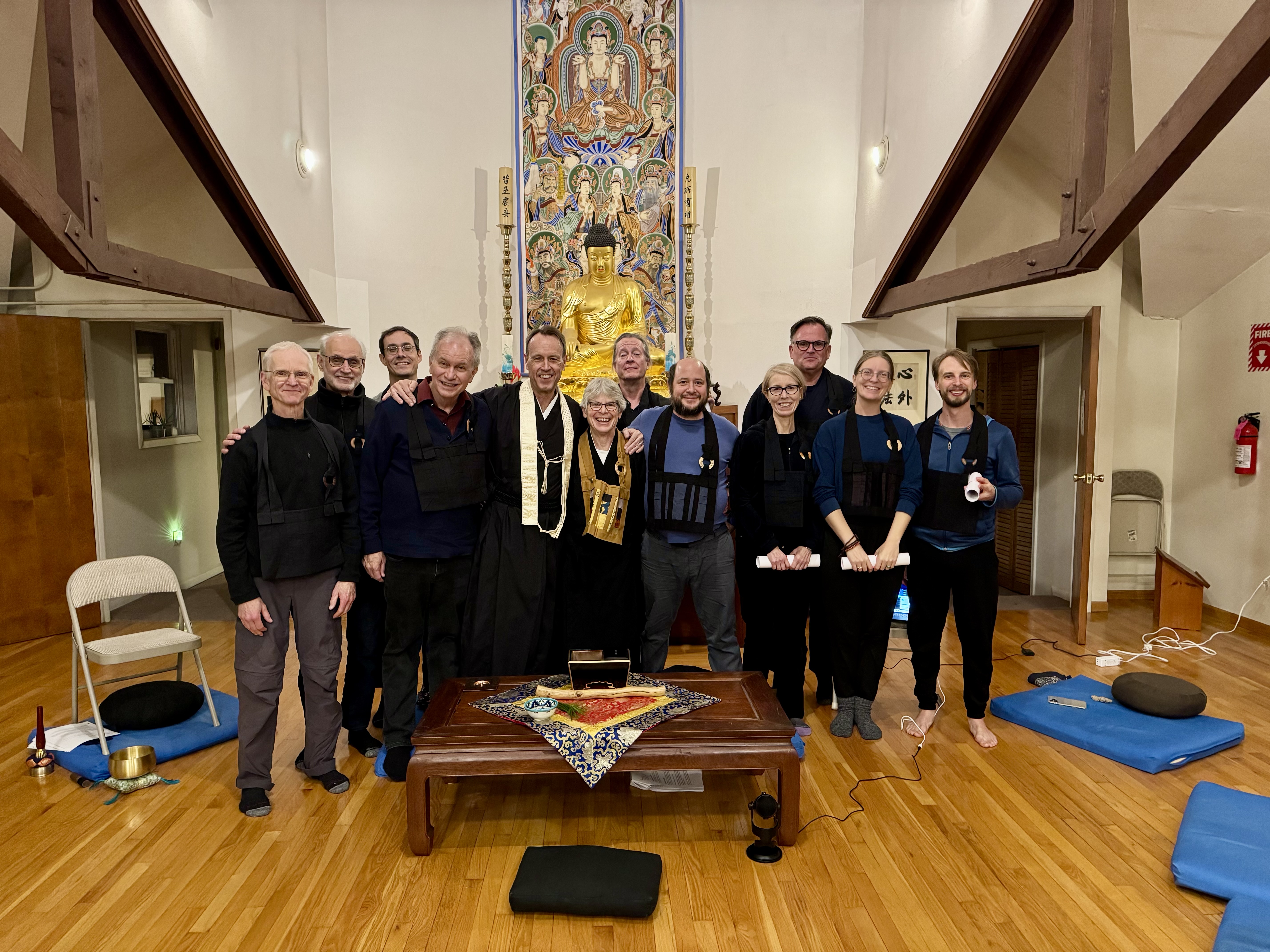
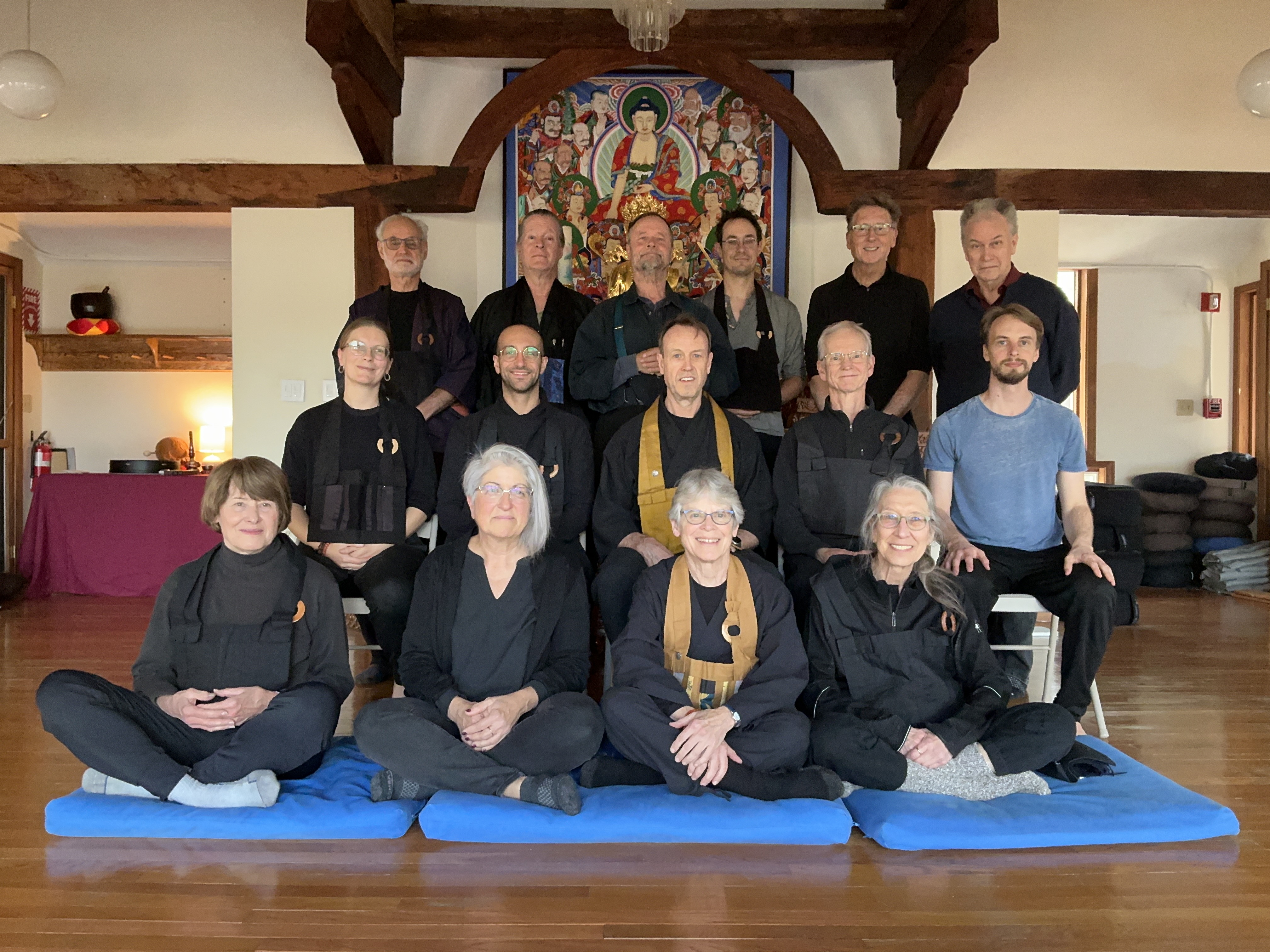
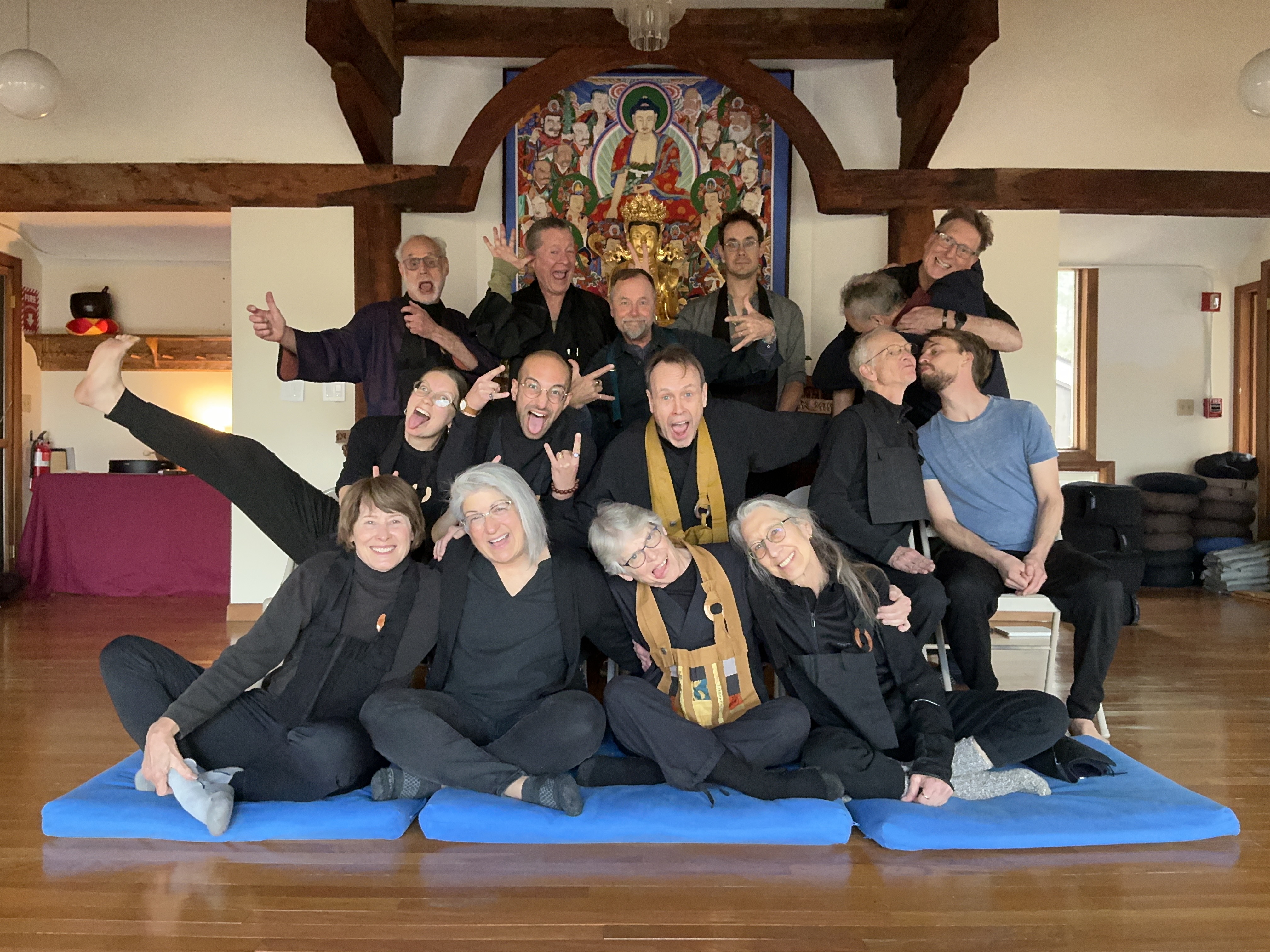
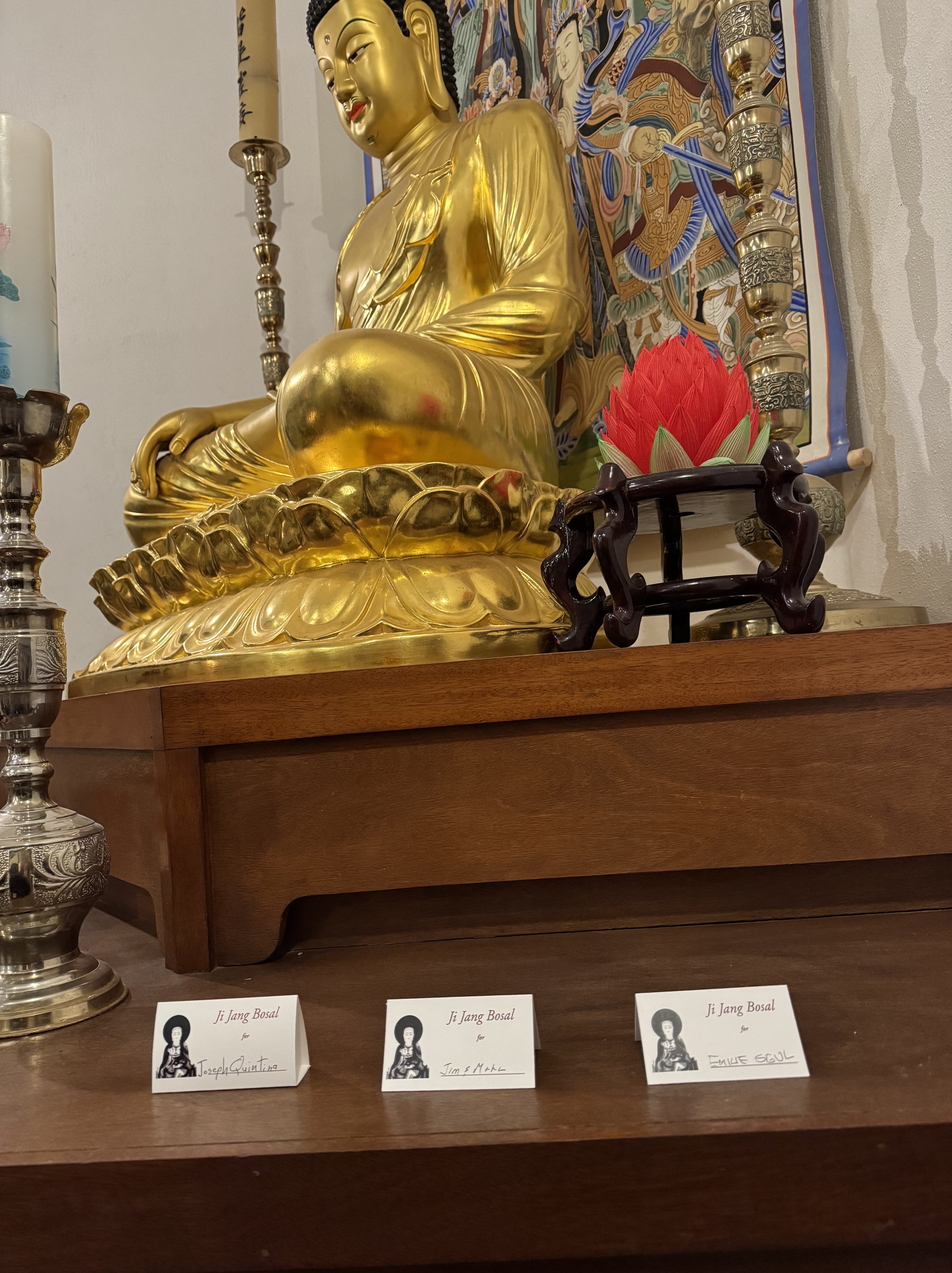
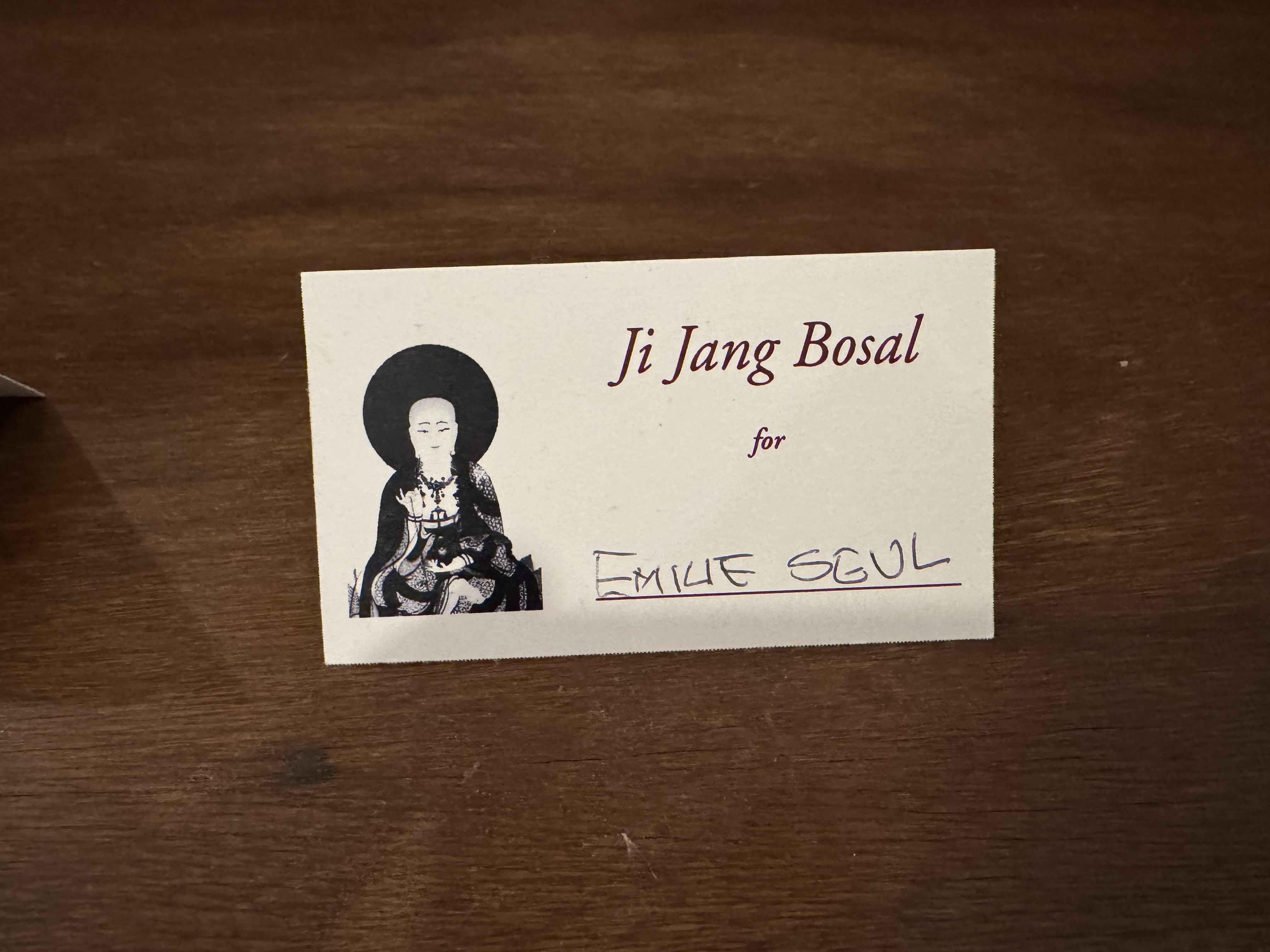
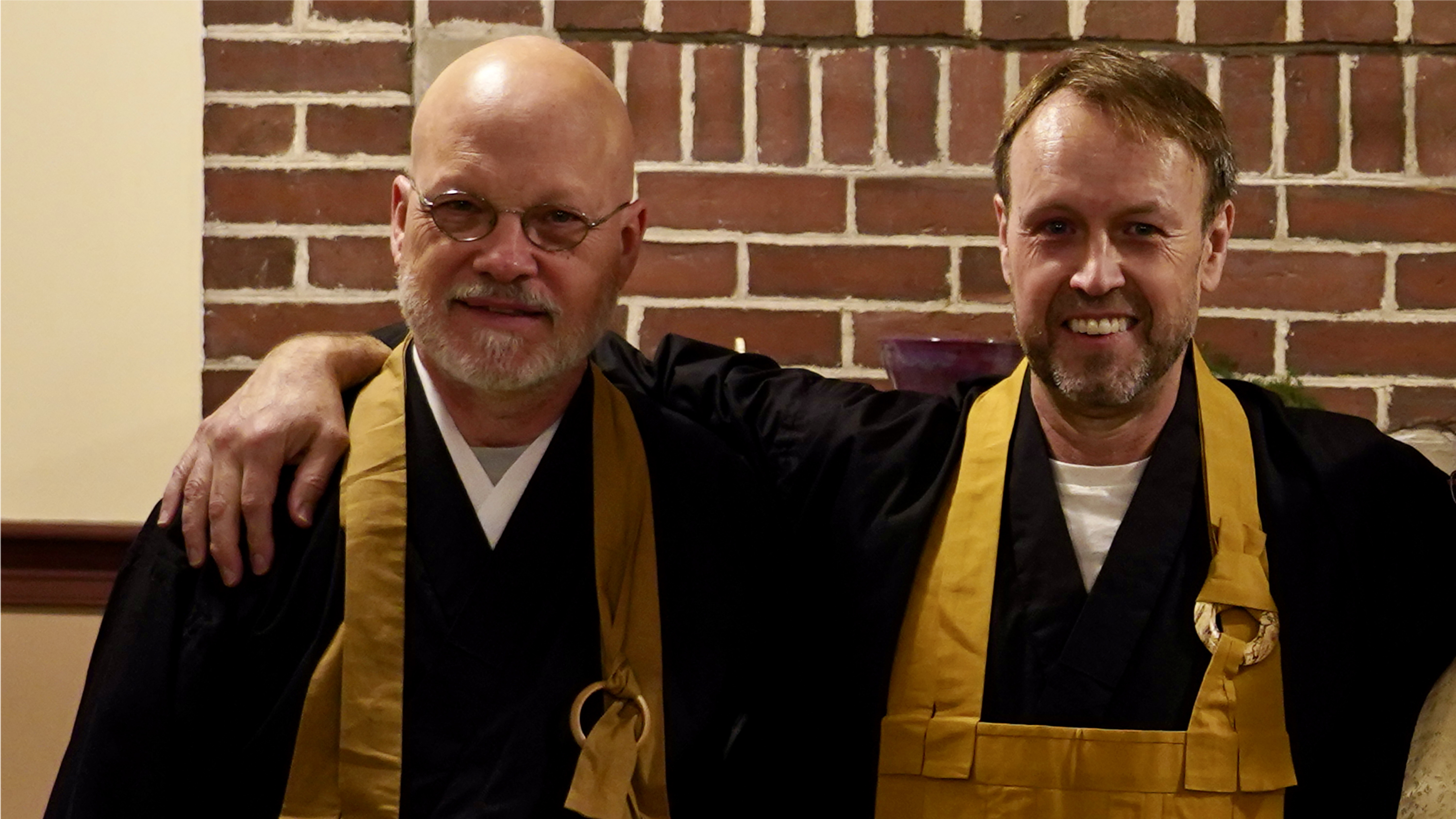
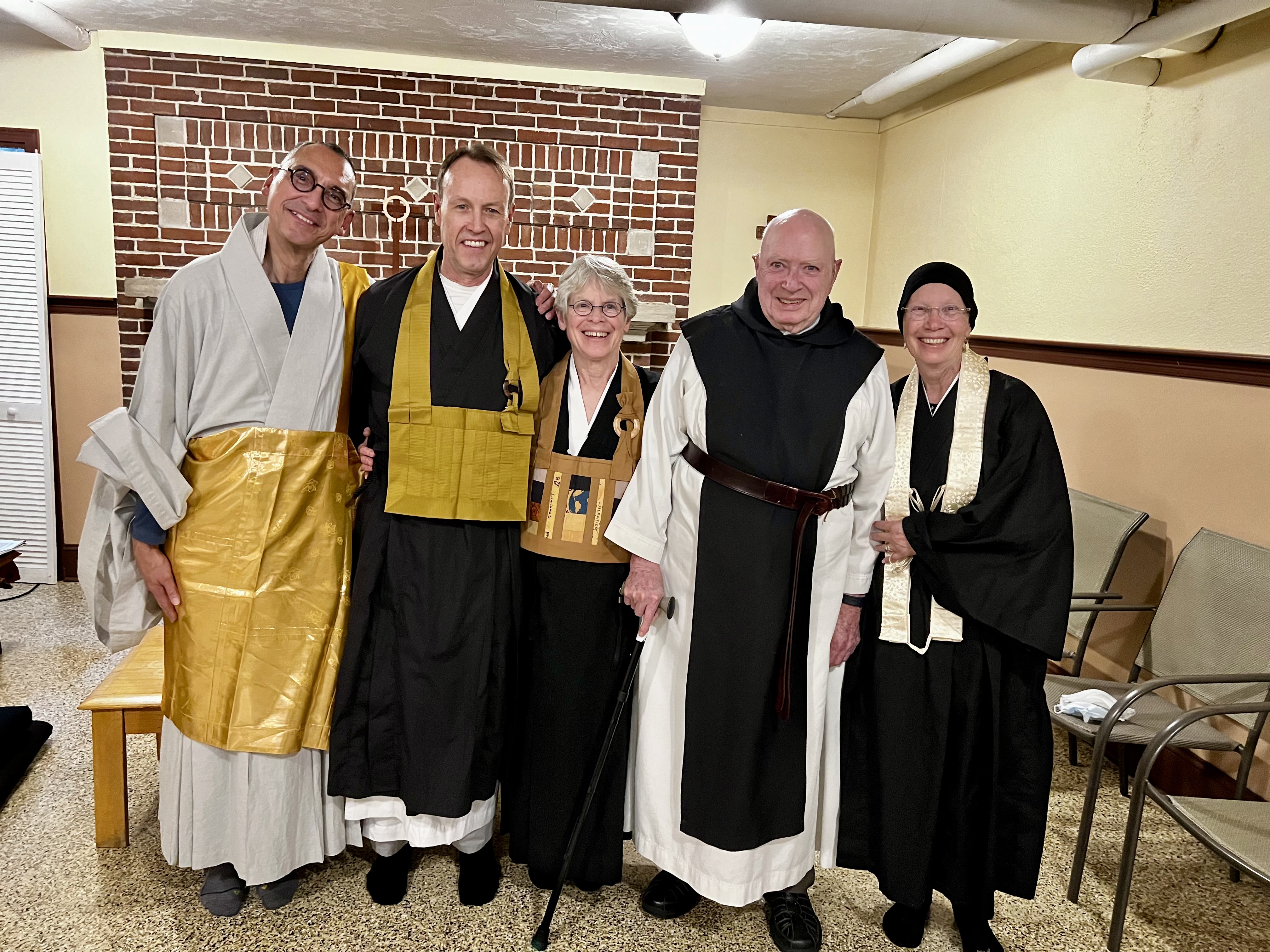
Here is a photo following our Jukai ceremony last November during a sesshin at Providence Zen Center. I’ve included a few other photos from that retreat, including one of the altar memorial card for my mom, who had passed away just a few weeks earlier.
This is a brief eulogy I offered for my dear friend and Dharma Brother, Tim St. Onge, during a memorial service on September 15, 2024. Tim was the second dharma heir of our teacher, Kevin Jiun Hunt, Roshi. He died of cancer on August 28, 2024.
Good evening. I’m Jeff Seul, another of Fr. Hunt’s Dharma heirs. Tim was my Dharma big brother. We truly felt we were brothers. We referred to one another as brother. That meant a whole lot to me.
When I think of Tim, I see a strong, gentle lion, and I hear the lion’s roar. I’m sure this image of Tim would come to mind even if I didn’t know Shakyamuni Buddha likened himself to a lion and his teachings to a lion’s roar on those rare occasions when he spoke of himself in relation to other teachers of his era and to their teachings. It seems the Buddha saw Asiatic lions and heard their thundering roar during his years as a wandering ascetic in northern India, before he found what he was seeking and began to teach. The noble lion’s presence pacifies all the other beings across vast space. Years ago, our family was fortunate to see and hear lions in the wilds of Africa, so I can appreciate why the Buddha used this metaphor.
What did the Buddha realize and what were the fruits of that realization? Why might he compare his teachings to the lion’s roar? Here’s what the contemporary Buddhist teacher Tara Brach says:
“We typically think of our happiness as dependent on certain good things happening. In the Buddhist tradition, the word sukha is used to describe the deepest type of happiness that is independent of what is happening. It has to do with a kind of faith, a kind of trust that our heart can be with whatever comes our way. It gives us a confidence that is sometimes described as the lion’s roar. It’s the confidence that allows us to say, `No matter what life presents me, I can work with it.’ When that confidence is there, we take incredible joy in the moments of our lives. We are free to live life fully rather than resist and back off from a threat we perceive to be around the corner.”
It is so clear to me, as I imagine it is to each of us, that Tim had this confidence in his bones. He embodied, demonstrated, and channeled it. He wanted us to have this confidence, too.
This was clear before Tim learned of his cancer, but the real proof was how he lived after he learned. Continuing his practice and teaching. Traveling to visit friends and family everywhere. To lead zazenkai and join sesshins in Madison. Even flying to India, alone, while in rapid decline and with a ravaged immune system, for a final, grand adventure on retreat there.
I’ll be remembering Tim as a lion, and he’ll continue to inspire me. Another lion image of Tim I’ll hold is the lion from the Wizard of Oz, but after he met the wizard. The perfect marriage of courage and a tender heart.
They say Zen teachers don’t die, they just go into hiding. Everywhere.
Every bird’s song, every thunderclap: Tim, roaring. Tim’s presence. Tim reminding us to be present. To know the presence that we are.
I gave Dharma transmission (Denbo) to Fran Jindō Ludwig on Saturday, November 4th, having given Fran Preceptor transmission (Denkai) a bit earlier. Dharma transmission is the process by which one becomes a Zen teacher.
Roshi Kevin Jiun Hunt and Roshi Cindy Kin Ryu Taberner and Zen Master Tan Gong (a guiding teacher of the Providence Zen Center in the Kwan Um school) were present for the Denbo ceremony, as were about 15 members of our sangha. Two pictures from this happy occasion are attached.
Fran lives in Connecticut and is actively involved in our Full Moon Zen sangha based in Cambridge, Massachusetts. Readers of this blog who don’t know Fran can read her personal statement on our website.
May Fran have many more years of Zen service for our benefit and the benefit of all beings!
And, still, I’m with Peter: This country and our communities could really use an annual, nationwide reminder and collective expression of our interdependence, with many more reminders and new structures and practices to promote thought, speech, and conduct in keeping with our interdependence during the rest of the year.
Yun Yan asked Tao Wu, “What does the Bodhisattva of Great Compassion use so many hands and eyes for?” Tao Wu said, “It’s like someone reaching back and groping for a pillow in the middle of the night.” Yun Yan said, “I understand.” Tao Wu said, “How do you understand it? Yun Yan said, “All over the body are hands and eyes.” Tao Wu said, “You have said quite a bit there, but you’ve only said eighty percent of it.” Yun Yan said, “What do you say, Elder Brother.” Tao Wu said, “Throughout the body are hands and eyes.”
Last week I spoke about Sengcan’s Awakening Faith in Mind, that long verse we chanted last Saturday and again today. I focused on three themes raised by that foundational Zen text:
• First, our human capacity for self-reflection is wonderous and useful, and it’s also bedeviling. It can produce an echo chamber or hall of mirrors in which we may remain neurotically trapped. This echo chamber is the “small mind” discussed in the text, at least when small mind is all small mind knows.
• Second, this small mind is in the business of slicing and dicing; of objectifying and making relative comparisons among objects. Inside the hall of mirrors, we tend to use our own subjectivity to objectify ourselves and other subjects. This produces much personal and collective suffering. Small mind seeks an escape from the hall of mirrors.
• Third, small mind tries to think it’s way out, but it can’t. Inside the hall of mirrors, small mind imagines itself as having the capacity to find what it’s seeking. Like a hammer, it pounds away at its supposed problem, but without realizing it is pounding on a screw. A better metaphor might be a hammer pounding on a sponge ball. It can’t make a dent. The pounding is futile—properly directed, it’s an expression of bohdicitta, the mind aimed at awakening. The pounding eventually tends to give way to rest and ease as small mind discovers itself in Great Mind.
This week I want to build on what I said last week, picking up on some of the themes presented in your wonderful questions and comments during our discussion following my talk, including the first, excellent question RB posed after my last talk: How does all this play out in our lives? I want to use the lovely and much beloved koan I just read as a touchstone for today’s discussion.
Yun Yan asked Tao Wu, “What does the Bodhisattva of Great Compassion use so many hands and eyes for?” Tao Wu said, “It’s like someone reaching back and groping for a pillow in the middle of the night.”
Have you had this experience? You’re shifting in bed, still in a sleep state, but conscious enough to know you’re readjusting your position. Without thinking, you reach for a pillow, find it, and put it someplace where it provides support and comfort. And then you slip back into deep sleep. It all just sort of happens.
A few nights ago, I woke in the middle of the night and small mind started spinning. I so wanted to get back to sleep, but I couldn’t find it with that spinning mind. But when I just ceased to engage that mental activity, and when, eyes closed, I centered my mind’s eye in the luminous darkness, sleep found me and I let go into it. It was there all along, ready to have me when I was done trying to have it.
Great Mind always is there for us like this. We often tune into it in seemingly small, ordinary moments, knowing ourselves both as part of it and as it, appreciating it and consciously entering the flow of it. Some people experience this walking in a forest or meadow; others while playing with a child. They may use different religious or secular language than I’m using here, depending upon their way of life, but we’re tuning into the same thing.
Great Mind often finds me as I sit quietly in my home office, the morning sunlight illuminating the papers on my desk. Or as I watch steam rise from my teacup. The steam is dancing, no less alive than I am.
We sense in these moments that Great Mind is not something we possess or achieve. Great Mind is not contained in my skull. It’s not contained period. It’s there as the ground of all being, in which we beings participate.
Zen practice ultimately invites, prods, and supports us toward an experience of harmony among small mind—my personal experience of ordinary mind—and Great Mind—the ground of all being in which small mind can discover itself rooted.
A big, transformative realization of Great Mind sometimes occurs suddenly in Zen practice. But I truly think that deep realization always develops, or sinks in, slowly. We must know Great Mind in our bones, not as an idea or a one-shot experience. We come to know that this no-ground ground is always here, even when we’re not perceiving it quite so clearly or pleasantly.
Sengcan’s chant is about awakening faith in mind, but intimacy and complete trust ultimately are what we are seeking. Perhaps we need something like faith early on, as small mind remains anxious about ceding control; about accepting itself as immersed in Great Mind; unwilling to admit it’s not driving the bus. But the experience to which Sengcan is ultimately inviting us is more akin to trust born of experience than to an intellectual leap of faith or act of will.
It’s true that some Zen texts seem to equate the moment at which we’re first overcome by a realization of Great Mind with completion, and it’s true in a sense. But other texts tell us these experiences are a sort of initiation and encourage us to stay focused on continual integration of small mind and Great Mind. This is important, because there are myriad ways small mind may try to co-opt its recognition of Great Mind.
We can fetishize those moments of recognition, particularly the most dazzling ones. We can inflate them and imagine they make us extra special. We can try hard to reproduce them, usually without success. We can become a samadhi junkie, spending countless hours on retreat, chasing blissed out states and imagining we’re becoming more holy. I’ve been guilty of versions of all of these things along the way.
Small mind can become completely intoxicated with and lost in the recognition of Great Mind. In her book The Awakened Brain, Lisa Miller, a Columbia professor who researches the neuroscience of spirituality, tells a story about a woman who has an initial awakening experience and, in her excitement, enters a Buddhist monastery. She lives there for over three years, dedicating most of that time to meditation practice. She eventually feels disconnected from the world and her own life, so she leaves the monastery. In the first days after her departure, she has a dream that convinces her she must return and that the Dali Lama will be coming to pick her up. She packs a bag and spends the day waiting in her front yard, but he never shows up. Miller’s research affirms that the most resilient, wise, and well-adjusted people among us are not stuck in either place; they’re tuned into Great Mind and small mind is functioning fully, in harmony with Great Mind.
So there are countless ways small mind can and probably will attempt to co-opt and control Great Mind once it perceives it. We must be alert to this possibility. At the extreme, we sometimes see one who has recognized Great Mind get tragically stuck in the perspective of the absolute, from which we say there can be no killing, because there is no life and death; no stealing, because there is nothing to possess; and so on. Small mind confuses itself with Great Mind, becomes grandiose, and perverts these metaphysical truths, finding license in them to do things that cause harm.
Small mind isn’t really knowing itself and manifesting as Great Mind until it’s thoroughly soaked in Great Mind and knows and accepts its humble, joyous place within it. The koan with which I started nicely shows that. After Tao Wu make the reaching for a pillow analogy, Yun Yan says, “I understand.”
Tao Wu said, “How do you understand it? Yun Yan said, “All over the body are hands and eyes.” Tao Wu said, “You have said quite a bit there, but you’ve only said eighty percent of it.” Yun Yan said, “What do you say, Elder Brother.” Tao Wu said, “Throughout the body are hands and eyes.”
The younger monk gets it, but he’s still skimming the surface. The older monk attests to his experience that the eyes and hands of compassion permeate every cell of one’s body; that they are every atom of this vast universe. This is small mind manifesting as Great Mind.
Our Zen practice nudges and supports this awakening to and trust in Great Mind in multiple ways:
• Through zazen, in which we allow small mind to relax, step back, and rest in Great Mind. • Through koans, if we take up that practice. Small mind wants to approach them as puzzles or dilemmas, but we discover that satisfying responses to them don’t originate from small mind. • Through ritual, chants, and other forms in which we enter the stream of activity of Great Mind, moving, vocalizing, and giving of ourselves. • Through sangha, in which we can discover the Bodhisattva of Compassion in our midst. • Through the Precepts, which help us know how to harmonize small mind with Great Mind in those situations in which our experience of sangha—of community—is most at risk. • Through service, from which we can discover there is no distinction among giver, receiver, and gift.
I turn 60 in July. The world has changed a lot in my lifetime.
One change I have been very grateful for, in some ways at least, is the end of the Cold War. I grew up in an era when the possibility of nuclear annihilation was ever present. We were reminded of it constantly, with tests of the civil defense system that would interrupt the cartoons we watched on Saturday morning. With bomb attack drills at school in which we would crowd into the basement or take cover under our desks, as if that really would protect us from a nuclear blast or its fallout.
I was in Jerusalem and Ramallah last week doing the conflict and peacebuilding work I’ve been involved in there and elsewhere for many years. While I was away, my 13-year old daughter had a nightmare about being someplace that was bombed.
To the extent I even thought about it these days, I thought those days were gone. The days of kids having nightmares about nuclear bomb blasts. That was just something my generation had to endure, right?
Not so much, it sadly seems. Of course, that view—that near-certainty that this era had passed—was conditioned by my location in a rich, powerful country with a vast stockpile of nuclear and conventional weapons. Much as I thought I could relate more than some to people living in war zones—I have been to a several—I really don’t know what it’s like to go to sleep every night not knowing whether a bullet, or a missile launched from a drone or a plane (perhaps even one with a U.S. emblem on it) might disrupt my sleep, or even take my life or those of loved ones.
I imagine some of you, or your loved ones, are feeling as anxious as my daughter these days. Like her, all of us see the images of what’s happening in Ukraine, and the stern rhetoric coming from all directions.
I thought I’d talk about this a bit today, tentatively, through the lens of the Zen Peacemaker Order’s Three Tenets.
Not Knowing
The first tenet is not knowing, a theme—and, I hope, an experience—we encounter frequently in Zen practice.
We sometimes talk of our certainties in terms of delusions—delusions which are inexhaustible, and which we vow to transform.
Why are our certainties a type of delusion and ignorance, and a potential source of conflict and other forms of suffering?
The more certain we become about our own views and convictions, the more we close ourselves to new information, perspectives, and experiences. Our capacity to perceive and know is always limited, but the less curious we become, the greater the risk we’ll descend down a rabbit hole, missing things that are important and behaving in ways that cause harm to ourselves and others whose needs and interests lie outside our present field of vision or comfort zone.
I suspect this is how most big blunders happen—in whatever domain, from our personal lives to wars within and among nations. Many so-called “mistakes” and other calamities likely occur because someone is invested in a partial story with a foregone conclusion. These stories are partial in two senses: they serve our own perceived (or misperceived) interests, and they omit important information and perspectives, including others’ perspectives. We also tend to be too confident about how these stories will end if we don’t buy into them, as if we alone had a crystal ball.
Zen encourages a very different orientation, or default setting. Time and again, Zen teachings emphasize not knowing. This is not an abstract principle or aspirational ideal or virtue. It is, in fact, the only sensible orientation self-aware people of good judgment and goodwill could embrace: acknowledging we actually don’t know what we do not, and perhaps cannot, know. There are many things we simply don’t know, and likely never can know, despite our evident discomfort with this seeming predicament and our strong desire to know.
Sometimes we must act in the face of uncertainty, and at these times our core values, like those expressed in the Bodhisattva Precepts and the Zen Peacemaker Order’s Three Precepts, can help guide us. But we shouldn’t cling to them blindly or apply them on auto-pilot. We must do our best to remain curious and open in difficult situations; to acknowledge the limitations of our vision even as we act.
Bearing Witness
One of the most remarkable examples of bearing that I have encountered personally is the Katsuzo Sawada.
My family lived a stone’s throw away from Boulder, Colorado, in the late 1960s and the first half of the 1970s, and I was in college in nearby Denver from 1976 to 1980. I lived in Boulder off and on between 1985 and 1995, first as a grad student, then working as a young lawyer. Throughout most of this time, spanning nearly three decades, plutonium parts for nuclear bombs were being manufactured at Rocky Flats, a massive, underground, top secret facility just outside Boulder.
I can’t remember precisely when I first heard Sawada’s steady drumbeat come and go, but it was definitely during the time I was a student in Boulder. I was in the little cabin in Chautauqua Park where I lived, in a coffee shop, out on a run. The first couple of times I heard Sawada’s drum, it was a sonic apparition. I turned to see the source of this unusual sound, but couldn’t locate it. The next time I heard it, I turned quickly and caught sight of Sawada, taking broad, swift strides, in full monk garb, beating his hand drum.
This was Sawada’s practice. Morning to night. For decades.
Sawada is part of a Buddhist sect that emphasizes walking meditation and work for peace. Much to his parents’ dismay, he became a monk as a young man and ultimately moved to Boulder, alone, to bear witness to the madness of the nuclear arms race. Many years later, a couple of other monks from his order eventually joined him in Boulder, perhaps, in part, to lessen the physical toll this form of protest must have taken on Sawada.
Sawada’s presence in Boulder–the sound and sight of him at random times during the week–made a deep impression on me. I really appreciate his example of bearing witness. It has stayed with me. He must have been deeply moved to move to Boulder from Japan and spend long days in motion, circumambulating a nuclear weapons plant. His incredible patience and presence and commitment and determination and calmness and spirit of ahimsa (not harming) are among the qualities of his bearing witness that have made the deepest impressions on me.
Taking Action
Yes, we must act. But if our actions are not grounded in the practice of the first two tentets, beware.
There is a war in Ukraine. What will we do? What can people like you and me possibly do?
I gave this talk on Saturday, January 29, 2022. There’s also a link below to a recording of this talk.
This is Case 38 in The Gateless Gate:
Wu-tsu said, “It is like a buffalo that passes through a latticed window. Its head, horns, and four legs all pass through. Why can’t its tail pass through as well?”
Here’s Wu-men’s commentary on the koan:
If you can get upside down with this one, discern it clearly, and give a turning word to it, then you can meet the Four Obligations above and give comfort to the Three Existences below. But if it is not yet clear, pay close attention to the tail and you will resolve it at last.
And here’s Wu-men’s verse:
Passing through, falling into a ditch;
turning beyond, all is lost.
This tiny little tail –
what a wonderful thing it is!
Our daughter, who is 13, has strong likes and dislikes.
One thing she really likes is birthdays—her own, for sure, but others’ birthdays, too. She looks forward to celebrations so much, and that brings all of us a lot of joy.
One thing our daughter really does not like is change. I don’t think she’s yet forgiven my wife and me for our move from a suburb into Boston two years ago. As much as she’s come to like where we now live, she still feels the sting of leaving the only home she’d known until we moved.
Our daughter’s love of birthdays and her distaste for change met head on eight years ago, as she was about to turn five. At times, she seemed excited to celebrate her birthday; other times, she seemed anxious and down.
I sat with her at bedtime one night to try to understand what was going on. She said she was sad that she wouldn’t be four anymore; that four would be lost.
I had bought our daughter a set Russian nesting dolls on a trip I’d taken several months earlier. Many of you have seen these dolls, I’m sure. This set had five dolls: five hollow, brightly painted dolls, each one a bit larger than the next. The four largest dolls separate at the waist, so you can put the smallest doll inside the doll one size up; those two in the next one up; and so on. When they’re all packed up, the largest doll is the only one you see. Now it contains all the others.
I reached for the set of dolls on a bookshelf nearby, took it apart, and started reassembling it. As I put the smallest one inside the next size up, I told my daughter this was just like when she turned two: one was still inside two. When I put those two in the third, I made the same point about when she turned three; and I made that point again when I put the first three dolls in the fourth. By the time we got to the fifth doll, she understood that turning five didn’t mean losing four. Four would still be part of her.
Growth in most domains of life is like this. Our perspective and experience may be transformed, but they’re transformed in a way that integrates and refigures our prior perspectives and experiences. The old and the new; this way and that way; the things that used to seem like binaries, and that used to generate discomfort, become synthesized into a new way of knowing and being that we never could have imagined.
Like Alice, we can peer into the looking glass, but we can’t know what’s through it until we’re through it. In this case, however, “through” isn’t exactly a way out. Getting to the other side; well, what we find might not exactly be another side.
In the koan with which I opened this talk, the window is a metaphor for enlightenment, of course. The buffalo—which is you or me—wants to pass from someplace she doesn’t want to be to someplace she imagines to be better. But she can’t quite get through. Her tail is stuck.
Hakuin, the 18th century teacher who revived the Rinzai school in Japan, and koan practice with it, regarded this koan as one of eight that are especially difficult to pass through. I suppose it is, if we conceive of enlightenment as a passage to someplace completely other than where we’ve been, and if we expect to become someone completely new, other than who we’ve been.
To be clear, the Zen way entices us toward a particular sort of growth. Its teachings and practices both support and embody that growth as we take them up. I suppose we can call it spiritual growth if we must call it something. It’s a paradoxical sort of growth, not unlike those Russian dolls.
Why is spiritual growth paradoxical?
On the one hand, our practice may help us grow beyond the existential angst many of us feel; that acute, uncomfortable, fragile sense of existential isolation that propels so much action and inaction which can compound our own and others’ suffering.
The biggest Russian doll is bigger than the whole universe; it is hidden in plain sight, as everything and nothing. Taking up and continuing along the Zen Way, we may discover and center in this reality—experientially, as the fabric of our being, not as an idea. We may come to discover and feel ourselves, and everything else, as arising and boundlessly coterminous with that biggest of all Russian dolls.
We can think of enlightenment experiences or insights, if we have them, as glimpses of that biggest Russian doll reality. But I think it’s best to think of enlightenment, if we’re going to think about it at all, as progressively becoming securely anchored in that awareness and experience. And not just from the universal perspective, the perspective of that biggest of all Russian dolls, important as it is to cultivate it, and as much as Zen practice is about helping us do so. But also from one’s own very concrete and particular perspective, as a being interdependently present with other beings.
There used to be a brushwork piece hanging here that depicted a candle burning from both ends. At one end it said, “Sometimes swiftly.” At the other it said, “Sometimes slowly.”
This image depicts the eventual resolution of a debate that raged for some time in the early days of the Zen tradition. Back in 8th century China, the so-called Northern School of Zen claimed enlightenment comes suddenly, and the so-called Southern School claimed that enlightenment comes gradually. The image represents the synthesis that eventually emerged: both perspectives are valid. It can happen either way.
My view of how that ancient debate should be resolved is just a bit different. Instead of “sometimes swiftly, sometimes slowly,” I’d say, “sometimes swiftly, always slowly.”
And that’s a good segue to what makes spiritual growth paradoxical. It’s all about that tail.
Striving to pass through that window, we may think our tail has us stuck. If so, we certainly are stuck—but the other end has us stuck. There’s no escaping our tail-ness, and no need to escape it, as if we even could. We’re stuck because of how we’re conceiving of enlightenment and striving for what we conceive.
Enlightenment is a slippery word; some might even say it’s a dirty word. It certainly is a dirty word if one projects into it the pretense of completion; the end of growth.
Our enlightenment is ongoing; never ending. We can sink ever deeper into the realization that we are what we were seeking—not in a grandiose way, but in the sense knowing ourselves both as distinct beings and as not separate in any way. We continue to open; to marinate.
And as buffalos with tails, we always will have blind spots. As distinct beings, there are experiences and perspectives that are not our own. We can miss things about ourselves or about the world around us. Each of us needs others to help us see and learn from what we presently do not see.
I once met a teacher who said Zen has nothing to do with ethics. His point is that Zen is fundamentally about realizing that biggest of all Russian dolls insight, and he believes that awareness has nothing to do with ethics. That’s a view from the perspective of the absolute, but one that, to my thinking, neglects the unity of absolute and relative.
I’m with the 20th century teacher Yamada Roshi, who summed up the whole of Zen practice and its goal as the refinement of character. That biggest of all Russian dolls insight can and must contribute greatly to the refinement of one’s character. If that doesn’t yet seem to be happening, there’s reason to question how securely one is anchored in that awareness and experience.
As we grow in insight, wisdom, and maturity, we hopefully become less subject to baser impulses and delusive ways of thinking that possessed those smaller Russian dolls within us, cute as they are. But real maturity is accepting their presence with all humility and tending to them skillfully; never thinking we’re free of blind spots or have otherwise fully passed through some mythical, ultimate gate; and remaining open to new insights from wherever or whomever they may come.
So let’s please each pay close attention to our own tail.
I gave this talk during our Full Moon Zen sit on September 23, 2021.
These are the first four lines from Hsüeh-tou’s verse for Case 2 of the Blue Cliff Record:
The supreme way is not difficult:
The speech is to the point, the words are to the point.
In one there are many kinds;
In two there’s no duality.
If Catholics can’t sing, as they say, then Zen types can’t count.
You’ve heard the phrase “not one, not two” in Zen circles. This seemingly paradoxical notion also is expressed in the last couple of lines of the verse I just read:
“In one there are many kinds; in two there’s no duality.”
Not one, not two.
Look around. The world consists of 10,000 things. Countless things.
Not one.
This realm of 10,000 things is where we tend to live and know ourselves—physically, cognitively, emotionally, and spiritually.
There is me and there is you. My left hand and right hand; your left and right hands. There is day and there is night. Thursday and Friday. This year and next. Up and down. And so on.
It’s a dazzling realm, this land of 10,000 things, and yet one in which, paradoxically, we can find ourselves feeling alone amidst so much company. It’s a house divided, so to speak, and our hearts tend to feel divided if this is the only way we see and know and experience it.
But let’s borrow a little thought exercise from both Indian and Western philosophy and examine one of the 10,000 things closely. I can’t remember what object my intro to philosophy professor used; that was so long ago. I think it was a chair or a ship.
Let’s keep it simple and dismantle a chair. Break it apart into four legs, a seat, and a back. Not only do we now have 10,006 things; it gets harder to call those six pieces lying on the floor a chair. It turns out a “chair” is a contingent, transitory thing.
Zoom in on one of those four legs. We could break it up lengthwise with an axe. What is it now? Kindling, I suppose.
Start a fire with those bits of wood, and we have warmth for a while, then ashes. The ashes feed the soil from which flowers emerge.
And so on.
And it’s not just chairs. Everything is like this, including you and me.
Chairs are real, of course. Just pull up one and sit in it. But we tend to walk through the world projecting more solidity and permanence onto everything than we should.
We don’t need a hatchet to expose this reality, as anyone who also has taken a physic course knows. When we look closely enough at anything, it disappears. Everything is contingent; everything is decaying and morphing all the time. That decay is life.
I recently listened to a podcast in which a Harvard Medical School professor I know, Vamsi Mootha, was interviewed. He studies mitochondria: little organelle that inhabit our cells and those of almost all other life forms. They’re invaders into our animal kingdom; they’re not animal in origin.
Anyway, the host of this podcast asked Vamsi a seemingly simple question: How many mitochondria are there in each human cell? “They’re hard to count,” Vamsi said. “The number is changing all the time, and sometimes they’re in a state that’s not really one, and not really two.”
If the 10,000 things are in a constant state of flux, what are we left with?
Not two.
One then? Show me this one.
The one exists as the 10,000 things.
Our practice, everything we do—sitting, chanting, bowing, and so on—is an expression of the one in the many; the many as one.
Not one, not two. Fathomless, and as straightforward as our hands in gassho.
Taizan Maezumi Roshi, the great teacher who migrated from Japan to the United States in the 1950s to help plant Zen in our cultural soil, died 26 years ago. The White Plum Asanga–the affiliate group of all teachers succeeding from him–introduced an annual remembrance ceremony for him last year, which I attended. This year’s ceremony, which I also attended, was recorded. I counted 112 teachers–the vast majority of us–in attendance.
If you would like to sense the flavor of the broader–and broad, like the Way, it is!–WPA, this is a fine place to start. The rap remembrance by Roshi Gerry Shishin Wick, one of Maezumi Roshi’s direct Dharma heirs, is delicious, and the principal talk, given by Roshi Wendy Egyoku Nakao, one of Roshi Bernie Glassman’s Dharma heirs, who was the longstanding abbot of the Zen Center of Los Angeles, which Maezumi Roshi founded, is nourishingly bittersweet.
The ceremony included a video montage of moments from Maezumi Roshi’s life, which also has been posted separately.

 Turning Words