Sesshin


I didn’t attend Boundless Way Zen’s weeklong sesshin this year.  It ended today.


I found myself “participating” sympathetically throughout the week, sometimes almost telepathically.


I was really missing our sesshin-attending sagha-mates at Tuesday night’s sit at the Greater Boston Zen Center.  My legs became strangely tight and painful, much like they would after days on retreat, and not at all like I normally experience after 20+ years of 1-2 25-minute sits most days.


Sitting at home during the week, I sometimes felt like I was sitting in the zendo at the Boundless Way Temple, where our sesshins occur.


Lying in bed one night, I could almost hear the day’s closing chants, which end with this stark, ghostly reminder of how precious this life-time is:


“Let me respectfully remind you: Life and death are of supreme importance.  Time swiftly passes by and opportunity is lost.  Each of us should strive to awaken… awaken!  Take heed!  Do not squander your life.”


Long sesshins are wonderful.  I have benefitted immensely over the years from the many week+ retreats I’ve attended — intensive practice periods, during which one sits and meets with teachers from early morning until late at night.  I look forward to attending more of them in the future.


And extended, leisurely periods of time with family and friends, or with oneself, also are wonderful.  For many Zen practitioners, and perhaps mainly for those of us with younger children and/or spouses who are not Zen practitioners (sympathetic, like my wife, though they may be), devoting a full week to sesshin each year can be a real challenge.


Most people still in the workforce have limited vacation time, and vacations may need to be coordinated with school schedules and a spouse’s schedule.  Even if one can arrange time for sesshin, a week at a Zen retreat may mean a week of family vacation lost.


This is my current reality.  We have school-age kids.  I have missed a week of family vacation time for the past several years by attending our weeklong sesshin.  My family is truly supportive of my Zen practice, and yet this just feels like too much.  It certainly feels like a huge loss from my perspective, even though I know there’s much to be gained from intensive periods of practice.


One of the big projects inherent in Zen’s migration west — one of the big opportunities we’re presented — is about adaptation of the traditional forms and practices to this new context-era.  Numerous features distinguish this new context-era from those in which the traditional forms and practices evolved, but perhaps none is more prevalent and salient than the relative leveling of lay life/practice and the path of priestly and/or monastic life/practice.


This leveling has many causes and many implications.  It is bound up with other progressive trends, like democratization and increasing gender equality, in ways that make them impossible to separate entirely.


The practice of sesshin developed in context-eras in which there were sharp distinctions between the laity and monastics, whether they be lifelong monks or young men spending some months or some small number of years in a monastery as a rite of passage.


And these monks were mostly childless men.  If the monastic life was their permanent vocation, it was their livelihood, their work.  They begged and contributed to the institution’s other income producing endeavors throughout their lives.  If they were passing through, they begged and contributed to those same endeavors while they were there, knowing they would eventually return to lay (and likely family) life and some form of work less conducive to spending weeks or months on a cushion all day.


Fast forward to today . . .


On the one hand, a week isn’t a long period of time, particularly compared to the month+ retreats that are common in many Asian monasteries, even still.


On the other hand, see above.


From one perspective, perhaps there is something to be said for making a stoic effort to attend longer retreats, despite family and work obligations and opportunities, but I’m not much moved by that perspective.


These sorts of discussions and thoughtful experimentation are happening within BoWZ, and I’m very excited to be part of this organization and this project.  In addition to our annual weeklong sesshins, we have several shorter sesshins each year and numerous daylong intensives.


The weeklong (or longer) retreats truly are wonderful.  For some, “shifts happen” in these longer, intensive periods of practice, and perhaps would be less likely to happen for them in another context.  Bonds develop.


And, I must say, in recent years I have found my most profound shifts happening, and my most transformative bonds developing, within the context of family life.  Of course, Zen practice, including the weeklong sesshins I’ve attended, has been hugely supportive of this.  That’s the point, as BoWZ’s teachers continually remind us.


One of the really exciting and heartening things about this BoWZ project is the community’s recognition that Zen practice needs to work in the context of people’s ordinary lives.  Indeed, that Zen is our ordinary lives.


And, yet, there is a tradition that we have received, and that tradition transmits to us a treasure trove of forms and practices that people have found powerfully useful for awakening to the full richness of this ordinary life.  The adaptation/experimentation project is tricky.


It’s important not to cling slavishly to traditional forms, holding up intensive practice — the longer and more frequent and more ardent, the better — as “real Zen.”  And it’s important not to dilute the forms down to nothing.  They’re nothing in one sense, of course, and yet most definitely not nothing.


At least until our youngest (who’s now four) goes to college, I suspect my rhythm will be marked by frequent short retreats and daylong sits, and only very occasional long sesshins.  I settled down relatively late in life, and I am fortunate to have participated in many longer retreats before starting a family.


Every Zen practitioner should experience longer retreats.  If one feels one benefits from them and can swing it, one definitely should participate in them regularly.  Looking over the arc of my 20+ years of sitting practice, I now see them not as more valuable than other forms of practice, but as differently valuable — and as having been differently valuable particularly at specific points in my own journey.


For those who find that hard to do or otherwise legitimately undesirable, however, I’m very interested in seeing us continue to develop adapted forms of intensive and/or extended practice that offer folks some of the immense benefits of longer intensives in more flexible packages.  Not as a substitute for sesshins, but as a complementary sort of opportunity.  The wonderful, much westernized, “drop in and out freely” Ango practice period that’s occurred at the temple (and, simultaneously and by extension, at many of our homes) the past couple of years is a marvelous example of this.


I look forward to the time when longer sesshins fit more comfortably into the parameters of my life.  And, in the meantime, I really look forward to those family vacations.


And to continuing to be a part of this living, communal project of ours . . .
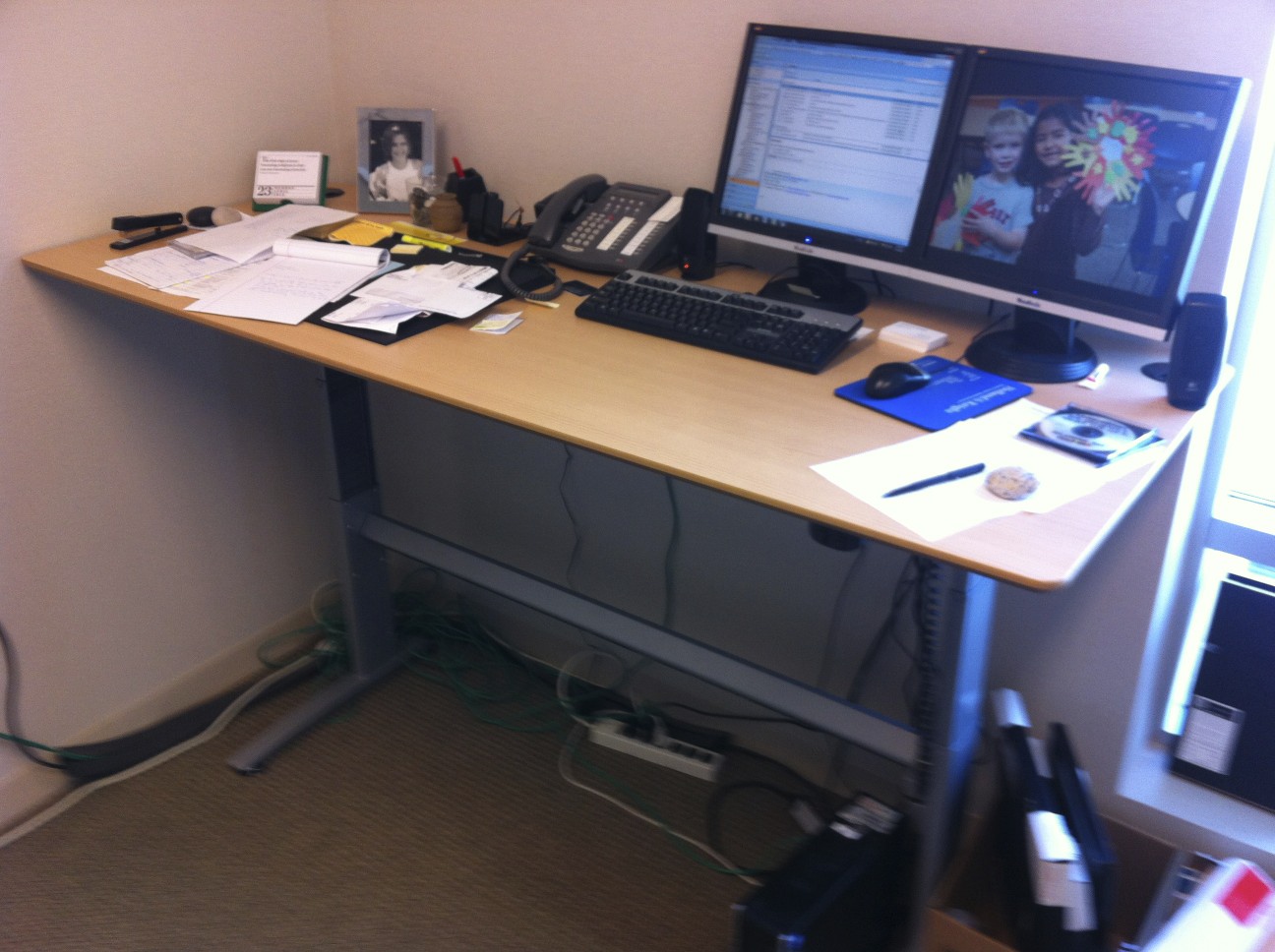
 

Sitting is Bad for You


I recently got a standing desk.


We’ve known for some time now that sitting all day will kill you.


Sure, there’s no way to avoid death, but why hasten it?


Makes me wonder about the wisdom of sesshins.  So good and life-giving in so many ways, and yet . . .


Ironically, one of our sanghamates fainted tonight while we sat at Waldo (which is soon to be blended into the Greater Boston Zen Center).


Fortunately, he’ll be fine.


First time I’d seen that one in 21 years of frequenting meditation halls and other such establishments.


Christmas Reflection

The kids unwrapped their presents hours ago.  There were a whole lot of them.  They — we — definitely are among the most fortunate people on this planet from almost every point of view, not least of all our access to basic and not-so-basic material resources.  I am very grateful for that.


The kids seem grateful, too, though, at six and three, they don’t yet have a global perspective on their good fortune, nor even a particularly keen local perspective. Ellis, our six-year old, is developing a pen pal relationship with a boy in Uganda, but his ability to relate to the differences in their circumstances is limited at present.


The relative abundance we enjoy prompts so many questions:


How have we arrived at a moment in history when some children wake up on Christmas morning to a rash of presents while other children wake up starving?


How on earth can we tolerate this?


How and when does one sensitize one’s children to these realities without overwhelming them or being a complete killjoy?


Beyond the moral shock one hopefully feels and expresses at these disparities, what — practically speaking — can and should we do to change things?  Needless to say, the problems are complicated, and so many social, political and economic efforts to address them have failed miserably.


From one perspective — which is global, longitudinal and diffuse — things are changing decisively for the better, and they have been changing with increasing rapidity for some time.  Watch these short, amazing videos by Hans Rosling, a Swedish physician, public health scholar and statistician, to see how and why:


200 years that changed the world


The magic washing machine


(The rest of this post may not make much sense unless you watch the videos, or at least the first one, which is just four minutes long.)


I can relate a bit to Roslings’ story about his mother’s first washing machine and what it meant for their family.  My paternal grandmother, who died in 2003, six months shy of her 100th birthday, told me many stories about how cars, air travel, modern medicine and other innovations she had witnessed transformed her world.


My father (her son) worked three jobs when we were young — as a laborer for the Northern Illinois Gas Company (by day), as the foreman of a janitorial crew (at night), and as a floor salesman at Sears (on the weekend) — to make ends meet and better our living standard before eventually getting his first white collar job as a bank teller.  Many of my own early Christmas presents, some of which were technological innovations like the walkie-talkie, were “purchased” with S&H Green Stamps that my mother collected from gas and grocery store purchases throughout the year during that just-making-ends-meet era, so the space beneath the tree would seem to overflow for my brothers and me, just as it seemed to overflow for our kids this morning.  Her mother, my grandmother, who was widowed at an early age, no doubt was equally ingenious at providing more for her three girls at Christmastime than her secretary’s income otherwise allowed.


My parents wanted to create better circumstances for us than their parents and immigrant grandparents had been able to create for their children.  Stories like this abound in the west and, increasingly, around the world.  Stories of aspiration, of hard work, of creative insight skillfully applied, and of resulting innovations that help transform the world and improve others’ lives.  The Rosling family’s washing machine.  The Internet that made the Arab Spring possible.


I’ve worked in entrepreneurial environments for much of the past 25 years — sometimes as part of new businesses, sometimes as an advisor to them.  I’m presently involved in a solar energy startup that’s developing technology with the potential to supply the world’s energy needs, cleanly, at half the cost of the cheapest fossil fuel.  I advise a new fund which invests only in companies that treat their employees well, engineer their operations for sustainability, and the like.  Many of my colleagues and friends are involved in similarly promising enterprises.  These and many other businesses like them are examples of the types of enterprises that give Rosling, and me, hope for our common future.


The picture is not all rosy, as we know.  Businesses are profiting today by solving problems created by past business activities, and some of today’s new businesses no doubt are creating other problems.  There’s way too much greed and corruption.  Wealth distribution within some rich and developing countries is far too uneven, and currently moving in the wrong direction.  Even at their theoretical — imaginary, really — best, business activity and technological innovation are just two potential forces for positive change.  Happy endings aren’t guaranteed.  But, like Rosling, I’m inclined to be hopeful, in part because I’m in the business world, see parts of it that give me reason to be hopeful, and so can’t paint it all black with an overly broad brush, as I see many people doing these days.


There is much progress on other fronts, as well.  Steven Pinker’s recent, exhaustively researched book, The Better Angels of Our Nature, makes the case that (in Peter Singer’s words) “our era is less violent, less cruel and more peaceful than any previous period of human existence.”


You may doubt all this, insisting that the world surely is going to hell in a hand basket, but, with the exception of a few notable and not-to-be-discounted problems like global warming, the trend data is decisively against you.


There’s another perspective, of course — this one intensely local, in-the-moment, and specific.  Seven billion of them actually, way too many of which still are defined by poverty, anguish and hopelessness.  It’s the perspective of that starving child, whether he is in Mumbai or Manhattan.  Of the poor, lonely, elderly woman who has no one with whom to share Christmas.


This is the perspective to which Jesus and other ancient and contemporary prophets give voice.  Though hope for the future is a key theme in prophetic discourse, from this perspective there really is no hope other than the hope that’s actualized here-and-now.  There is no arc of progress.  Only food for the hungry.  Shelter for the homeless.  Clothing for the unclothed.  Speech on behalf of the voiceless.  Here.  Now.


We obviously need both perspectives.  Moreover, and more than ever, I think we need to integrate both perspectives, in relations among nations, within national governments at all levels, within companies, within our homes, within our hearts.


All seven billion of them, but especially those relatively few hearts that awoke to plenty this Christmas morning.


Lunch


Crazy day.


I left my office around 12:30 to get something to bring back to my desk to eat.


Stopping for plastic utensils and a paper napkin before leaving Au Bon Pain with my soup and sandwich, I thought, “I need this spoon, but do I need a fork?  I shouldn’t take it if I don’t, but maybe my sandwich will disintegrate.  Better take it.  I’ll stash it in my desk for future use if I don’t need it.”


I unpack my lunch sack back at the office to find . . . two plastic forks (and no spoon).


Ugh.


I open my desk drawer to deposit one of the forks, only to find . . . seven plastic forks living there already.  Guess I’ve been here before.


Ugh.


Monkey mind.