Which of Me Is the True Chi’en?

I have fallen behind on posting talks and other musings and news. Here begins a flurry of catch-up posts. This is a talk I gave on January 12, 2023.

This is an extended version of Case 35 in The Gateless Gate:

Ch’ien was the beloved only child of a merchant who one day announced he had found a good husband for her. But her cousin was her secret lover and they had known each other since childhood.

That night the cousin, distraught, set off up the yellow river, but he saw running along the banks a form in the moonlight, and it was Ch’ien, and she joined him. They settled upriver and had two children, and made a life, but she longed to see once again her home and her father. They returned and Ch’ien waited in the boat while her husband approached the house to see what sort of a reception he would get.

To her husband’s surprise, the father was delighted to see him. The young man confessed, “Ch’ien ran off with me that night, and we lived together and had two children. She is waiting in the boat, eager to see you.” And the father said, “Is this a joke? Since the time you left, she has been sick in bed, unable to arise or speak.” The father told the woman in the sick bed what he had heard, and at this, she rose to her feet and stepped out the door. At that moment, the woman from the boat herself arrived at the garden gate. The two women walked towards each other, embraced, and became one.

Wu-tsu asked a monk, “The woman Ch’ien and her spirit separated. Which is the true Ch’ien?”

Fran and I have been reflecting on and talking about shadow work and its relationship to Zen practice for over a year. (Fran initiated and has been driving this discussion, and I am grateful to her for that.) The term “shadow” is from Jungian psychology. It’s the idea that there are elements of oneself that are hidden to us but still influence what we feel, think, say, and do.

It’s important to understand that shadow elements are neither good nor bad. Anger may be a shadow element for some of us—an emotion one has difficulty discerning in oneself and expressing in functional ways—but anger is not bad. If the conscious part of oneself is cut off from anger we are more likely to behave passive-aggressively to get our needs met in relationship. As a result, we may not be very effective at meeting our needs and we may damage our relationships. Others are likely to feel manipulated or feel we’re hard to read and something of a burden. Maybe some people even will take advantage of us because we can’t let them know we’re upset by their behavior. When we do express anger, it’s likely to be expressed explosively, because angry energy has been building up for so long—most of a lifetime, perhaps. If we had been in touch with it all along, if anger were not in the shadows, it could be channeled and expressed more constructively. Anger calibrated, expressed, and channeled constructively sometimes even can help us do great things, like standing up against human rights abuses.

It’s not just feelings and impulses that we tend to think of as bad, like anger, that can be banished to the shadows. Our capacity for love, healthy pride, and courage can reside there, too, similarly limiting one’s capacity to show up as the best version of oneself.

What does all this have to do with this old Chinese fable that Wu-tsu used as a koan? I see it as encouragement to call forth our shadow elements and embrace them.

Like many good stories, there’s a central moral dilemma, and moral dilemmas often divide us—not just divide one person from another but divide one person internally. Chi’en is a young woman in a traditional, patriarchal culture in which family is a primary value and social structure. Respect for and obedience to one’s elders is a key requirement in this culture. Chi’en would have felt duty-bound to respect her father’s judgement and wishes about her marriage and obligated to stay near her birth family to care for her parents in old age. Even today, Chinese culture is relatively more relationship-based than many Western cultures. It places relatively more emphasis on group harmony and stability. The needs and preferences of individuals are important, yet they tend to be addressed in what might seem to many of us to be more nuanced (and, from our perspective, often less personally satisfying) ways within one’s web of close and distant relationships.

Add up all these factors and we can imagine that Chi’en would have felt as if she had little personal agency to declare her true love and speak and act against her father’s wishes. (In fact, I know from reading the work of a Chinese-American expert in Chinese moral philosophy that Chi’en might even have thought of her flight from home as something she had to do for her family, because remaining home as a malcontent would have made life intolerable for them.) We can imagine that a young woman like Chi’en, in this family and social context, might be conditioned to repress certain feelings and impulses that can help make us happy and whole, but which would have felt risky to express—feelings and impulses like eros and a sense of our own worth, power, and agency. But those feelings exist as shadow elements nonetheless.

Chi’en may have felt divided between the love she felt for the young man of her dreams and the obligation she felt to conform to her parents’ and culture’s expectations. She may have felt divided internally between love of her boyfriend and love of her family, including her father. Chi’en and other women then and now often have felt constrained—unjustly, or at least unfortunately, subject to other shadow elements operating at the level of a group, like one’s family or workplace, or even an entire culture—yet we can also imagine that Chi’en genuinely loved her father, even as he enacted cultural scripts that constrained her agency in keeping with prevailing social norms regarding his social role. We can feel both love and distaste for another person, and this ambivalence very often gets resolved internally by embracing one feeling and repressing the other, rather than accepting and dealing with our complex reality in a more functional way.

What is Chi’en to do with her dilemma? What does she do?

In the first chapter of this brief story, Chi’en runs away with her boyfriend and lives the life of her dreams, seemingly strong and self-possessed, showing that her capacity for love and her personal power do not reside in the shadows. (Then again, as noted above, perhaps Chi’en felt she ran away as much for her family’s benefit as for her own.) But the plot thickens when Chi’en’s heart longs for her home and father, and she returns home.

Chi’en’s husband discovers that her father is not angry, but rather is thrilled to see him. It seems there’s another Chi’en who stayed behind and has been heartbroken and bedridden ever since her father told her about the marriage he had arranged and Chi’en’s true love ran away.

Were Chi’en’s passion and personal power residing in the shadows after all? Did the man her father introduced sense that she had given her heart to someone else and decide not to marry her? Did a despondent Chi’en then withdraw from life, paralyzed?

Which life did Chi’en really live? When we ask the question that way, the story provides no answer. This is myth and allegory. Chi’en’s physical body didn’t really duplicate itself, with each double going in different directions to live different lives.

But Wu-tsu doesn’t ask the monk which life Chi’en really lived. He asks, “Which is the true Chi’en?”

If most good stories have a central moral dilemma, most also have a good twist at the end. This isn’t just a good story; it’s a great story. There are two twists at the end. The first twist is that one Chi’en returns after many years to encounter another. The second is that the bedridden Chi’en, who had been longing for her lover all these years, gets up and walks right past him. She does not immediately embrace the man for whom she has been longing. Instead, she embraces herself, and the two Chi’ens become one. She really can’t love her husband or her father fully and well until she can love all the parts of herself, healing her internal divide.

I see this koan as an allegory about the necessity of making self-integration, or atonement within oneself (at-one-ment), an important feature of what it is to be a Zen practitioner. When those aspects of ourselves that are hidden are coaxed out of the shadows and embraced, we become one. We can’t consciously be one with that which we don’t (yet) see in ourselves. We can’t be our true selves, or at least our best selves, if we don’t fully know ourselves. And the parts we refuse to know will assert themselves somehow if we don’t see and embrace them, and only to ill-effect, perhaps even causing grave harm.

We can’t be whole personally if we don’t peer into the shadows and invite what resides there to come forth, and we can’t be whole collectively either. We don’t know what happens after the two Chi’ens merge, but we’re left with this sense that the relationships among the three central characters in this story—Chi’en, the man she loves, and her father—now are on a better trajectory. You also get the sense that the father and husband have grown and perhaps glimpsed and embraced their own shadow elements, in turn making it easier for Chi’en to greet and integrate hers. Her father seems to have liberated tenderness, compassion, and self-confidence from the shadows. It must have taken all three to accept how his conformity to convention had injured his daughter and so to welcome her true love when he returned.

While I see this koan as evidence that we are encouraged to seek self-integration and at-one-ment, I don’t think Zen traditionally has offered all the tools we need to do that work. In fact, it’s possible to use our practice as a defense—to engage in what’s sometimes called “spiritual bypassing,” which is turning to meditation and spiritual practice to avoid uncomfortable emotions and experiences, much like one might turn to alcohol or gambling. I want to be quick to add that meditation, koan work, and other elements of our practice can really help us discover and integrate what’s hidden. They can help prepare the ground for and can positively reinforce modern shadow work practices. And it’s not just Zen practitioners who sometimes become curious about and explore those other practices. Psychologists have become quite curious about Zen and are exploring it and integrating it into their practices.

We’ll have more to say about Zen and shadow work in the coming weeks and months. We want to spark a broader dialogue about it and create elective opportunities to integrate shadow work into our practice.

The true Chi’en, the true you and me, is the whole person, ever more intimately known to herself. Zen practice really must be a practice—a set of practices—for ever increasing at-one-ment.

Insight

This is the text of a talk I gave on June 8, 2023.

This is Case 20 in The Book of Equanimity:

 Master Jizo asked Hogen, “Where have you come from?”

“I pilgrimage aimlessly,” replied Hogen.

“What is the matter of your pilgrimage?” asked Jizo.

“I don’t know,” replied Hogen.

“Not knowing is the most intimate,” replied Jizo.

At that, Hogen experienced great enlightenment.

Jizo’s final remark in this koan, “not knowing is the most intimate,” is among the most profound and repeated lines in the Zen tradition, but I want to focus on the very last line of this koan instead.

This past Saturday (June 3rd) I gave a talk about seeking and finding meaning.  In that talk I said many of us come to practice because things seem out of joint; disintegrated.  Humpty Dumpty is cracking, or maybe already in pieces.  We’ve made meaning when all the pieces of oneself and all the pieces of the world we inhabit seem to cohere in a new way.  We’re seeking integration; a sense of wholeness.  The knowledge we seek isn’t a philosophical, theological, or scientific formulation, but the experience of knowing oneself and all else as interlaced threads of the vast robe of liberation itself.

Many koans end like the one I read a moment ago: “At that, so-and-so experienced great enlightenment.”  Reading this, we might assume the monk’s search for coherence and cohesion is over in a flash.  If this is what we expect for ourselves—that we’ll have a flash of insight that puts our heart-mind to rest once and for all—we may be disappointed.

Many Zen practitioners do have a powerful kensho experience at some point.  These experiences absolutely can, and they very often do, leave one with an abiding sense that one is not separate from it all.  Many other Zen practitioners don’t have such a singular experience, however, but instead have many less dramatic moments of non-dual insight, like a sense of the oneness of it all while watching steam dance upward from a teacup or watching the play of light streaming through a window.  Whatever our experience, the spark that brought us to practice is bursting into a flame.

But old ways of knowing and seeing, and the old habits of mind and heart that accompany them, tend to die hard.  Zen practice is a context that tests and challenges the boundaries of the ways of knowing and being we have brought to it.  It sometimes pierces, sometimes simply sidesteps our preexisting mental frames.  Chief among these mental frames is our sense of self; of who we are and how we exist. 

The moments of insight we experience as Zen practitioners are disorienting to that sense of self, with its overly rigid boundaries and its containment, command, and control projects.  Early in our practice, our self-sense may react to new insight by trying to co-opt it; to contain and control it as something “I” now “have.”  The ever-quotable Tibetan teacher Chogyam Trungpa was fond of saying that the ego wants to be present at its own funeral.  Our insight experiences can be held in a way that’s self-referential; regarded as personal accomplishments, and so indicative of spiritual pride.

If and as we continue to practice, however, if and as we continue to nurture and fuel the flame insight experiences ignite, that rigidly bounded sense of self ultimately may be consumed by the flame and turned to ash.  Other practices, like therapy, can complement and support our practice, and vice versa (but should not be confused with it).  

Ash isn’t nothing; it isn’t mere refuse.  It mixes with the the soil that gives life.  It scatters and rides the wind in the Ten Directions.  Now we truly identify, mingle with, nourish and are nourished by all that arises.

Mature, seasoned insight is the experience of feeling centered in a universe with infinite centers.  Now we know and experience ourselves and all else as interlaced threads of the vast robe of liberation itself.  No containment necessary, or even possible.

The monk in our koan dropped his guard for a moment.  He became vulnerable; exposed.  He had been wandering around with an intense sense of purpose, but he realized he had no idea what he was looking for or even why he felt something was missing in the first place.  To his surprise, Jizo validates his not knowing; encourages him to give up the self-referential containment, command, and control project that his spiritual journey had become, and simply live into the mystery. 

This monk, like so many of us, set foot on a narrow path thickly overgrown with questions.  With this moment of initial insight, the path begins to widen, feel less vexed and more spacious.  Maybe the path eventually will disappear into a vast clearing.  Lost in it, we see nothing but the horizon in every direction.  And each blade of grass at our feet.

In-sight.  Seeing from within, not seeking a way out.  

What is this vast clearing in which we find ourselves?  Home, warm and intimate.

I think Jizo is encouraging the monk to rest his weary legs, mind, and heart.  I think the monk is on the cusp of accepting that practice is the point of practice; that his life is the point of his life.  Jizo is affirming that recognition.            

Jizo is telling the monk that he’d might as well make himself at home.

Verse of the Kesa

I gave this talk on Thursday, November 10, 2022.

I want to speak briefly about the Verse of the Kesa tonight.  This is the short verse people are chanting silently to themselves before our sits when you see them kneeling at their cushions with their rakusus on their heads.  I’ve recently started using an alternate version of this verse, which I prefer to the one I was taught.  

The version I learned, and which most of us here chant, goes like this:

Vast is the Robe of Liberation,

A formless field of benefaction.

I wear the Tatathagata’s teachings,

Saving all sentient beings.

The alternate version goes like this:

Vast and wonderous is the Robe of Liberation,

Formless yet embracing every treasure.

I wish to unfold the Buddha’s teaching,

That I may help all living things.

Subtle differences.

The first line adds “wonderous” alongside the adjective “vast.”   I like that.  A sense of wonder, of awe, is at the heart of our practice.  To wonder is to not know—to not know in a very positive way.  To marvel.  To be awestruck.  

We’re not trying to understand in a narrow sense in Zen; to reduce existence to syllogistic formulations.  To sum it all up.  We’re cultivating an ever-deeper realization that we’re part of it all.  We’re learning to recognize ourselves and all else as Buddha.  We’re feeling ourselves ever more tightly woven into the Robe of Liberation.

The second line:  I always have loved the image of a “formless field of benefaction,” yet I think the alternate version both captures its spirit and adds something lovely. 

“Formless yet embracing every treasure.”  Emptiness, the Absolute, manifesting as the 10,000 things, each a treasure.  I like that word “embracing.”  It evokes the ideal of agape, of the highest love, for me.  To embrace also is to hold.  Each treasure, including you and me, held.

The third line:  I like the formulation “I wish to unfold the Buddha’s teachings” much more than “I wear the Tatagatha’s teachings.”

“I wish” speaks to our intention, our aspiration, as we step onto and continue walking along this path.  And “unfold” suggests ongoing discovery and learning.  Buddha—this—is ever revealing its teaching, and yet ever mysterious.  The vast universe is ever pouring itself out, wonderously.

It’s possible to hear “I wear the Tatagatha’s teachings” in a way that seems more pridefully descriptive, with an air of exclusivism, though I’m not suggesting that’s intended.  The intention is that I’ve accepted the teachings completely—so completely I’ve wrapped myself in them.  Yet I suppose it’s possible to hear these same words in a tribal or sectarian way: Buddhist doctrine is my uniform; that with which I identify and which identifies me distinctively compared to you.  

And the last line: I like “That I may help all living things” so much better than “Saving all sentient beings.”  Having been coerced in my youth into converting for a period from Roman Catholicism to a fundamentalist strain of Christianity, I’ve always felt uncomfortable with this notion of “saving” others.  I don’t care how you spin it, I just don’t like that idea.  Even viewing it from what we call the intrinsic perspective in Zen, from the perspective of the Absolute, where there is no one in need of saving, it still smacks of absolutism and missionary zeal to me.  Helping, however:  Yes, I can pledge to try to help.  

And why limit our sphere of concern to sentient beings, however broadly we might define sentient?  Why not try to help all living things?  Yes, I like that better, too.  And, by the way, all is alive, including the zafus and fish drum.  The whole of this vast and wonderous Robe of Liberation is alive.  All is Life.

Kesa means robe.  Buddhist renunciates have made and worn a robe of died fabric scraps since ancient times.  Our rakusus are mini robes.  No one is quite sure when and why they emerged, but it happened in China, most likely in response to persecution of Buddhists as Buddhism fell out favor and Buddhists were persecuted for several years during the mid-ninth century.  Monks may have made rakusus to wear under their street clothes, much like the tallit worn by Orthodox Jewish men.  

Dogen saw Chinese monks wearing rakusus and chanting the Verse of the Kesa and brought these practices to Japan.  Dogen gave important talks about the kesa.  He put these practices and what they symbolize at the heart of the expression of Zen he taught.

Now we have these practices.

I was poking around the web as I wrote this talk, taking in what others have said about the kesa and the verse we chant as we put it on.  I found a lovely website called Zen Universe that’s maintained by three Zen adepts in Eastern Europe.  Their page on the kesa is wonderful.  It includes this passage:

Heaven and earth, the entire universe, are one single kesa.  No world exists outside of the kesa.  We do not fall into hell or rise up to heaven – we go nowhere, we come from nowhere.  There is only one kesa.  We owe it to ourselves to wear the kesa.

When we wear our kesas we affirm to ourselves and others that there is only one kesa.  That we “do not fall into hell or rise up to heaven.”  That we ourselves and all others have never needed saving, though we might need some help realizing this, and it is right and good to offer what genuine help we can give.But here’s the point I really want to make, and that I hope we all internalize.  Whether you’ve taken Jukai or not, please think of getting dressed each day as putting on the kesa, because that is what we’re doing.  We can say the Verse of the Kesa, or just call it to mind for an instant, as we put on our jeans.  Let’s see the ordinary clothes we wear, and our pajamas too, and our very skin, even when we’re alone in the shower unclothed, as the Robe of Liberation.  Because they are.

Zhuangzi’s Grief

I gave this talk on Saturday, October 30, 2021.

I’m part of a reading group that’s focusing on Chinese literature this year.  Our guide is a Chinese-American poet who grew up in China at the end of the Cultural Revolution.  I thought I’d open with a story from the ancient Daoist text known as the Zhaungzi, named after its author.  

This translation is from a much more recent book called The Path: What Chinese Philosophers Can Teach Us about the Good Life, which I highly recommend.  

Zhuangzi’s wife died and Huizi went to console him.  He found Zhuangzi squatting on the floor with his legs open, drumming on a pot and singing.  Huizi said, “You lived with her, raised children with her, grew old together.  To not cry at her death is bad enough, but drumming on a pot and singing—what could you be thinking?”  Zhuangzi said, “Oh, it’s not like that.  When she first died, how could I not grieve?  But then I looked back to her beginning, before her birth.  Not just before her birth, but before she had a body.  Not just before she had a body, but before she had qi.  In the midst of that amorphous chaos, there was a change, and she had qi; the qi changed, and she had a body; her body changed, and she was born.  Now there is yet another change, and she has died.  This is like the change of the four seasons: spring, autumn, winter, summer.  Now she is residing in the greatest of chambers.  If I were to follow her sobbing and wailing, it would show I understood nothing about our destiny.  So I stopped.”

I’m visiting you at a time when people the world over—and no doubt some of us here—have experienced and are continuing to experience extraordinary loss and hardship. Over the past 18 months, a global pandemic has claimed millions of lives; lives have been lost to hate crimes and some responses to them; political unrest here and elsewhere has claimed lives; storms, fires, and other extreme weather events have taken lives, homes, and livelihoods.  

During the past year, my wife and I each lost our fathers, hers to COVID and mine to declining health in old age.  Our family also lost two dear friends, one 95 when she passed and the other only 12.  Several of our close friends have experienced similar losses or will soon.  

Everywhere one turns these days, hearts seem laden with loss and hardship.  This is always true, of course.  The pandemic and the other extraordinary things I just mentioned have been occurring alongside the ordinary march of old age and illness that ends in death.  

What are we to make of this story about Zhuangzi, as dark clouds gather above us?

For me, this snapshot of Zhaungzi during his experience of loss is evidence of the fruit our practice can bear.

We should first note that Zhuangzi’s response to his great loss is not spiritual bypass, stoicism, or ascetic detachment.  Zhuangzi felt and grieved his wife’s passing.  His first response—his primary response—was to wail and sob for some time.  

But his loss obviously did not crush his spirit.  In fact, his spirit ultimately seems enlarged by this difficult experience.  Zhuangzi embraces the aching part of himself.  It has a welcome seat at the table—and, for Zhuangzi, we’re all sitting together at a very, very large table.

One does not get the sense from this story or others in his book that Zhuangzi approaches practice as an effort to discover and perfect his essential, “true self,” whatever that might mean.  Zhuangzi’s persona and response to life are simple, earthy, and right on the surface.  The picture of Zhuangzi that emerges is that of a tender, vulnerable human being with a wise, open heart.  This tender heart opens to its own stirrings, to silver linings, to the whole of his life as the life of the cosmos.

Realizing, maintaining, and sharing this orientation to life is what Zen practice is about. 

We can and must work to end this pandemic and strengthen public health efforts globally; address climate change; counter hate and violence; and more.  If and as we make progress in these areas, however, we will continue to experience everyday losses and hardships.  

Zhuangzi’s sorrow and his joy are related; they’re of a piece.  As we know, true joy doesn’t arise from the temporary satisfaction of compulsive, personal cravings, or the temporary avoidance of what makes us anxious.  It arises as we lose and find ourselves in and as the vast robe of liberation into which we and all else are woven.

This robe of liberation includes our sorrow.  We won’t experience true joy if we’re defending ourselves against our own pain and sorrow and closing ourselves to others’ hardships.

When people first hear about the Four Noble Truths, some think the Buddhist path is aimed at insulating oneself from suffering; at bypassing—not touching—that which feels painful.  But it’s quite the opposite. 

So much energy today is directed toward finding and magnifying the self—polishing a version of oneself, putting it on display, and defending it.  Sadly, even spiritual practice and our service commitments sometimes are coopted by this program.  If we seek and magnify ourselves in that way, however, the magnifying glass ultimately concentrates the heat we were hoping to escape, rather than reducing it.

We’ve recently been exploring differences between Chinese and American conceptions of the self in the reading group I mentioned, so our guide encouraged us to watch a documentary called The Century of the Self.  It’s about the evolution of modern conceptions of the self in America.  

The late American playwright Arthur Miller is quoted in the film.  He’s reflecting on the death of his ex-wife, Marilyn Monroe, who committed suicide soon after an intensive, weekend-long therapy immersion experience with proteges of Sigmund and Anna Freud.  I’m not against therapy, even in its contemporary psychoanalytic forms, but I do think Miller’s critique nicely diagnoses one illness that plagues our culture more generally.

He says:

“My argument with so much of psychoanalysis, is the preconception that suffering is a mistake, or a sign of weakness, or a sign even of illness, when in fact, possibly the greatest truths we know have come out of people’s suffering; that the problem is not to undo suffering or to wipe it off the face of the earth but to make it inform our lives, instead of trying to cure ourselves of it constantly and avoid it, and avoid anything but that lobotomized sense of what they call `happiness.’ There’s too much of an attempt, it seems to me, to think in terms of controlling [a person], rather than freeing [a person]. Of defining [the self] rather than letting [the self] go.”

Zhuangzi isn’t valorizing suffering, and neither should we, but nor does he push it away.  Our awakening is an awakening to the contingency and vulnerability of our creatureliness—of all that is dear to us and everyone we love. 

And to the vitality and expansive mystery of our existence.  Our practice is a practice of caring for ourselves and each other as the contingent, vulnerable, and imponderably vast beings that we are.

Nonsentient beings expound the Dharma

I gave this talk during our Full Moon Zen sit on August 26, 2021.

From the Record of Tung-shan (aka Ts’ao-tung):

Tung-shan accordingly took leave of Kuei-shan (aka Isan) [whom he had asked whether nonsentient beings expound the Dharma] and proceeded directly to Yün-yen’s. Making reference to his previous encounter with Kui-shan, he immediately asked what sort of person was able to hear the Dharma expounded by nonsentient beings.

Yun-yen said, “Nonsentient beings are able to hear it.”

“Can you hear it, Ho-shang (another name for Yun-yen)? asked Tung-shan.

Yun-yen replied, “If I could hear it, then you would not be able to hear the Dharma I teach.”

“Why can’t I hear it?” asked Tung-shan.

Yun-yen raised his fly whisk and said, “Can you hear it yet?”

Tung-shan replied, “No, I can’t.”

Yun-yen said, “You can’t even hear it when I expound the Dharma; how do you expect to hear when a nonsentient being expounds the Dharma?”

Tung-shan asked, “In which sutra is it taught that nonsentient beings expound the Dharma?”

Yun-yen replied, “Haven’t you seen it? In the Amitabha Sutra it says, `Water birds, tree groves, all without exception recite the Buddha’s name, recite the Dharma.’”

Reflecting on this, Tung-shan composed the following gatha:

How amazing, how amazing!

Hard to comprehend that nonsentient beings expound the Dharma.

It simply cannot be heard with the ear.

But when sound is heard with the eye, then it is understood.

Today has been a scorcher in Boston.  The Earth is screaming, “Summer!”—and, also “Ouch! Climate change!”

Yet it’s almost September, and Fall is poking through.  Some trees are beginning to shed their leaves.  Birds and squirrels are busy gathering provisions.  Duck and geese are on the move.

The central character in the story I just read, Tung-shan, lived and taught in the 9th century.  In this story, he’s still an ordinary monk, wandering around visiting monasteries, seeking out teachers.  Later, he becomes a teacher who is regarded as the Chinese founder of the Soto Zen stream in which we’re situated.

In Tung-shan’s day, people were obsessed with a certain type of philosophical question. It’s a question that continues to preoccupy philosophers, physicists, neuroscientists, ecologists, and ordinary people, like you and me, to this day.

I seem to be alive and conscious. You seem to me to be alive and conscious. But, what else is alive and conscious? Birds? Trees? Stone walls?

Chou-chou, the teacher who gave a provocative “No!” when another young monk asked him whether the temple dog had Buddha nature, was a contemporary of Tung-shan.  

In the story we’re looking at tonight, Yün-yen, one of the teachers Tung-shan visited, gives Tung-shan the same answer Chou-chou gave the young monk who questioned him about the dog.  But, Yün-yen gives that answer in the form of a provocative “Yes!”

Yün-yen affirms that birds and trees expound the Dharma. Everything hums the song of the universe.

Tung-shan had been trying to reason his way to this realization, but seemingly wasn’t getting anywhere. He put his hand to his ear, hoping to hear what he thought he was listening for. His thinking mind was sure it must be hidden; an esoteric, coded message of some kind. A riddle only the thinking mind could solve. But all he heard was birdsong or silence—and, well, that just couldn’t be it, he thought.

Tung-shan sought answers in the sutras, as if words on a page could resolve the matter and put his heart at rest.

This encounter with Yün-yen does seem to have been a turning point for Tung-shan.  That’s evident from the verse he composed after it.

After this encounter with Yün-yen, who eventually made Tung-shan one of his successors, Tung-shan realizes we can’t “hear” birds and trees expounding the Dharma with the ear. We hear it with the eye.

In other words, we develop a new kind of insight; a new kind of perception.

Zen practice is about learning to hear with our eyes in this way.  It invites a shift in our perception; in our orientation.

This shift is what we call enlightenment.  It’s not something we can grasp for and achieve, like running a six-minute mile or baking a souffle that doesn’t collapse.  It’s something we seep into, and that seeps into us, through our practice.  Like tofu soaking up soy sauce; soy sauce permeating tofu.

Dōgen described the shift this way:

“Before one studies Zen, mountains are mountains and waters are waters,” he said.

We’re like young Tung-shan, in other words. We see people and animals and plants and rocks. We’re sure people are conscious and consciousness is a good thing to “have.” The poor, dumb rocks don’t have it. Plants? We’re not so sure.

Dōgen goes on, “. . . after a first glimpse into the truth of Zen, mountains are no longer mountains and waters are no longer waters; . . .”

As one begins to awaken to the awakened nature of all that is, many become lost in Oneness for a time.

Finally, Dōgen says, “after enlightenment, mountains are once again mountains and waters once again waters.”

Rocks are rocks, yes, but now we do hear them expounding the Dharma.  Yün-yen’s whisk is Yün-yen’s whisk—and if he swats you with his whisk or his staff, as Zen teachers were prone to do in that era, believe me, you would feel it!  Getting whacked by Oneness stings!

But now we truly know that whisk is the One.  The relative and the Absolute are one and the same.  Form is emptiness; emptiness is form.

In the countless, slapstick-style koans in which a Zen adept has a breakthrough insight when a teacher slaps his face, or closes her leg in a door, or cuts off their finger, this is what one is realizing.

And, once we realize this, birds and trees and stones are no longer dead to us; the world is alive to us experientially, not alive as an idea. I have to believe that this shift is much needed today, on a broad scale, at this moment of global ecological crisis.

We often hear meditation practitioners, and some teachers, say that mediation is about developing our powers of attention and concentration.  I suppose mediation has that effect.  

But I prefer to think of our practice as more about attending, than attention—though one must be attentive to attend.  

Meditation is about attending.  Showing up.  Participating.  Taking part.  We are just a part—and every much a manifestation and microcosm of the One as anything else.  Nothing more, and certainly nothing less.

Through our practice, we open up to our own experience; to all experience.  We come to sense the hum of the universe within and without.  Let it bubble up and seep in.  

And our ideas of within and without, up and in, begin to soften.

We turn our ear to see a bird.

Open our eyes to hear it sing.

Rocky Flats, Sawada, and Bearing Witness

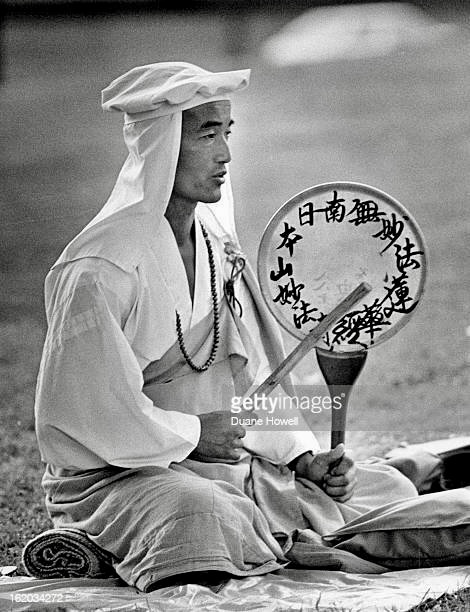
AUG 4 1989; Rev. Katsuzo Sawada, a Japanese Buddhist Monk in front of state Capitol of Nipponzan Myohoji, continues protest and fast to close Rocky Flats Plant. The fast was started on July 4 by LeRoy Moore of the Rocky Mtn. Peace Center and is being carried on by Sawada.; (Photo By Duane Howell/The Denver Post via Getty Images)

My family lived a stone’s throw away from Boulder, Colorado, in the late 1960s and the first half of the 1970s, and I was in college in nearby Denver from 1976 to 1980.   I lived in Boulder off and on between 1985 and 1995, first as a grad student, then working as a young lawyer.  Throughout most of this time, spanning nearly three decades, plutonium parts for nuclear bombs were being manufactured at Rocky Flats, a massive, underground, top secret facility just outside Boulder.  

I can’t remember precisely when I first heard Sawada’s steady drumbeat come and go, but it was definitely during the time I was a student in Boulder.  I was in the little cabin in Chautauqua Park where I lived, in a coffee shop, out on a run.  

The first couple of times I heard Sawada’s drum, it was a sonic apparition.  I turned to see the source of this unusual sound, but couldn’t locate it.  The next time I heard it, I turned quickly and caught sight of Sawada, taking broad, swift strides, in full monk garb, beating his hand drum.

This was Sawada’s practice.  Morning to night.  For decades.  

Sawada is part of a Buddhist sect that emphasizes walking meditation and work for peace.  Much to his parents’ dismay, he became a monk as a young man, and ultimately moved to Boulder, alone, to bear witness to the madness of the nuclear arms race.  Many years later, a couple of other monks from his order eventually joined him in Boulder, perhaps, in part, to lessen the physical toll this form of protest must have taken on Sawada.

Sawada’s presence in Boulder–the sound and sight of him at random times during the week–made a deep impression on me.  I got curious about him again a few days ago, after talking about him during our Full Moon Zen Zazenkai last Saturday.  While still alive, he is mostly forgotten now.  There is scant evidence of his life and practice online, though I did find a few crumbs, including an oral history interview that is part of a series of interviews documenting protest activities at Rocky Flats.  It seems memory of Rocky Flats, and even the Cold War itself, is fading.  I worry about that.

Boulder is and was a center of Buddhism’s transplantation and growth in the United States, so it also was interesting to find an article in Tricycle about Rocky Flats.

In 1983, years before I heard Sawada’s drumbeat, I was one of the student organizers of a massive, peaceful protest at Rocky Flats.  Nearly 17,000 people of all ages gathered to join hands around the above-ground perimeter of the facility.

Bearing witness to the cries of the world is an important ideal and practice in Zen.  Roshi Bernie Glassman, my Dharma great-grandfather, made bearing witness one of the three pillars of the Zen Peacemakers order he founded.  

I spoke about Sawada during our Zazenkai, because I was recalling and appreciating both the way in which his meditation was a practice of bearing witness, and how the monks who eventually joined him in Boulder made the practice communal, taking the baton from him throughout days and weeks to sustain the practice.  People came and went during our Zazenkai, according to their availability and needs, yet there was never a time when any of us sat alone.  I had this same sense of bearing communal witness Saturday, as we sat amidst the great turmoil and suffering of the present day.  

The world seems at full boil.  Perhaps what we do on the cushion, and what our time on the cushion inspires and helps us to do when we’re off it, will reduce the temperature just a bit.


On Breathing: Body Exposed in the Golden Wind

I gave this teisho during our Full Moon Zen regular weekly practice session on November 19, 2020.  You’ll find a recording of this talk after the text.

This Case 27 in The Blue Cliff Record, one of our koan collections:

A monk asked Yun Men, “How is it when the tree withers and the leaves fall?”

Yun Men said, “Body exposed in the Golden Wind.”

I meditate each day in an attic office.  My cushion is placed near a small dormer window.  The top of a giant tree hovers just outside.  Its leaves were turning gold and crimson a few weeks ago, shortly after I last spoke during one of our evening sits.  One morning the wind stirred up while I was meditating.  I could hear the leaves shaking loose from the tree’s branches and rustling in the air, before falling to the ground.

I knew then that I wanted this talk to be about breathing in Zen practice.  Most of us begin Zen practice by counting our breath.  

Many people tend to regard meditation primarily as a mental practice.  Early on, and despite the guidance we receive from teachers and experienced Zen students, most of us apply great mental effort trying to rid ourselves of mental activity, as if thoughts are bad and meditation were about banishing them completely.  Perhaps the ancient Buddhist texts we encounter, which often use the term Mind (with a capital “m”) as a synonym for the Absolute or Emptiness, contribute to this confusion.

It’s true that counting the breath early in Zen practice is a way to use one type of mental activity to tame another.  The idea at that point in our practice is to substitute a relaxed, focused form of mental activity for the frenetic, loop-de-loop sort of mental activity in which so many of us spend much of our lives lost.  But that’s not because loop-do-loop, this-that mind is “bad” and must be suppressed completely.  It’s just that it tends to be our default mode; we tend to get stuck there without realizing this is the frame of mind that sustains the illusion of separateness that causes so much needless suffering. 

That frame of mind is like living alone in a castle in the sky, standing in front of a mirror in that castle, having a conversation with oneself about the world, without realizing its an extended monologue about figments of our imagination.  We think we’re making real contact with the world, but we’re not.  

Breath practice helps us gently disengage from that frame of mind just enough to begin stepping back from the mirror.  It helps us exit the castle, at least for a while.  It’s a first step along a new path that Zen invites us to travel.

As we travel this path, the castle recedes toward the horizon . . . and yet it’s also right here, and we can instantly find ourselves back in it.  That’s fine.  Now we know how to find the door to someplace more spacious if we find ourselves jabbering into the mirror again.  

Eventually, we can let go of breath practice and just sit shikintaza, which is a rather formless form of meditation practice.  From here, the path opens wider and wider, in every direction.  It becomes an infinite field; one that manifests in and as our experience of life, right here, right now.

As our meditation experience shifts in this way, we might begin to relate to our breath differently.  While counting the breath, it’s pretty hard not to control it, much as I might imagine or intend otherwise.  When I stop breath counting practice, I’ll still become conscious of my breath from time to time, but I’ll be much more likely to feel as if my breath is breathing me, rather than the other way around.  To experience just breathing.  

All day long, and all through the night, breathing just happens, without willing it to happen.  I don’t even notice this most of the time.  As we take up meditation practice, we use this everyday, mostly unconscious aspect of our creaturely experience to reground our awareness; to coax it back to the here and now.

So, although many people wrongly tend to regard meditation primarily as a mental discipline, it’s fundamentally an embodied practice and experience.  In fact, it’s a practice that tends to collapse the distinction between body and mind; our mind-body dualism.

Some of us may have a sudden, profoundly transforming experience during meditation, or as a result of it—kenshō, a direct experience of emptiness.  Master Dōgen described his own kenshō experience as “dropping off body and mind,” not as a mental experience.  Whether or one has a sudden experience of body and mind dropping off, however, that same realization tends to soak into us over years of consistent Zen practice, like a tree soaking up water through its roots.

In the koan with which I opened, Yunmen’s student is using the familiar Chinese metaphor of a withering tree and falling leaves to ask his old teacher what it’s like to age and approach death.  Yunmen responds with another familiar Chinese metaphor, the Golden Wind—the wind that carries the autumn leaves away.

There’s a lovely Chinese myth about a cow herder and a weaver girl, whose love was forbidden.  (I suppose Romeo and Juliet is our Western equivalent.)  These lovers are banished, as stars, to opposite ends of the Milky Way.  Once a year, as Spring and Summer, the periods of birth and growth, give way to Fall and Winter, the periods of decline and death, a flock of magpies forms a sky bridge, allowing them to meet for a day.

There are many poems about this myth, one of which contains this beautiful line:

One meeting of the Cowherd and Weaver amidst the golden autumn wind and jade-glistening dew, eclipses the countless meetings in the mundane world.

As the wind kicked up during my morning sit a few weeks ago, a thought passed by with the leaves levitating just outside:  What is the wind, if not my own breath?

The wind is my breath, your breath, and old Yunmen’s breath.

And we are autumn’s leaves carried by that wind.  And we are the sapplings that will sprout from soil nourished by those leaves, their roots soaking up Spring’s jade-glistening dew.

Through our practice, we find our place, and our peace, as vulnerable, noble, embodied beings, exposed in the Golden Wind.

On Breathing: Body Exposed in the Golden Wind

On Chanting: Old and new, familiar and strange, known and unknown

I gave this teisho tonight at our Full Moon Zen regular weekly practice session.  You’ll find a recording of this talk after the text.


Vast is the robe of liberation,

A formless field of benefaction!

I wear the Tathāgatha’s teaching

Saving all sentient beings.

This chant is called the Verse of the Kesa. Kesa is the Japanese version of the Sanskrit word kāshāya, which means robe. Zen adepts through the centuries have chanted this verse each morning, whether individually or collectively, as they put on their robes before meditation. They balance them on their heads and let them drop into their hands near the end, just as I did now.

I do this every day before I sit. This rakusu I wear, which is ochre to signify that I’m a teacher, is a simplified version of the longer and more formal patched robe worn over the shoulder by a Buddhist monk or nun. I didn’t sew this one, but years ago I sewed the traditional black rakusu worn by a student after their Jukai ceremony, in which one formally receives and takes on the Buddhist precepts as a way of life.

Eihei Dōgen, who carried the Zen tradition from China to Japan early in the 13th century, was moved to tears the first time he heard this chant and observed this practice while on retreat at a monastery in China.  He made a vow to himself at that moment:

However unsuited I may be, I will become an authentic holder of the buddha dharma . . . and with compassion show the buddha ancestors’ authentically transmitted dharma robes to those in my land.

Dōgen ultimately returned to Japan and fulfilled that vow.  Not only did he carry traditional Zen forms and practices from China to Japan—many of which you and I still uphold today—he also became a great religious innovator.  Whenever Zen migrates from one land to another, form one cultural context to another, new life is breathed into the tradition, just as the tradition breathes new life into that land and context.  This is happening now in the United States, and throughout the Western world, in these still relatively early days of Zen’s migration here.

Like Dōgen, I love this chant and practice. Well, most of it, anyway.

Vast is the robe of liberation,

A formless field of benefaction!

When I chant these words each morning, I remind myself that this is the garment I wear; the robe that envelops me, everywhere and always. This robe is a borderless, seamless field of benefaction—of goodness. At once, vast and mysterious and as concrete and visible as my tee shirt.

You and I also are that vastness and mystery, made concrete and visible. Each morning when I chant these words, I remind myself of this. Each day, if I consent and commit the way Dōgen did, I live more deeply and concretely into the mystery, and the mystery lives more deeply and concretely into me.

My life becomes more and more like that old Zen story about the monk walking through the mist.  When he leaves the meditation hall, his robe is dry.  At some point, it’s soaked through and through.  When is that point exactly?  Who really knows.  Just walk the path, and it’s happening.

I wear the Tathāgatha’s teaching

Tathātaga is a Sanskrit word the Indian sage Siddhartha Gotama, aka The Buddha, used to refer to himself.  It means “one who is thus gone” or “one who has thus come,” suggesting that he had seen into his true nature, beyond all dualities of coming and going, living and dying.  When I chant these words, I remind myself of my own buddha nature.  I also situate myself in the ancient, evolving Zen tradition.

To be honest, I don’t much like the last line in this particular translation of the chant:

Saving all sentient beings.

To my ears, this smacks of a sort of dualistic exclusivism or fundamentalism and of missionary zeal. On one reading of this line, and others like it in other Zen chants and verses, one is either saved or not, and it’s our job to save others once we’ve saved ourselves. Sure, there are more nuanced and contemporary ways this line can be spun; even so, it still grates on me a bit.

Salvation here means awakening; seeing our true nature.  This commitment to save other beings actually is viewed within the Mahayana strain of Buddhism, from which Zen sprouted, as an advance over the goal in the prior, and oldest strain of Buddhism, called Hinayana, where the focus was on personal salvation.  The Boddhisattva ideal arises with this new commitment.  A Boddhisattva vows not to transcend this realm of suffering until all sentient beings do so.

But what is a sentient being exactly?  Only humans, or also animal life?  What about plant life, and even seemingly inanimate things?  What about the biosphere and the universe as a whole?

What would it mean for a plant, or our whole biosphere, to wake up; to be saved?  Perhaps, especially now, waking up, salvation, must be as much a collective endeavor and experience as a personal one.  Perhaps it’s less about striving to escape one’s personal suffering and more about compassionately embracing our own and others’ creatureliness, and making this one life—yours and mine and the goldfish’s—as good and right as it can be.

There’s another traditional translation of the last line of the Verse of the Kesa that I like a bit better.  Rather than “saving all sentient beings,” it’s simply “to awaken countless beings.”

But maybe we need a new last line for this era, in this land and context.  As I was reading the David Loy book, A New Buddhist Path, that I quoted from in my last talk, a phrase that seems like a good candidate last line leapt off a page:

Working for the wellbeing of the whole.

I rather like it:

Vast is the robe of liberation,

A formless field of benefaction!

I wear the Tathāgatha’s teaching

Working for the wellbeing of the whole.

Zen master Keizan urges us not to “just long for the past,” but to “avail oneself of the present day to practice Zen.”  These words are so contemporary, yet Keizan lived over 700 years ago.  He studied and became a teacher at the great monastery Dōgen founded when he returned to Japan from China.  Keizan ultimately left it to make Zen more accessible and relevant to ordinary people like you and me, including women—which, sadly, was a rather radical proposition at that time.

I assembled a very bare bones chant book as we launched this small, informal group a short while ago.  Some people today find the traditional Zen chants and verses, many of which are still recited in the West in Pali, Sanskrit or Japanese, odd and off-putting.  Others, love and are very moved by chanting.  Our chants and verses are a rich part of the tradition.  I’ll progressively be adding more of them to our chant book and liturgy. 

As I do, I plan to revisit the traditional formulations of some them, perhaps taking liberties here and there; updating some of those formulations, mindful of Keizan’s encouragement.  I want to be careful and respectful as I do, however.  We are recipients and stewards of an ancient tradition that has served countless beings very well.  These beings developed these chants for us.  These chants are recognizable to people all over the world, much like a Catholic can attend mass anywhere and feel it’s familiar, even if she doesn’t speak the local language.  There’s something really beautiful and awe inspiring about this.

Our chants take many different forms and seem to have many different functions.  Invocations.  Thanksgiving.  Atonement.  Remembrance.  Dedication.  Honoring our ancestors in The Way.  Marking the opening or the close of a meal or a teacher’s talk.  Expressing our aspirations.  Though Zen is nontheistic, some chants bear a resemblance to petitionary prayer in theistic traditions, as in the version of the dedication chant we used tonight:

Whenever these devoted invocations are sent forth they are perceived and subtly answered.

Some chants, called dharanis, are incantations that are thought to bring good fortune, to help avert calamity, or whatever.  Most have their roots in the Vedic scriptures of Hinduism.  We can think of them as mantras.  Most have not been translated into English, in part because that would be difficult or impossible to do.  The literal meaning of the words is obscure, and their literal meaning is not really the point.  Our intention, in our hearts, and the experience of chanting them is the point.

Here’s one common dharani:

No mo san man da moto nan

oha ra chi koto sha sono nan

to ji to en gya gya gya ki gya ki un nun

shifu ra shifu ra hara shifu ra hara shifu ra

chishu sa chishu sa chishu ri chishu ri

soha ja soha ja sen chi gya

shiri ei somo ko

Whatever your present orientation to our chants, I encourage you to let them chant you. I’ll be chanting them in the traditional way, so just follow along. You’ll get the hang of it. Don’t let fear of making mistakes hinder you. In Zen, there is no such thing as a mistake, and everything is a mistake.

Why do we chant?  Why do we play bells and drums and wooden blocks?  Why do we balance our robes on our heads and let them fall to our hands?

In a famous koan, the great teacher Yunmen said, “The world is vast and wide.  For what reason do you put on your seven-piece robe at the sound of the bell?”

Today Yunmen might ask instead, “For what reason do you pull your jeans on in the morning?”

The answer for each of us is lurking in the question.

Perhaps you will also chant the Verse of the Kesa as you put on your robe—even if that means your sweatpants and hoodie—in the morning. If that seems like too much, perhaps you might at least call to mind and heart the spirit of this verse as you dress for the day. Maybe some of you will decide to sew your own rakusu and take up the Boddhisattva precepts one day. I’d be more than happy to support anyone who wishes to do that; to help you make it happen.

In the stew

This is a teisho I gave on July 30, 2020.

I said my next talk would be in honor of Tim and Kathleen, and their lovely series of talks on Zen and cooking.  This is it.

Please settle yourselves, and close your eyes.  Gently take in, and let out, a few breaths.  Notice and feel your mind and body settling.  Notice your chest rise and fall.  Notice your heartbeat.  In that still place, with your eyes remaining closed, just listen as I read a poem by the Vietnamese Zen teacher, Thich Nhat Hanh.

Please Call Me by My True Names

Don’t say that I will depart tomorrow —
even today I am still arriving.

Look deeply: every second I am arriving

to be a bud on a Spring branch,
to be a tiny bird, with still-fragile wings,
learning to sing in my new nest,
to be a caterpillar in the heart of a flower,
to be a jewel hiding itself in a stone.

I still arrive, in order to laugh and to cry,
to fear and to hope.

The rhythm of my heart is the birth and death
of all that is alive.

I am the mayfly metamorphosing
on the surface of the river.
And I am the bird
that swoops down to swallow the mayfly.

I am the frog swimming happily
in the clear water of a pond.
And I am the grass-snake
that silently feeds itself on the frog.

I am the child in Uganda, all skin and bones,
my legs as thin as bamboo sticks.
And I am the arms merchant,
selling deadly weapons to Uganda.

I am the twelve-year-old girl,
refugee on a small boat,
who throws herself into the ocean
after being raped by a sea pirate.
And I am the pirate,
my heart not yet capable
of seeing and loving.

I am a member of the politburo,
with plenty of power in my hands.
And I am the man who has to pay
his “debt of blood” to my people
dying slowly in a forced-labor camp.

My joy is like Spring, so warm
it makes flowers bloom all over the Earth.
My pain is like a river of tears,
so vast it fills the four oceans.

Please call me by my true names,
so I can hear all my cries and my laughter at once,
so I can see that my joy and pain are one.

Please call me by my true names,
so I can wake up,
and so the door of my heart
can be left open,
the door of compassion.


You can open your eyes.

Thich Nhat Hanh, or Thay, as he is known to his community, is one of the leading proponents and examples of Engaged Buddhism, a term he coined.  Martin Luther King, with whom he was friends, nominated him for the Nobel Peace Prize.  As a young monk during the Vietnam War, Thay became a peace activist, organizing relief efforts for victims of the war, among other things.  He was eventually exiled from Vietnam, founding the Plum Village community in France, which has grown to become a global sangha.  His 100+ books have been translated into many languages and inspired millions of people.  One bestseller, Being Peace, which I read over 30 years ago, is among the reasons I took up Zen practice and committed myself to peacebuilding work.

Zen is about waking up in the way Thay invites us to realize through this poem.  Waking up in this way is enlightenment.

When I was a graduate student in religious studies at Harvard, I took a mega-class on world religions with Diana Eck, a famous scholar of comparative religion.  She read this poem to us at the start of our unit on Buddhism.  Some students objected to it.  How could Thay seemingly put the rapist and his victim, the emaciated boy and the arms dealer, on the same plane?  How could he see himself in all of them?

Many of the students in that class no doubt were Christian.  Thay is simply expressing something in the Gospel of Matthew these students had no doubt heard or read:

God’s “sun rises on the good and upon the evil and his rain descends on the just and on the unjust.” Matthew 5:45 (Aramaic Bible in Plain English).

The sun illumines the good and the evil; rain nourishes the just and the unjust.  The peace activist risking his life to feed starving war victims, and the pirate who harms another human being because his heart isn’t open.

We are in the stew together.  Much as we pretend otherwise; much as we try; there is nowhere to hide from one another.  When we stop hiding from ourselves—when we truly open our hearts—we discover our true name.  Our true names.

What are we doing in our practice?  We’re marinating.  Softening.  Soaking up the flavors of other ingredients.  Becoming porous, so what’s inside us comes out.  Opening up, and expressing ourselves.  Our true selves.  Exposing what has been hidden.

We are not getting out of the pot; we’re not transcending this.  Quite the opposite:  We’re becoming ever more this.

The heat and pressure of that pot—of our practice, of our lives—is disintegrating that sense that I am a separate self, mending the universe and “me” at once.  As that construct, the “self,” disintegrates, becomes porous, we come to see the luminance everywhere; in everything and everyone, including oneself.

How should we respond to those who object to Thay’s poem, perhaps unaware of the life story of this remarkable contemplative, activist-poet?

Let me answer by reading a brief passage from David Loy’s book, A New Buddhist Path: Enlightenment, Evolution and Ethics in the Modern World, which I’ve recommended to you:

“If awakening involves transcending this suffering world, then we can ignore its problems.  If the Buddhist path is psychological therapy, we can focus on our own individual neuroses.  Yet both of those approaches reinforce the illusion that I am essentially separate from others, and therefore can be indifferent to what they are experiencing.  If `I’ am not separate from others, [however,] neither is my wellbeing separate from theirs. Today this means we are called upon not only to help other individuals deconstruct their sense of separation (the traditional role of a bodhisattva), but also to help our society reconstruct itself, to become more just and sustainable—and awakened.”  (Loy, pp. 63-64, emphasis mine.)

The Heart Sutra proclaims that emptiness is form; form is emptiness.  Transcendence is immanent; the immanent is transcendent.  The Absolute is the relative; the relative is the Absolute.

Zen teaches, and helps us come to realize, that this land is the Pure Land.  This realm of suffering is Nirvana.

Many of us are compulsively searching for and trying to construct a personal Heaven on Earth, all the while oblivious to the reality that Heaven is Earth; Earth is Heaven.  Or, as the prophet Jesus said, “The Kingdom of God is at hand.”  In other words, right here, now.  In our midst.  Hidden in plain sight.  Shining in and through everything.

Yet, while the Absolute and the relative, the higher and the lower realities, or truths, are the same, they also are different.  Not one, not two.  David Loy makes this point nicely, connecting it to the imperative that inner transformation lead to outer transformation, to social and environmental action, at least on a small scale; at least in the context of our day-to-day interactions with other sentient being and what our deluded consciousness calls the material world.  In the brief portion from Loy’s book I’m about to read, he is commenting on a long quote by someone else that he’s included in his book:  It’s an account by the English minister and poet Thomas Traherne of his own enlightenment, expressed from a Christian perspective.

Relating Traherne’s personal story to the Buddhist perspective on kenshō experiences, Loy says:

“In Buddhist terms, the `higher truth’ that [Traherne] describes so well is sundered from the conventional `lower’ truth that we are more familiar with.”

Buddhism’s higher truth is that this very world of suffering is Nirvana.  Heaven.  One feature of the lower truth is that, for most of us, we don’t yet see this, and so we think, speak, and act in ways that pile needless, avoidable forms of suffering on top of the forms of suffering that are unavoidable as embodied beings.

Loy continues:

“Traherne’s heavenly world has no problems; each luminous thing is a way that `empty infinity’ presences, including the children playing in the street . . . but do they go to bed hungry at night?  Although everything manifests eternity . . . in his day many of those particular manifestations died before their second birthday.  Yes, the `higher truth’ is that they really didn’t die because they had never been born; from the perspective of the lower truth, however, there is birth, and death, and suffering.  Patriarchy and slavery were the norms in Traherne’s time.  His society was organized hierarchically, for the benefit of those at the top of the class pyramid—something that seems to be increasingly true of our society.”

We, and our intentions; the commitments we make, including our commitment to practice; the values and goals we embrace; the insight we cultivate; and our words and deeds all matter.  They are the activity of the infinite, whatever their quality, but only a certain quality of activity will produce the relative reality—the Beloved Community—that MLK and John Lewis envisioned.

A kenshō experience and $2.00 will buy you a cup of coffee.  Enlightenment in the sense that Thay shows us through his poem, and the poem that is his life, is well seasoned; marinated through-and-through.  It manifests outwardly in the large and/or small ways he exemplifies, not just inwardly.

God has no hands but these hands, as the Christians say.  The universe has no hands but our hands.

We sit here in the midst of a global pandemic and the Black Lives Matter protests.  The pot is boiling, with us in it.  How can we stay as we are?  How can we remain impervious to the pressure and the heat?

How can the door of my heart, the door of compassion, remain closed?  How can these hands not be lifted and lent?