The Thing Speaks for Itself

I gave this talk today at our Full Moon Zen Sunrise Sit.

This is Case 3 in The Gateless Gate:

Whenever Chu-Chih (J: Gutei) was asked a question, he simply raised one finger. One day a visitor asked Chu-Chih’s attendant what his master preached. The boy raised a finger. Hearing of this, Chu-Chih cut off the boy’s finger with a knife. As the boy ran from the room, Chu-Chih called to him. When the boy turned his head Chu-Chih raised a finger. The boy was suddenly enlightened.

When Chu-Chih was about to die he said to his assembled monks, “I received this one finger Zen from T’ien-lung. I used it all my life but never used it up.”

Surgeons and those who work with them tend to be a close-knit group.  Like all humans, these people make mistakes, and, like many close-knit groups, they tend to circle the wagons when mistakes happen.

Lawyers representing patients harmed by surgical mistakes or representing loved ones after a patient had died from medical malpractice used to have a hard time getting redress.  One common malpractice scenario was leaving the little surgical sponge used to soak up blood during the procedure inside the patient’s body after she was sewed up.  The sponge would cause an infection.  Often, the patient died.

The rules of legal evidence generally require proof of what happened—of who did what when—to assign responsibility and assess penalties.  Members of surgical teams accused of malpractice would simply stay mum, refusing to respond to questions about how an obvious mistake happened.  They maintained a conspiracy of silence.

For a long time, the legal system didn’t quite know how to deal with this.  Plaintiffs’ lawyers lost cases, and victims or their families, some poor already, went uncompensated.

Then some insightful lawyer stated the obvious, arguing in court that the thing simply speaks for itself.  The judge agreed, and now we have the legal doctrine of Res Ipsa Loquitur, Latin for “the thing speaks for itself.”

This practice-journey we’re on together is our conspiracy of silence.  But it’s a different sort of conspiracy.  We’re not trying to conceal what can’t be concealed.  We’re allowing ourselves to notice and accord with—and as—that which is constantly revealing itself.

For 25 minutes at a time, we loosen our grip on our stories and yield the floor to silence.  Stories are powerful, especially arresting ones like Chü-chih cutting off the finger of a boy who didn’t yet know this life, his life, speaks for itself.  

We know from archeological sources and other evidence that our capacity for storytelling is ancient.  Our interest in story and capacity to understand it seems to be one of the most fundamental and enduring aspects of brain function.  Brain damaged kids with IQs as low as 20 still comprehend stories, even though they comprehend little else.  Kids organize play around stories. Humans of all ages construct their sense of self in narrative terms.

We’re often completely lost in our stories, as if our personal stories or the stories told by the groups to which we belong encompass and make sense of all there is to perceive and experience.  I don’t think we can completely escape our stories, but I do think we can interrupt stories that are too narrow, too partial, too parochial, or too fixed.  We can widen the aperture of the lens through which we let the light of experience in, and through which we channel the light of the world.  We can discover ourselves situated in a story vaster than we had imagined.  

So vast that simply going mum and being it is an appropriate response.

I’m partial to mysteries.  This story we live is a mystery.  A mystery that speaks for itself.  Everywhere and always.

In our meditation practice, we raise a finger to it, and as it.  Like this.  [Raising finger.]  Shhhhhhh.

What is going on in meditation, anyway?

I gave this talk at our Full Moon Zen sit on Thursday, February 1, 2024.

A close friend of mine who began practicing a secularized form of mindfulness meditation a couple of years told me last week that he’s become more curious about what he’s been doing.  He has settled into the practice he took up, but that practice is unrelated to any tradition, any historical or social context, that situates it and offers a broader perspective and supportive scaffolding.  He has questions about what he’s doing and experiencing that his meditation coach, who mainly works with companies and businesspeople, doesn’t seem to be able to answer.  He’s been reading some Dharma books—mostly written by the Americans who popularized Theravadin approaches to meditation, like Joseph Goldstein, Jack Kornfield, and Sharon Salzberg.  I gather he appreciates what he’s finding there, yet he is eager for more, and not just what’s available through reading.  He has signed up for a couple of meditation retreats and is looking forward to them excitedly, if also with a bit of trepidation.

I had recommended a Zen book to this friend about a year ago and sent him a link to my blog, where I post the texts of many of these talks. He thanked me for these resources last week—and said, with a wry smile, that he didn’t understand any of it. I thanked him for the feedback.

This friend is a very smart, deep-thinking person.  I know a Zen teacher who seems to take pride in the fact that his talks have become more and more obscure and elliptical over time.  I suppose there’s a case to be made for being obscure and elliptical, at least as one tool in a Zen teacher’s toolkit.  This Zen teacher wouldn’t be the first to try to describe the indescribable this way.  But that’s not what I’m trying to do most of the time.

Tonight, I’d like to offer one take on what’s going on in meditation.  I hope this talk will seem more approachable, and perhaps useful, to my friend, and that there’s something in it for us, too. 

Let me start by offering a metaphor for our experience of self as we take up meditation. It’s an image of two containers.  I recently ordered a box of Mason jars to make Japanese-style pickled vegetables, so let’s imagine a jar inside a box.  I’m the jar and the universe we inhabit is the box.

There’s activity inside the jar of self that is me; there’s other activity inside the box that is the universe; and these spheres of activity, inside and outside me, often seem to be related.  If something “good” presents itself in the box, in my corner of the universe, like tasty food or a loved one, a “good” feeling arises in the jar of self.  Likewise, if thought of or desire for something I perceive as good arises in the jar, I might take this as a queue to act in relation to something else in the box.  Perhaps I start thinking about my wife, so I text her to say I’m thinking of her or to suggest go out to dinner over the weekend.  We also can imagine examples of activity “inside” and “outside” the jar of self that have a negative valence.

But this initial image is too simple, static, predictable, and mechanistic.  We need to complicate it a bit.  These containers don’t always feel stable.  The jar of self is moving inside a box that is moving, and things are moving inside each of them.  Our own thoughts and feelings about things shift.  Loved ones aren’t always available and don’t always respond as we wish.  And so we may feel disoriented much of the time; we’re constantly called upon to reorient.

Both we and the world around us are changing constantly, and some part of us wants what’s inside and outside oneself to stay in a fixed state that feels safe, secure, and satisfying.  This part of us responds to the tumult and its desire for stability by acting in ways intended to manage what’s going on inside and outside the jar of self.  Sometimes we can manage things to a point of reasonable satisfaction for a while, but eventually something arises in the current of experience that challenges our capacity to cope.  Something arises inside the jar or inside the box that exceeds the present boundaries of our comfort zone.  Life shows us that our power to control it, to make it conform to our ideals and other wishes, is limited.  Experience is dynamic, partially unpredictable, and not contained or containable.

Meditation is one way we can respond to this situation; to the seeming tumult and our usual ways of responding to the tumult.  Like other potential responses, meditation is an activity.  Even though it looks passive, it’s another form of action.  It’s a period when we choose to sit and simply attend to whatever is going on inside the seeming jar of self and inside this seeming box in which we jars find ourselves.

By the time many of us come to meditation in late adolescence or adulthood, we may have noticed that some of our default responses to the tumult can be rather reactive, even compulsive.  We often respond to activity inside and outside in predictable ways that may be more a product of evolutionary and/or early life conditioning.  Much of the time we act very unlike we’re acting as we meditate.  We act, well, even more actively, in ways we think will stabilize or better our experience, keep us safe and happy. 

But our actions don’t reliably produce desired results; when they don’t, we tend to generate more activity—whether visible to others or just more and more rumination within the jar of self—that never fully or permanently delivers the results we think will satisfy us.  The logic of our thought and actions so often is about trying to contain and control experience, as if we really were jars inside a box.  We want to bottle up and preserve what’s pleasing and to quarantine and cut off what’s not pleasing. 

We can think of all this in terms of Buddhism’s three poisons.  Greed is compulsive grasping for thoughts and feelings inside us and configurations of beings and things in the broader universe that we experience as pleasant.  Hatred is compulsive avoidance or pushing away of thoughts, feelings, beings, and things we experience as unpleasant.  Delusion is about our false thought streams, our false narratives—and all narratives, even our presently most comprehensive narratives, are at least partially false.  They’re incomplete, or they will be soon, as the world continues to turn.  We tend to invest our narratives—even our best ones, even the one I’m offering now—with more explanatory power than they deserve.  We’re really trying to fix ourselves, our identities, as we do.

In meditation, stuff arises: mild pain in a foot, the pleasant smell of a cake baking, my narratives about this or that, boredom.  We’d normally act differently to these stimuli, but, in meditation, we choose just to sit and attend.  We choose that activity instead.  We choose just to abide.  We learn we can abide; that we can cope.  We adopt a stable orientation in this realm of shifting experience. 

As confidence in our capacity to do that consistently grows, interesting things begin to happen.  Our comfort zone during time off the cushion also begins to expand.  Our need to contain and control declines.  We might feel relatively more calm some of the time.  We may become less reactive; more truly agentic.

In meditation, we’re separating from our habitual ways of relating to activity inside us—what we contain, so to speak—and outside us, within the larger container that contains us.  Paradoxically, in this realm as others, we must separate to connect—genuinely connect with our own experience and with others.  As poets and astronomers know, it’s so much easier to connect with the moon and stars than with ourselves and our loved ones, because of their seeming vast distance from us.  Telescopes and poems about stars are efforts to draw them closer.

In mediation, we discover that, for 10 or 15 or 25 minutes at a time, we can endure that discomfort we thought we couldn’t endure; we can resist that temptation we thought we couldn’t resist; we can cope with boredom.  In fact, we start to notice, just sitting here, just being here without trying to distract ourselves, that doing that isn’t boring.

As our experience begins to change, our perspective also may begin to change.  My perspective on myself, on all that’s arising inside and outside me, on life writ large may begin to change.  In one of his books about meditation that I read long ago, Thich Nhat Hahn says something like, “Once we are capable of stopping, then we begin to see.” 

The sense of being a container inside a container, of being and needing to constrain, may begin to dissolve.  We may begin to identify (if that’s the right word) with flow of activity itself.  We may begin to discover ourselves with all beings and things as one thing.  We need a new metaphor at this point.  Maybe we become more like the relatively stable, but still evolving, still slowly shifting, banks and bed of an old river.  But we’re also the water moving through it.  You may know that many rivers are deceptive looking.  They’re not like a bathtub or a pipe.  What we call a river is just the water visible on the surface.  There’s far more moving water in the ground, surrounding, mixing with, and constantly reforming the riverbed.  We become permeable like this through our practice; our boundaries become clearer and more stable feeling in some sense, and yet simultaneously fuzzier and permeable.  The boundary between inner and outer blurs.  The larger container seems boundless.  Our personal experience feels more spacious.  Less confining.

There’s much more we could say about what’s going on in meditation, and how our other practices, like chanting, bowing, reading and reflection, and working with koans and the precepts, complement it.  I also should note that practices outside the Zen tradition, including various forms of therapy and somatic practices, also can contribute to the transformation of our experience and perspective I’ve been describing.  In fact, there’s risk in meditation that we’ll get too good at distancing ourselves from what’s arising; that we’ll use meditation to bypass features of our experience, past and present, that we would be wise to examine more closely through some practice that’s better suited for that.

Anyway, there’s much more we could say about what’s going on in meditation, but let’s leave it here for now. I’m not sure I’ve achieved my goal of making what’s going on more understandable. If not, I hope your reactions and insights will help clarify things for all of us.

Wandering as Path

I gave this talk on November 11, 2023, during our Full Moon Zen sesshin. A recording follows the text.

This is Case 98 in The Blue Cliff Record:

While on pilgrimage, Tianping visited Xiyuan. He was always saying, “Don’t say you have understood Buddhism. There is no one who can have a dharma dialogue with me or examine me.”

One day Xiyuan saw him at a distance and called to him, “Come here, Congyi.”

Tianping raised his head.

Xiyuan said, “Wrong!” Tianping went on for two or three steps.

Xiyuan said, “Wrong!” Tianping turned and came closer.

Xiyuan said, “I have just said, ‘Wrong’ twice. Is it I who am wrong, or is it you?”

“It is I.”

“Wrong.” Tianping was silent.

“Stay here for the summer retreat, and I’ll examine this question of two wrongs
with you.” Tianping, however, departed.

Years later, when Tianping became an abbot, he addressed his assembly and said, “Once in my days of pilgrimage, I visited Xiyuan by chance, and he twice said, ‘Wrong.’ He advised me to stay with him for the summer retreat to examine this question of two wrongs with him. I don’t say I was wrong then, but when I left for the South, I realized for the first time that I had finished saying ‘Wrong.’

The Buddhist tradition begins with the story of one person’s wandering. Gautama Siddhartha leaves home and explores the world and himself, engaging in myriad spiritual experiments and enduring many privations, before finding what he was seeking.

This is an unusual origin story. Origin stories serve as anchors. They solve the “turtles all the way down” problem, among other functions. You know the World Turtle myth, right? We wonder, what anchors or supports the Earth, and so our own existence? It and we rest on the flattened back of a giant turtle, according to the World Turtle myth. So what does the turtle rest on? Another turtle, of course. And that turtle? Another turtle. It’s turtles all the way down. Infinite regress.

Many traditions get around the turtle problem by positing an absolute agent that created everything, gave us all the answers in a foundational text, and is the ultimate truth, authority, and judge on all matters temporal and beyond time. One can see how this sort of construct can be comforting and useful, for both individuals and groups, in this realm of existential vulnerability, change, and uncertainty.

Zen, and contemporary Buddhism generally, take a different approach. No turtle? What’s the problem? Or, as the ever quotable, Chogyam Trungpa said, “Existence is like jumping from an airplane. The bad news is you have no parachute. The good news is you discover there is no ground.”

The Buddha’s wandering yields the Eightfold Noble Path, of course, but that’s about our agency, not superhuman agents, and, well, it’s a path without a clear starting point or final destination. We do speak of the Absolute in Zen, but we also say it and the relative—this cushion on which I’m sitting, the cool morning air—are one and the same.

What are we to make of this tale of wandering at the start, and at the heart, of our tradition? What are we to make of the Buddha’s wandering, Tianping’s wandering, and our wandering with them? Spiritual wandering is a time-honored tradition, and some of us will put a lot of energy into it, wandering along many paths and meeting many adapts as we do.

I wandered in this way for many years. I explored several Christian denominations and multiple strands within one of them. I stepped onto the Buddhist path initially through the Tibetan tradition and also Zen Archery understood and taught as meditation. Along the way, I lived in a Quaker intentional community for two years. I later left law practice early on to study comparative religion. There were more twists and turns as I walked the straight road with 99 curves.

And then there’s the wandering we do inside. I’ve begun reading the work of a young philosopher, Zachary Irving at the University of Virginia, who is developing an empirically grounded theory of mind wandering. He works with cognitive scientists to conduct experiments that shed light on what mind wandering is and the functions it serves.

It turns out to be a rather complicated subject. There are many different types of mental activity scholars have labeled mind wandering: We can direct our minds away from the task at hand or our attention can just drift away from it. We can ruminate anxiously on something. We can be lost in thought. We can wander mentally about pursuit of a goal. And so on.

But Irving and his collaborators are homing in on a more precise concept of mind wandering that aligns with how most ordinary people like us think about it: Mind wandering as dynamically unguided attention. Unguided attention that simply shifts as time passes. Attention that isn’t guided, and which also isn’t ruminative, goal directed, or “lost” in the sense of complete absorption in thought.

It turns out that such dynamically unguided thought is associated with creativity; with the development of important types of personal agency; and with the default mode network, a part of our brain scientists still don’t understand fully but which is involved in things like our perception of beauty, feeling connected to others, and construction, maintenance, and dissolution of the boundaries of the self, or our sense of personal identity. Interestingly, scientists have found that meditation causes structural changes in parts of the default mode network.

Our practice of shikantaza sounds a lot like Irving’s notion of mind wandering. In shikantaza, we don’t focus on anything in particular, such as our breath. We gently disengage when we find ourselves ruminating, reasoning, plotting our way toward some goal, or just lost in thought. Dynamically unguided attention seems like an apt description of the state our minds are in much of the time we’re on sesshin.

I should end this meandering talk at some point, so let’s rest where we began.

Years later, when Tianping became an abbot, he addressed his assembly and said,
“Once in my days of pilgrimage, I visited Xiyuan by chance, and he twice said, ‘Wrong.’ He advised me to stay with him for the summer retreat to examine this question of two wrongs with him. I don’t say I was wrong then, but when I left for the South, I realized for the first time that I had finished saying ‘Wrong.’

What does Tianping seem to learn on his pilgrimage?

He seems to learn there’s no place to go. That wherever you go, there you are. That we are as we wander, and that we can wander in place.

He seems to learn he’s the bottom turtle. Or, rather, that he and all else, including the vast space below, above, and all around, together are the bottom turtle.

Some of us do seem to need to wander a bit to make our way home. I say there’s nothing wrong with that.

The Wheels Have Come Off

I gave this talk on November 2, 2023.

This is Case 10 in The Gateless Gate and its verse:

The priest Yuean (Geban) said to a monk, “Xizhong (Keichu) made a hundred carts.  If you take off both wheels and the axle, what would be vividly apparent?”

The Verse

Where the wheel revolves,

Even a master cannot follow it;

The four cardinal half-points, above, below, 

North, south, east, west.

The prominent Vajrayana (Tibetan) Buddhist teacher Pema Chodron has a popular book titled When Things Fall Apart.  I’m almost certain I read it decades ago, but it’s been so long I honestly can’t recall, much less remember what the book says if I did read it.  I suppose this proves her point:  Things truly do fall apart, like our memories.  

Presently it seems like the world is falling apart.  Wars in Europe and the Middle East are inflaming conflicts here that, so far, are mostly rhetorical.  Let’s hope they stay mostly rhetorical.  January 6th, awful as it was, gave us just a glimpse of how bad things really could get.  Then there is a climate crisis, a teen mental health crisis, an opioid epidemic, global recession fears, migration crises, mass shootings . . . I could go on.  There is always good news, and I suppose each era brings convulsions of some sort, but still it feels like the wheels may have come off the cart for good this time, and the axle with them.

It’s tempting to make this a talk about impermanence.  That’s one too-obvious Dharma point to make.  Things are always falling apart in a sense.  And, of course, there are always highs and lows; no highs without lows; and, viewed from the perspective of the Absolute, ultimately no highs or lows.  True as all these insights may be, they don’t offer much reassurance or other forms of support when things are especially bleak.

What else is there to say in times like these?  And what to do?  It shouldn’t be surprising that we may feel disoriented and uncertain, perhaps even completely lost, when things seem to be falling apart all around us, inside us, or both.

Our practice teaches to and helps us meet experience, whatever it is.  Not to separate from our experience, outside or inside—and there isn’t really a separate outside and inside.  Just this.

One image that comes to mind for me right now is standing in front of one of those maps we find dispersed around cities or shopping malls with an arrow pointing to the spot where I’m standing.  “You are here,” it says.

At times like this I feel the need to acknowledge that things are a mess and I am right here in it, rather than looking away or sugar-coating a bad situation.  Our practice can help us orient and stabilize ourselves even in turbulent times, and acknowledging the turbulence seems like a sane way to begin to find our balance.  I find just connecting to experience—noting and acknowledging what seems broken, without minimizing or amplifying it—can be a helpful place to start.

Then what?  Well, I suppose it depends.   Our practices also helps us to be less reactive, or more appropriately reactive; to sense and respond to what the situation requires.  The situation itself is the map, suggesting where to go next and how to get there.  Maybe we put the wheels and axle back on the cart.  Or we pull the cart like a sled.  Or we build a new cart.  Or we just pause; wait; leave space; do nothing for now. Maybe a cart is not what we’ll need going forward.

Yunmen’s verse accompanying this koan is lovely and wise, as ever:

Where the wheel revolves,

Even a master cannot follow it;

The four cardinal half-points, above, below, 

North, south, east, west.

The master can’t follow the cart—this very being-time, that is—because she’s right here with it, in it, as it.  We are part and parcel of our experience; part of this whole world that’s on fire.  We don’t control all that’s arising in our presence, let alone on other continents, but we often can influence our own and other’s experience at least weakly, and sometimes even strongly.  We also have some agency over our response to what’s arising—to direct our arising response to what’s arising around and within us—or at least the potential to develop some agency.  Practice can help us develop more agency.  

I’m not just talking about meditation practice.  I’m talking about all of it.  Bowing as we enter the Zendo.  Playing instruments and chanting.  Lighting and placing a new stick of incense after the prior one burns down.  Each of these acts is an opportunity simultaneously to meet and respond to and co-create arising experience, and to do so with reverence.  

“Realizing this, our ancestors gave reverent care to animals, birds, and all beings,” we chanted tonight.  We’re not talking about realizing this as an intellectual idea.  Realizing as making it real.  Realizing as manifesting.  Realizing as doing; as offering an appropriate response.  

The Germans have a great way of saying goodbye:  Mach’s gut.  Make it good.

The wheels are off the cart, and the axle, too.  We are here.  What will we do?  What would it mean to make it good at this time?  Can we?

Which of Me Is the True Chi’en?

I have fallen behind on posting talks and other musings and news. Here begins a flurry of catch-up posts. This is a talk I gave on January 12, 2023.

This is an extended version of Case 35 in The Gateless Gate:

Ch’ien was the beloved only child of a merchant who one day announced he had found a good husband for her. But her cousin was her secret lover and they had known each other since childhood.

That night the cousin, distraught, set off up the yellow river, but he saw running along the banks a form in the moonlight, and it was Ch’ien, and she joined him. They settled upriver and had two children, and made a life, but she longed to see once again her home and her father. They returned and Ch’ien waited in the boat while her husband approached the house to see what sort of a reception he would get.

To her husband’s surprise, the father was delighted to see him. The young man confessed, “Ch’ien ran off with me that night, and we lived together and had two children. She is waiting in the boat, eager to see you.” And the father said, “Is this a joke? Since the time you left, she has been sick in bed, unable to arise or speak.” The father told the woman in the sick bed what he had heard, and at this, she rose to her feet and stepped out the door. At that moment, the woman from the boat herself arrived at the garden gate. The two women walked towards each other, embraced, and became one.

Wu-tsu asked a monk, “The woman Ch’ien and her spirit separated. Which is the true Ch’ien?”

Fran and I have been reflecting on and talking about shadow work and its relationship to Zen practice for over a year. (Fran initiated and has been driving this discussion, and I am grateful to her for that.) The term “shadow” is from Jungian psychology. It’s the idea that there are elements of oneself that are hidden to us but still influence what we feel, think, say, and do.

It’s important to understand that shadow elements are neither good nor bad. Anger may be a shadow element for some of us—an emotion one has difficulty discerning in oneself and expressing in functional ways—but anger is not bad. If the conscious part of oneself is cut off from anger we are more likely to behave passive-aggressively to get our needs met in relationship. As a result, we may not be very effective at meeting our needs and we may damage our relationships. Others are likely to feel manipulated or feel we’re hard to read and something of a burden. Maybe some people even will take advantage of us because we can’t let them know we’re upset by their behavior. When we do express anger, it’s likely to be expressed explosively, because angry energy has been building up for so long—most of a lifetime, perhaps. If we had been in touch with it all along, if anger were not in the shadows, it could be channeled and expressed more constructively. Anger calibrated, expressed, and channeled constructively sometimes even can help us do great things, like standing up against human rights abuses.

It’s not just feelings and impulses that we tend to think of as bad, like anger, that can be banished to the shadows. Our capacity for love, healthy pride, and courage can reside there, too, similarly limiting one’s capacity to show up as the best version of oneself.

What does all this have to do with this old Chinese fable that Wu-tsu used as a koan? I see it as encouragement to call forth our shadow elements and embrace them.

Like many good stories, there’s a central moral dilemma, and moral dilemmas often divide us—not just divide one person from another but divide one person internally. Chi’en is a young woman in a traditional, patriarchal culture in which family is a primary value and social structure. Respect for and obedience to one’s elders is a key requirement in this culture. Chi’en would have felt duty-bound to respect her father’s judgement and wishes about her marriage and obligated to stay near her birth family to care for her parents in old age. Even today, Chinese culture is relatively more relationship-based than many Western cultures. It places relatively more emphasis on group harmony and stability. The needs and preferences of individuals are important, yet they tend to be addressed in what might seem to many of us to be more nuanced (and, from our perspective, often less personally satisfying) ways within one’s web of close and distant relationships.

Add up all these factors and we can imagine that Chi’en would have felt as if she had little personal agency to declare her true love and speak and act against her father’s wishes. (In fact, I know from reading the work of a Chinese-American expert in Chinese moral philosophy that Chi’en might even have thought of her flight from home as something she had to do for her family, because remaining home as a malcontent would have made life intolerable for them.) We can imagine that a young woman like Chi’en, in this family and social context, might be conditioned to repress certain feelings and impulses that can help make us happy and whole, but which would have felt risky to express—feelings and impulses like eros and a sense of our own worth, power, and agency. But those feelings exist as shadow elements nonetheless.

Chi’en may have felt divided between the love she felt for the young man of her dreams and the obligation she felt to conform to her parents’ and culture’s expectations. She may have felt divided internally between love of her boyfriend and love of her family, including her father. Chi’en and other women then and now often have felt constrained—unjustly, or at least unfortunately, subject to other shadow elements operating at the level of a group, like one’s family or workplace, or even an entire culture—yet we can also imagine that Chi’en genuinely loved her father, even as he enacted cultural scripts that constrained her agency in keeping with prevailing social norms regarding his social role. We can feel both love and distaste for another person, and this ambivalence very often gets resolved internally by embracing one feeling and repressing the other, rather than accepting and dealing with our complex reality in a more functional way.

What is Chi’en to do with her dilemma? What does she do?

In the first chapter of this brief story, Chi’en runs away with her boyfriend and lives the life of her dreams, seemingly strong and self-possessed, showing that her capacity for love and her personal power do not reside in the shadows. (Then again, as noted above, perhaps Chi’en felt she ran away as much for her family’s benefit as for her own.) But the plot thickens when Chi’en’s heart longs for her home and father, and she returns home.

Chi’en’s husband discovers that her father is not angry, but rather is thrilled to see him. It seems there’s another Chi’en who stayed behind and has been heartbroken and bedridden ever since her father told her about the marriage he had arranged and Chi’en’s true love ran away.

Were Chi’en’s passion and personal power residing in the shadows after all? Did the man her father introduced sense that she had given her heart to someone else and decide not to marry her? Did a despondent Chi’en then withdraw from life, paralyzed?

Which life did Chi’en really live? When we ask the question that way, the story provides no answer. This is myth and allegory. Chi’en’s physical body didn’t really duplicate itself, with each double going in different directions to live different lives.

But Wu-tsu doesn’t ask the monk which life Chi’en really lived. He asks, “Which is the true Chi’en?”

If most good stories have a central moral dilemma, most also have a good twist at the end. This isn’t just a good story; it’s a great story. There are two twists at the end. The first twist is that one Chi’en returns after many years to encounter another. The second is that the bedridden Chi’en, who had been longing for her lover all these years, gets up and walks right past him. She does not immediately embrace the man for whom she has been longing. Instead, she embraces herself, and the two Chi’ens become one. She really can’t love her husband or her father fully and well until she can love all the parts of herself, healing her internal divide.

I see this koan as an allegory about the necessity of making self-integration, or atonement within oneself (at-one-ment), an important feature of what it is to be a Zen practitioner. When those aspects of ourselves that are hidden are coaxed out of the shadows and embraced, we become one. We can’t consciously be one with that which we don’t (yet) see in ourselves. We can’t be our true selves, or at least our best selves, if we don’t fully know ourselves. And the parts we refuse to know will assert themselves somehow if we don’t see and embrace them, and only to ill-effect, perhaps even causing grave harm.

We can’t be whole personally if we don’t peer into the shadows and invite what resides there to come forth, and we can’t be whole collectively either. We don’t know what happens after the two Chi’ens merge, but we’re left with this sense that the relationships among the three central characters in this story—Chi’en, the man she loves, and her father—now are on a better trajectory. You also get the sense that the father and husband have grown and perhaps glimpsed and embraced their own shadow elements, in turn making it easier for Chi’en to greet and integrate hers. Her father seems to have liberated tenderness, compassion, and self-confidence from the shadows. It must have taken all three to accept how his conformity to convention had injured his daughter and so to welcome her true love when he returned.

While I see this koan as evidence that we are encouraged to seek self-integration and at-one-ment, I don’t think Zen traditionally has offered all the tools we need to do that work. In fact, it’s possible to use our practice as a defense—to engage in what’s sometimes called “spiritual bypassing,” which is turning to meditation and spiritual practice to avoid uncomfortable emotions and experiences, much like one might turn to alcohol or gambling. I want to be quick to add that meditation, koan work, and other elements of our practice can really help us discover and integrate what’s hidden. They can help prepare the ground for and can positively reinforce modern shadow work practices. And it’s not just Zen practitioners who sometimes become curious about and explore those other practices. Psychologists have become quite curious about Zen and are exploring it and integrating it into their practices.

We’ll have more to say about Zen and shadow work in the coming weeks and months. We want to spark a broader dialogue about it and create elective opportunities to integrate shadow work into our practice.

The true Chi’en, the true you and me, is the whole person, ever more intimately known to herself. Zen practice really must be a practice—a set of practices—for ever increasing at-one-ment.

Nonsentient beings expound the Dharma

I gave this talk during our Full Moon Zen sit on August 26, 2021.

From the Record of Tung-shan (aka Ts’ao-tung):

Tung-shan accordingly took leave of Kuei-shan (aka Isan) [whom he had asked whether nonsentient beings expound the Dharma] and proceeded directly to Yün-yen’s. Making reference to his previous encounter with Kui-shan, he immediately asked what sort of person was able to hear the Dharma expounded by nonsentient beings.

Yun-yen said, “Nonsentient beings are able to hear it.”

“Can you hear it, Ho-shang (another name for Yun-yen)? asked Tung-shan.

Yun-yen replied, “If I could hear it, then you would not be able to hear the Dharma I teach.”

“Why can’t I hear it?” asked Tung-shan.

Yun-yen raised his fly whisk and said, “Can you hear it yet?”

Tung-shan replied, “No, I can’t.”

Yun-yen said, “You can’t even hear it when I expound the Dharma; how do you expect to hear when a nonsentient being expounds the Dharma?”

Tung-shan asked, “In which sutra is it taught that nonsentient beings expound the Dharma?”

Yun-yen replied, “Haven’t you seen it? In the Amitabha Sutra it says, `Water birds, tree groves, all without exception recite the Buddha’s name, recite the Dharma.’”

Reflecting on this, Tung-shan composed the following gatha:

How amazing, how amazing!

Hard to comprehend that nonsentient beings expound the Dharma.

It simply cannot be heard with the ear.

But when sound is heard with the eye, then it is understood.

Today has been a scorcher in Boston.  The Earth is screaming, “Summer!”—and, also “Ouch! Climate change!”

Yet it’s almost September, and Fall is poking through.  Some trees are beginning to shed their leaves.  Birds and squirrels are busy gathering provisions.  Duck and geese are on the move.

The central character in the story I just read, Tung-shan, lived and taught in the 9th century.  In this story, he’s still an ordinary monk, wandering around visiting monasteries, seeking out teachers.  Later, he becomes a teacher who is regarded as the Chinese founder of the Soto Zen stream in which we’re situated.

In Tung-shan’s day, people were obsessed with a certain type of philosophical question. It’s a question that continues to preoccupy philosophers, physicists, neuroscientists, ecologists, and ordinary people, like you and me, to this day.

I seem to be alive and conscious. You seem to me to be alive and conscious. But, what else is alive and conscious? Birds? Trees? Stone walls?

Chou-chou, the teacher who gave a provocative “No!” when another young monk asked him whether the temple dog had Buddha nature, was a contemporary of Tung-shan.  

In the story we’re looking at tonight, Yün-yen, one of the teachers Tung-shan visited, gives Tung-shan the same answer Chou-chou gave the young monk who questioned him about the dog.  But, Yün-yen gives that answer in the form of a provocative “Yes!”

Yün-yen affirms that birds and trees expound the Dharma. Everything hums the song of the universe.

Tung-shan had been trying to reason his way to this realization, but seemingly wasn’t getting anywhere. He put his hand to his ear, hoping to hear what he thought he was listening for. His thinking mind was sure it must be hidden; an esoteric, coded message of some kind. A riddle only the thinking mind could solve. But all he heard was birdsong or silence—and, well, that just couldn’t be it, he thought.

Tung-shan sought answers in the sutras, as if words on a page could resolve the matter and put his heart at rest.

This encounter with Yün-yen does seem to have been a turning point for Tung-shan.  That’s evident from the verse he composed after it.

After this encounter with Yün-yen, who eventually made Tung-shan one of his successors, Tung-shan realizes we can’t “hear” birds and trees expounding the Dharma with the ear. We hear it with the eye.

In other words, we develop a new kind of insight; a new kind of perception.

Zen practice is about learning to hear with our eyes in this way.  It invites a shift in our perception; in our orientation.

This shift is what we call enlightenment.  It’s not something we can grasp for and achieve, like running a six-minute mile or baking a souffle that doesn’t collapse.  It’s something we seep into, and that seeps into us, through our practice.  Like tofu soaking up soy sauce; soy sauce permeating tofu.

Dōgen described the shift this way:

“Before one studies Zen, mountains are mountains and waters are waters,” he said.

We’re like young Tung-shan, in other words. We see people and animals and plants and rocks. We’re sure people are conscious and consciousness is a good thing to “have.” The poor, dumb rocks don’t have it. Plants? We’re not so sure.

Dōgen goes on, “. . . after a first glimpse into the truth of Zen, mountains are no longer mountains and waters are no longer waters; . . .”

As one begins to awaken to the awakened nature of all that is, many become lost in Oneness for a time.

Finally, Dōgen says, “after enlightenment, mountains are once again mountains and waters once again waters.”

Rocks are rocks, yes, but now we do hear them expounding the Dharma.  Yün-yen’s whisk is Yün-yen’s whisk—and if he swats you with his whisk or his staff, as Zen teachers were prone to do in that era, believe me, you would feel it!  Getting whacked by Oneness stings!

But now we truly know that whisk is the One.  The relative and the Absolute are one and the same.  Form is emptiness; emptiness is form.

In the countless, slapstick-style koans in which a Zen adept has a breakthrough insight when a teacher slaps his face, or closes her leg in a door, or cuts off their finger, this is what one is realizing.

And, once we realize this, birds and trees and stones are no longer dead to us; the world is alive to us experientially, not alive as an idea. I have to believe that this shift is much needed today, on a broad scale, at this moment of global ecological crisis.

We often hear meditation practitioners, and some teachers, say that mediation is about developing our powers of attention and concentration.  I suppose mediation has that effect.  

But I prefer to think of our practice as more about attending, than attention—though one must be attentive to attend.  

Meditation is about attending.  Showing up.  Participating.  Taking part.  We are just a part—and every much a manifestation and microcosm of the One as anything else.  Nothing more, and certainly nothing less.

Through our practice, we open up to our own experience; to all experience.  We come to sense the hum of the universe within and without.  Let it bubble up and seep in.  

And our ideas of within and without, up and in, begin to soften.

We turn our ear to see a bird.

Open our eyes to hear it sing.

Useless

I gave this teisho during our Full Moon Zen regular weekly practice session on February 25, 2021.

Rocky Flats, Sawada, and Bearing Witness

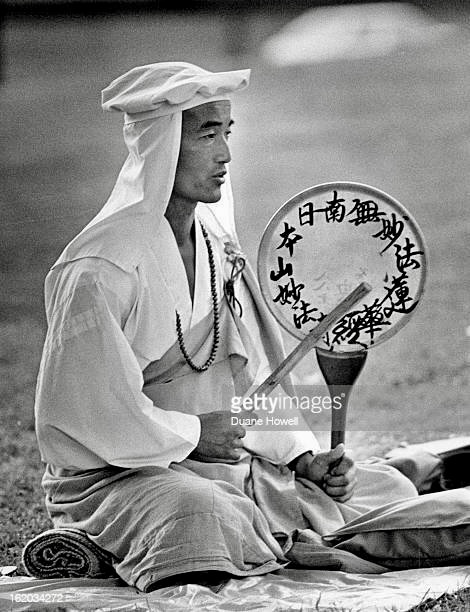
AUG 4 1989; Rev. Katsuzo Sawada, a Japanese Buddhist Monk in front of state Capitol of Nipponzan Myohoji, continues protest and fast to close Rocky Flats Plant. The fast was started on July 4 by LeRoy Moore of the Rocky Mtn. Peace Center and is being carried on by Sawada.; (Photo By Duane Howell/The Denver Post via Getty Images)

My family lived a stone’s throw away from Boulder, Colorado, in the late 1960s and the first half of the 1970s, and I was in college in nearby Denver from 1976 to 1980.   I lived in Boulder off and on between 1985 and 1995, first as a grad student, then working as a young lawyer.  Throughout most of this time, spanning nearly three decades, plutonium parts for nuclear bombs were being manufactured at Rocky Flats, a massive, underground, top secret facility just outside Boulder.  

I can’t remember precisely when I first heard Sawada’s steady drumbeat come and go, but it was definitely during the time I was a student in Boulder.  I was in the little cabin in Chautauqua Park where I lived, in a coffee shop, out on a run.  

The first couple of times I heard Sawada’s drum, it was a sonic apparition.  I turned to see the source of this unusual sound, but couldn’t locate it.  The next time I heard it, I turned quickly and caught sight of Sawada, taking broad, swift strides, in full monk garb, beating his hand drum.

This was Sawada’s practice.  Morning to night.  For decades.  

Sawada is part of a Buddhist sect that emphasizes walking meditation and work for peace.  Much to his parents’ dismay, he became a monk as a young man, and ultimately moved to Boulder, alone, to bear witness to the madness of the nuclear arms race.  Many years later, a couple of other monks from his order eventually joined him in Boulder, perhaps, in part, to lessen the physical toll this form of protest must have taken on Sawada.

Sawada’s presence in Boulder–the sound and sight of him at random times during the week–made a deep impression on me.  I got curious about him again a few days ago, after talking about him during our Full Moon Zen Zazenkai last Saturday.  While still alive, he is mostly forgotten now.  There is scant evidence of his life and practice online, though I did find a few crumbs, including an oral history interview that is part of a series of interviews documenting protest activities at Rocky Flats.  It seems memory of Rocky Flats, and even the Cold War itself, is fading.  I worry about that.

Boulder is and was a center of Buddhism’s transplantation and growth in the United States, so it also was interesting to find an article in Tricycle about Rocky Flats.

In 1983, years before I heard Sawada’s drumbeat, I was one of the student organizers of a massive, peaceful protest at Rocky Flats.  Nearly 17,000 people of all ages gathered to join hands around the above-ground perimeter of the facility.

Bearing witness to the cries of the world is an important ideal and practice in Zen.  Roshi Bernie Glassman, my Dharma great-grandfather, made bearing witness one of the three pillars of the Zen Peacemakers order he founded.  

I spoke about Sawada during our Zazenkai, because I was recalling and appreciating both the way in which his meditation was a practice of bearing witness, and how the monks who eventually joined him in Boulder made the practice communal, taking the baton from him throughout days and weeks to sustain the practice.  People came and went during our Zazenkai, according to their availability and needs, yet there was never a time when any of us sat alone.  I had this same sense of bearing communal witness Saturday, as we sat amidst the great turmoil and suffering of the present day.  

The world seems at full boil.  Perhaps what we do on the cushion, and what our time on the cushion inspires and helps us to do when we’re off it, will reduce the temperature just a bit.


On Breathing: Body Exposed in the Golden Wind

I gave this teisho during our Full Moon Zen regular weekly practice session on November 19, 2020.  You’ll find a recording of this talk after the text.

This Case 27 in The Blue Cliff Record, one of our koan collections:

A monk asked Yun Men, “How is it when the tree withers and the leaves fall?”

Yun Men said, “Body exposed in the Golden Wind.”

I meditate each day in an attic office.  My cushion is placed near a small dormer window.  The top of a giant tree hovers just outside.  Its leaves were turning gold and crimson a few weeks ago, shortly after I last spoke during one of our evening sits.  One morning the wind stirred up while I was meditating.  I could hear the leaves shaking loose from the tree’s branches and rustling in the air, before falling to the ground.

I knew then that I wanted this talk to be about breathing in Zen practice.  Most of us begin Zen practice by counting our breath.  

Many people tend to regard meditation primarily as a mental practice.  Early on, and despite the guidance we receive from teachers and experienced Zen students, most of us apply great mental effort trying to rid ourselves of mental activity, as if thoughts are bad and meditation were about banishing them completely.  Perhaps the ancient Buddhist texts we encounter, which often use the term Mind (with a capital “m”) as a synonym for the Absolute or Emptiness, contribute to this confusion.

It’s true that counting the breath early in Zen practice is a way to use one type of mental activity to tame another.  The idea at that point in our practice is to substitute a relaxed, focused form of mental activity for the frenetic, loop-de-loop sort of mental activity in which so many of us spend much of our lives lost.  But that’s not because loop-do-loop, this-that mind is “bad” and must be suppressed completely.  It’s just that it tends to be our default mode; we tend to get stuck there without realizing this is the frame of mind that sustains the illusion of separateness that causes so much needless suffering. 

That frame of mind is like living alone in a castle in the sky, standing in front of a mirror in that castle, having a conversation with oneself about the world, without realizing its an extended monologue about figments of our imagination.  We think we’re making real contact with the world, but we’re not.  

Breath practice helps us gently disengage from that frame of mind just enough to begin stepping back from the mirror.  It helps us exit the castle, at least for a while.  It’s a first step along a new path that Zen invites us to travel.

As we travel this path, the castle recedes toward the horizon . . . and yet it’s also right here, and we can instantly find ourselves back in it.  That’s fine.  Now we know how to find the door to someplace more spacious if we find ourselves jabbering into the mirror again.  

Eventually, we can let go of breath practice and just sit shikintaza, which is a rather formless form of meditation practice.  From here, the path opens wider and wider, in every direction.  It becomes an infinite field; one that manifests in and as our experience of life, right here, right now.

As our meditation experience shifts in this way, we might begin to relate to our breath differently.  While counting the breath, it’s pretty hard not to control it, much as I might imagine or intend otherwise.  When I stop breath counting practice, I’ll still become conscious of my breath from time to time, but I’ll be much more likely to feel as if my breath is breathing me, rather than the other way around.  To experience just breathing.  

All day long, and all through the night, breathing just happens, without willing it to happen.  I don’t even notice this most of the time.  As we take up meditation practice, we use this everyday, mostly unconscious aspect of our creaturely experience to reground our awareness; to coax it back to the here and now.

So, although many people wrongly tend to regard meditation primarily as a mental discipline, it’s fundamentally an embodied practice and experience.  In fact, it’s a practice that tends to collapse the distinction between body and mind; our mind-body dualism.

Some of us may have a sudden, profoundly transforming experience during meditation, or as a result of it—kenshō, a direct experience of emptiness.  Master Dōgen described his own kenshō experience as “dropping off body and mind,” not as a mental experience.  Whether or one has a sudden experience of body and mind dropping off, however, that same realization tends to soak into us over years of consistent Zen practice, like a tree soaking up water through its roots.

In the koan with which I opened, Yunmen’s student is using the familiar Chinese metaphor of a withering tree and falling leaves to ask his old teacher what it’s like to age and approach death.  Yunmen responds with another familiar Chinese metaphor, the Golden Wind—the wind that carries the autumn leaves away.

There’s a lovely Chinese myth about a cow herder and a weaver girl, whose love was forbidden.  (I suppose Romeo and Juliet is our Western equivalent.)  These lovers are banished, as stars, to opposite ends of the Milky Way.  Once a year, as Spring and Summer, the periods of birth and growth, give way to Fall and Winter, the periods of decline and death, a flock of magpies forms a sky bridge, allowing them to meet for a day.

There are many poems about this myth, one of which contains this beautiful line:

One meeting of the Cowherd and Weaver amidst the golden autumn wind and jade-glistening dew, eclipses the countless meetings in the mundane world.

As the wind kicked up during my morning sit a few weeks ago, a thought passed by with the leaves levitating just outside:  What is the wind, if not my own breath?

The wind is my breath, your breath, and old Yunmen’s breath.

And we are autumn’s leaves carried by that wind.  And we are the sapplings that will sprout from soil nourished by those leaves, their roots soaking up Spring’s jade-glistening dew.

Through our practice, we find our place, and our peace, as vulnerable, noble, embodied beings, exposed in the Golden Wind.

On Breathing: Body Exposed in the Golden Wind

Meditation Myths

I gave this teisho Thursday night.

I’ll start and end this talk with verses from Transmission of Light, one of Zen’s koan collections. This opening verse is from Case 7:

Though there be the purity of the Autumn waters
Extending to the horizons,
How does that compare with the haziness
Of a spring night’s moon?
Most people want clear purity,
But though we sweep and sweep,
The mind is not yet emptied.

I hear many people say they’ve tried to meditate, but have given up because they can’t stop their thoughts.

This is a misconception of what’s supposed to be happening in meditation, and I’m sure it’s one of the biggest reasons people don’t start or give up.

There’s nothing wrong with thoughts or thinking. Thoughts are just the mental activity that arises all the time. Thinking is giving our full attention to thoughts; conjuring thoughts, engaging with them, directing them. Our capacity for thinking is marvelous and immensely useful.

And, many of us, much of the time, are trapped in an echo chamber, a hall of mirrors, in which our endless internal dialogue is all we perceive, and our main way of knowing ourselves.

In meditation, we take the lid off of this echo chamber, this hall of mirrors. In meditation, we see and hear this dialogue, and we discover it is not all there is. In fact, it’s just one feature of what is.

And, in truth, it isn’t a particularly good portrait of who and what we are. It’s an isolating perspective. For all the good our thinking sometimes can achieve, it also can contribute greatly to our own and others’ suffering, when we only inhabit the myopic world of thought.

So, what are we doing in meditation as we take up the practice?  Well, in a nutshell, we don’t try to stop or resist thought or other mental activity — but we do gently relax its grip on us when we find ourselves lost in thought. We don’t engage with our thoughts or other mental activity the way many of us tend to do reflexively at other times.

So, for example, if I notice the thought “this seems to be going well” or “that was a car passing,” I don’t respond to that thought with another one.  When I think “this seems to be going well,” I don’t then actively think, “but I’m going to bail early if my foot won’t wake up, because I’ll fall over when it’s time for walking meditation.”  When I think, “that was a car passing,” I don’t then choose to think, “I wonder if that was Ginny coming home from the grocery store.”  I just gently return my attention to my breath.  If the response comes anyway, I just gently return to my breath after that.

If my lower back hurts, I don’t think about whether it’s okay to reposition a bit, I just do the least needed to reposition.

Sometimes you’ll hear it said that very experienced meditators reliably go through every meditation period with a completely quiet mind; without mental activity.  This is simply not true.  I know this from my own experience.

(Brain scientists are learning that meditation alters patterns of brain activity over time, rather than quieting mental activity altogether—whatever that might mean.)

Sure, there will be times and states that seem more clear and spacious, in which thoughts arise less frequently and assertively, and in which our attention is more relaxed, still, undisturbed, and focused, but focused on nothing in particular. These times may become more frequent and last longer over years of regular practice.  Our tendency to get trapped in loops of discursive thinking will diminish, and when that sort of mental activity occurs, one likely will be quicker to notice, and to disengage.  But a completely quiet mind?  Without thoughts, ever?  No.

What we eventually experience, as a sort of base stage to which one returns, is a relaxed, receptive (but non-striving) alertness.  It will feel open, spacious, grounded, calm.

It’s not a blankness, or fog, or half-sleep sort of nothingness.

If you just find yourself being less anxious about periods when the thoughts keep coming, or of active thinking, that’s progress. When you eventually find yourself unconcerned about whether you’re making progress, even better.

What’s happening in meditation isn’t mainly happening on the plane of thought anyway. The goal isn’t perfect mind control, whatever that might mean.

Our problem in meditation, even at the beginning, isn’t thoughts. Our problem is thinking the problem is thoughts. Being sure that, in meditation, as in the rest of our lives, I’m doing it wrong; that there’s something wrong with life, and with me.

The very part of oneself that brings some of us to Zen practice is also the very part that tries to sabotage Zen practice once we start it. It’s the part that compels us to search for something other than this, because this just couldn’t be right or enough, could it?

We judge Zen and our practice just like we judge everything else.  And it creates distance.  Separation. It separates me from my own life.

On the other hand, Zen and other contemplative practices are sometimes criticized for being anti-intellectual and quietistic, in part because of this suggestion that thinking—and, particularly, rational thought, which has been so fetishized since The Enlightenment, which is such an ironic term for Zen types like us—defines what it is to be human, or at least what is best about being human.

But Zen has no issue with thoughts and thinking. Its leading lights have produced endless volumes of conceptual, discursive literature, and they show no sign of stopping. Some of our practices other than meditation invite reflection, like certain verses, such as the Meal Gatha (in which we’re asked to reflect upon how our food comes to us) and our dedications (in which we’re asked to remember specific other people and commit our practice to their memory or well-being).

Zen is not anti-intellectual, but its core practices—meditation and koan introspection—aim to help us grasp what thinking cannot.

We tend to see our intellects as the whole of who and what we are and intellectualism as our only, or as our best and highest, capacity. Because of this tendency, we may believe we can think our way out of or through everything. Many of us come to a practice like Zen in search of something we think thinking will help us find, and so we tend to approach practice that way.

In reality, our thinking mind tends to spin up predicaments and dilemmas that aren’t there, and then tries to think our way out of them, which thinking can’t do. Our thinking creates the hall of mirrors then tries to plot our escape from it.

But we can’t think our way out of the existential trap our—amazing and otherwise useful!—capacity for thought thinks we are in.

The Zen path invites us to step off that hamster wheel.

Zen exposes our questions and dilemmas as baseless, as hollow—as empty!  It acquaints, or re-acquaints, us with the possibility of a different, and ultimately more satisfying, experience.  One that’s always right here, right now.

The Zen path doesn’t really lead to answers to our questions.  Rather, our intellectual questions tend to lose their force, sometimes swiftly, sometime slowly.  They begin to lose their death grip on us as we begin to touch our own experience differently.  As a different way of relating to life, of being in the world begins to take hold of us; as we begin to develop a different sense of who and what we are.

Buddha. Or, as Meister Eckhart said, “Though we don’t realize it yet, we are all sons and daughters of God.”

This new sense isn’t any less intellectual than our sense of sight. We can get very brainy about seeing, and analyzing and describing sight, but that is thinking about our sense of sight, not sight itself.

This new state of being, or orientation to life, isn’t any less intellectual than our sleep state. We can get very brainy about sleep, and analyzing and describing sleep, but that is thinking about our sleep state, not sleep itself.

We have no quarrel with sight and sleep, but most of us struggle to stick with meditation and Zen practice. Most of us struggle with our experience of life. We need to give up the fight, and our practice—with which many tend to struggle, to fight, at first—helps us do that.

Don’t let your practice become part of the struggle. Go easy on yourself. Lower your expectations at first. Sit for five minutes a day at first, if that’s all you feel you can manage initially, but stick with it. Every day, or most days, at least. When you feel you’re ready for five minutes more, start sitting for 10 minutes a day. Lower the bar enough to sustain your practice. Don’t judge it; just do it.

My 11-year old daughter sometimes fights sleep, even as she seeks it. I tell her that thinking about not falling asleep—the loop she gets stuck in, telling herself she can’t do it—is what’s keeping her awake. A few times I’ve laid next to her, holding her and encouraging her to follow her breath into sleep. At other times, she lies alone struggling. Either way, she eventually falls asleep! And then she has sleep, she is sleep, instead of being captive to thoughts about sleep and no sleep. Her fear of letting go into sleep has lost its grip.

Meditation practice is the same way. There have been countless times over my years of meditation practice—in the early days, or in the seventh hour of the first day of sesshin, or on the seventh day of sesshin—when I was struggling so; when the thought “I can’t make it” would arise. Then, “Ding! Ding!” The session was over. A session of mostly struggling and discomfort as meditation. And, then, getting up and carrying on with the rest of the day, the rest of the retreat . . . as meditation.

Zen, and what it reacquaints us with, is nothing other than this vital life we are living, right here, right now. Through our practice, we come to know and live life so intimately, and not as an “it,” as an object to our subject. Subject-object is not the mode in and through which we experience or comprehend life most deeply. Rather, we come to experience life neither in subject-object mode or not in subject-object mode—trusting life “in our bones,” in and as every fiber of our being, in and as every breath we take and release, without thinking about it. Matter. Of Fact. The Great Matter.

Best as we can tell, the historical Buddha merely called this state and sense “awake.” When people asked him what he was, and what made him different than other sages, he didn’t allow them to project anything too exalted on him. He simply said he was awake—and he no doubt knew what it meant to be truly awake.

Zen practice, including meditation, helps us let go of our fear of being alive, of being truly awake to life itself, as opposed to our ideas about life and how it should be. Fear of life loses its grip on us, just as my daughter loses her fear of sleep as she melts into it, whether she goes struggling or not.

Now, about everything I’ve just said:

Please don’t receive it in the mode of “too much thinking,” as my old Kyudo (Zen archery) teacher used to say. That’s what he would say when I released a shot that didn’t come from a heart centered in the place I’ve been talking about, even if the arrow happened to hit the target. I hope what I’ve just said speaks to your heart, more than your head. A heart centered in that place is the target. The target is life itself. Your life.

As promised, I’ll close with another verse, this one from Case 9 in the Transmission of Light:

Even Manjusri and Vimalakirti could not talk about it,
Even Maudgalyayana and Shariputra could not see it.
If people want to understand the meaning themselves,
When has the flavor of salt ever been inappropriate?